By using this site, you agree to the Privacy Policy and Terms of Use.
Accept
Health Works CollectiveHealth Works CollectiveHealth Works Collective
  • Health
    • Mental Health
  • Policy and Law
    • Global Healthcare
    • Medical Ethics
  • Medical Innovations
  • News
  • Wellness
  • Tech
Search
© 2023 HealthWorks Collective. All Rights Reserved.
Reading: The Increasing Problem of Chronic Wounds and Their Medtech Solutions
Share
Notification Show More
Font ResizerAa
Health Works CollectiveHealth Works Collective
Font ResizerAa
Search
Follow US
  • About
  • Contact
  • Privacy
© 2023 HealthWorks Collective. All Rights Reserved.
Health Works Collective > Business > The Increasing Problem of Chronic Wounds and Their Medtech Solutions
BusinessTechnology

The Increasing Problem of Chronic Wounds and Their Medtech Solutions

PatrickDriscoll
PatrickDriscoll
Share
4 Min Read
wound closure technology
SHARE

Wounds have many different sources, etiologies and forms and, therefore, demand a range of approaches. By virtue of these differences, they have considerably different costs. At the top of the list of wound culprits driving up cost is the category of chronic wounds. Simply put, these wounds are very slow to heal due to poor circulation at the site (e.g., decubitus stasis, or pressure, ulcers), concomitant health issues (diabetes) and the difficulty in changing the local environment toward one with conditions more conducive to the healing process.

Wounds have many different sources, etiologies and forms and, therefore, demand a range of approaches. By virtue of these differences, they have considerably different costs. At the top of the list of wound culprits driving up cost is the category of chronic wounds. Simply put, these wounds are very slow to heal due to poor circulation at the site (e.g., decubitus stasis, or pressure, ulcers), concomitant health issues (diabetes) and the difficulty in changing the local environment toward one with conditions more conducive to the healing process.

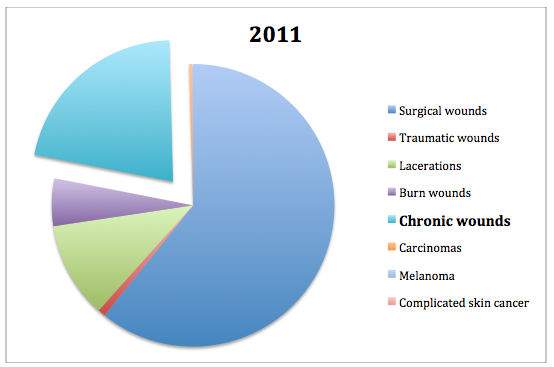
Chronic wounds are not the most common — that is a category represented by surgical wounds, in which the wound has been created medically or surgically in order to excise or otherwise manage diseased tissue. But surgical wounds, traumatic wounds and lacerations are by their nature acute and, especially for surgical wounds, can be surgically managed to create clean wound edges, good vascularization and other conditions that accelerate healing. Therefore, while the volume of surgical and traumatic wounds and lacerations is significant, their costs are manageable and their growth is unremarkable.

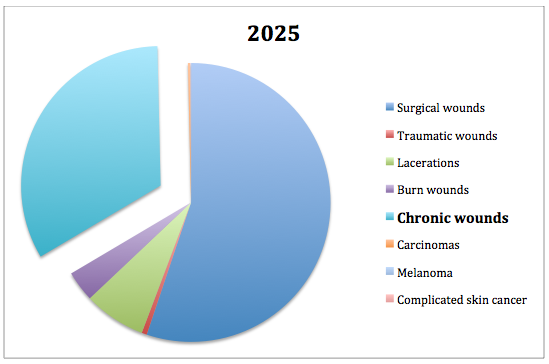
But the costs of chronic wounds are higher due to both the types of different products required and the length of time required for those products to be used. Moreover, given the association of chronic wounds with conditions that are growing in prevalence due to increasing incidence of obesity, diabetes and other conditions, combined with an aging population that is increasingly sedentary, the prevalence of chronic wounds is shifting the balance among wound types. Below is the balance of wound types by prevalence worldwide in 2011, followed by the projected balance of wound types in 2025.

More Read

saving money in healthcare
Best Money-Saving Tips for Health Managers
Palm Prints
Are You Ready for Medicare Part E?
Who talks more? The Doctor or the Patient?: Infographic
Imaging Tests Available Stat! The Blame Game Isn’t Necessary

Worldwide Share of Wound Prevalence By Type, 2011
wound closure technology

Source: MedMarket Diligence, LLC; Report #S190 and Report #S249. 

Worldwide Share of Wound Prevalence By Type, 2025
wound tech market

Source: MedMarket Diligence, LLC; Report #S190 and Report #S249.

Surgical wounds offer the potential for use of devices which can ensure hemostasis, prevent internal adhesions and anastomoses, secure soft tissue, and close the skin. Traumatic wounds also offer potential for skin closure products and for hemostats, and adhesion prevention during post-trauma surgery. New wound-covering sealant products may also offer potential for treatment of cuts, grazes, and burns.

Chronic wounds are generally not amenable to treatment by adhesives, sealants and hemostats unless the wound has either been debrided to a sterile bleeding surface (in which case it becomes like a surgical wound), or the product offers some stimulant activity. Many hemostats exhibit some inflammatory and cytokinetic activity, which has been associated with accelerated healing. However, this inflammatory activity has also been known to burn the patient’s skin. Chronic wounds are instead dealt with often by a combination of debridement, frequent dressing changes, products to address local vascular circulation and pressure (negative and positive) and others. Progress is being made in reducing the associated healing times, but a large opportunity remains.


TAGGED:wound management
Share This Article
Facebook Copy Link Print
Share
By PatrickDriscoll
Follow:
I serve the interests of medical technology company decision-makers, venture-capitalists, and others with interests in medtech producing worldwide analyses of medical technology markets for my audience of mostly medical technology companies (but also rapidly growing audience of biotech, VC, and other healthcare decision-makers). I have a small staff and go to my industry insiders (or find new ones as needed) to produce detailed, reality-grounded analyses of current and potential markets and opportunities. I am principally interested in those core clinical applications served by medical devices, which are expanding to include biomaterials, drug-device hybrids and other non-device technologies either competing head-on with devices or being integrated with devices in product development. The effort and pain of making every analysis global in scope is rewarded by my audience's loyalty, since in the vast majority of cases they too have global scope in their businesses.Specialties: Business analysis through syndicated reports, and select custom engagements, on medical technology applications and markets in general/abdominal/thoracic surgery, interventional cardiology, cardiothoracic surgery, patient monitoring/management, wound management, cell therapy, tissue engineering, gene therapy, nanotechnology, and others.

Stay Connected

1.5KFollowersLike
4.5KFollowersFollow
2.8KFollowersPin
136KSubscribersSubscribe

Latest News

patient care
Independent Practices Must Keep Human Connection at the Core of Patient Communication
Health
April 29, 2026
6 Best ABA Software Tools That Help Clinics Reduce Administrative Work
Hospital Administration Medical Innovations
April 29, 2026
Best Video Systems for Health Care
How to Choose the Best Video Systems for Health Care
Global Healthcare Technology
April 22, 2026
How Workplace Hygiene Impacts Community Health Outcomes 
Health
April 21, 2026

You Might also Like

Director of First Impressions and Other Great Job Titles

August 31, 2015

Social Media Summit at Mayo Clinic: Day One Exclusive Report

October 18, 2011
genetic therapy for leukemia
Medical InnovationsSpecialtiesTechnology

Is Genetic Therapy the Future for Treating Leukemia and Other Blood Disorders?

December 12, 2013
MMWarchitecture
BusinessFinanceMedical Devices

Secure Messaging Middleware Market Defined

July 3, 2014
Subscribe
Subscribe to our newsletter to get our newest articles instantly!
Follow US
© 2008-2025 HealthWorks Collective. All Rights Reserved.
  • About
  • Contact
  • Privacy
Welcome Back!

Sign in to your account

Username or Email Address
Password

Lost your password?