- What Is the LifeWave X39 Patch?
- What Does the Research on LifeWave X39 Show?
- Does LifeWave X39 Relieve Chronic Pain?
- Can LifeWave X39 Accelerate Wound Healing?
- Will LifeWave X39 Improve Sleep Architecture?
- Does LifeWave X39 Provide Anti-Aging and Skin Benefits?
- Is LifeWave X39 Safe? Side Effects and Medical Surveillance
- Is LifeWave X39 Approved by the FDA?
- How Much Does LifeWave X39 Cost? Retail vs. Subscription
- Is LifeWave a Multi-Level Marketing (MLM) Company?
- LifeWave X39 vs. X49: What Is the Difference?
- Who Should Skip LifeWave X39?
- Frequently Asked Questions
- Do LifeWave X39 patches contain actual stem cells?
- Is LifeWave X39 an MLM scam?
- How long can you wear each X39 patch?
- Can you wear LifeWave X39 at night?
- The Final Verdict: Is LifeWave X39 Worth It?
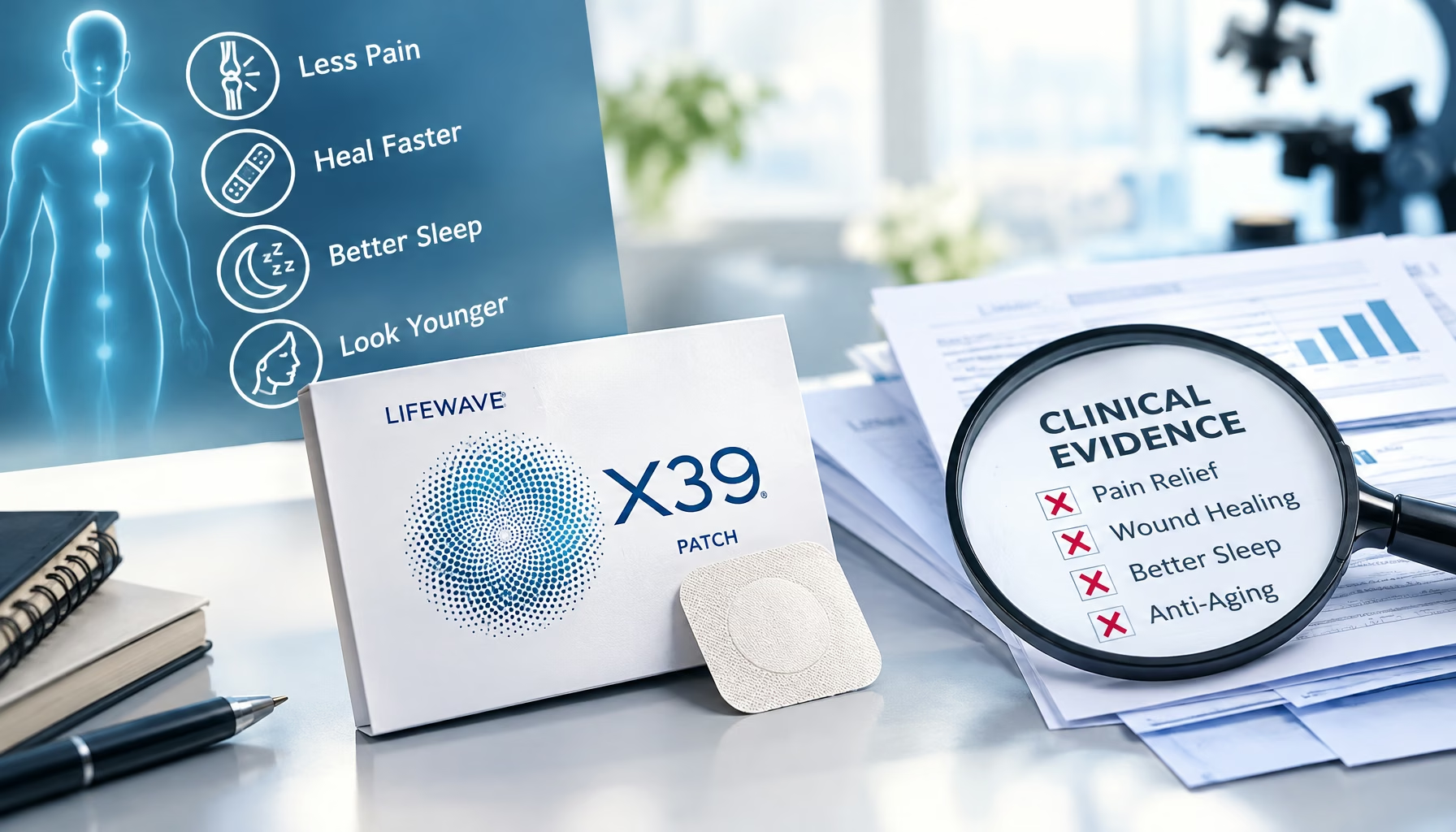
Quick Take: There is no convincing clinical evidence that LifeWave X39 patches relieve pain, heal tissue, improve sleep, or slow aging. X39 is a non-transdermal adhesive patch containing zero stem cells and zero drugs. While a 60-person, 7-day pilot study reported higher blood levels of the copper peptide GHK-Cu, that trial did not measure pain, healing, or any clinical health outcome. Independent medical experts note that marketing claims far outpace validated science.
In modern medicine, genuine stem cell therapy is an intensive biological intervention exploring treatments for severe conditions like lupus, Crohn’s disease, and stroke recovery. The FDA is still actively working to regulate cellular therapeutics, and researchers continue to untangle the real clinical wrinkles with stem cell therapies before widespread application.
Enter the consumer wellness market, where wearable patches promise cellular rejuvenation without needles, physician visits, or clinical costs. You will frequently hear enthusiastic anecdotes from distributors or friends who swear X39 relieved their knee pain or restored their sleep. What those stories cannot tell you is whether the patch caused the change, or whether it was the result of natural recovery, rest, or the placebo response (which is notably strong in pain and sleep management).
This independent review sorts manufacturer marketing from verified scientific data so you can make an informed choice before spending $99.95 to $149.95 per month. Below, we examine the biophysical mechanism, every published human study, federal safety records, real costs, and who should avoid the patch.

What Is the LifeWave X39 Patch?
LifeWave was founded in 2004 by inventor David Schmidt, who also chairs the company. Over the years, Schmidt has discussed company goals around energy and cellular vitality. LifeWave sells X39 as a “general wellness,” non-transdermal phototherapy product. Non-transdermal means no chemical drugs, herbs, or peptides pass through your skin.
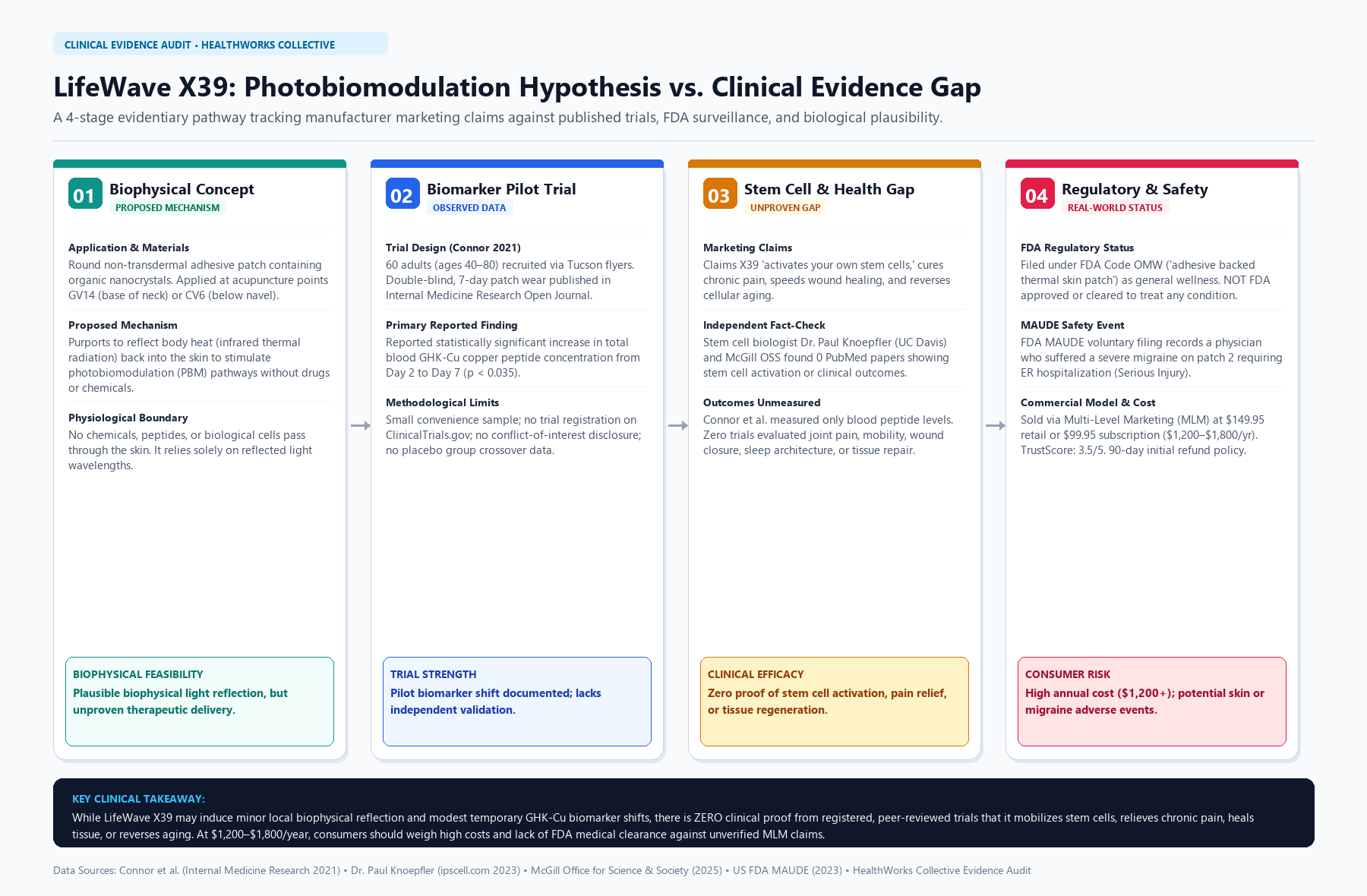
According to the official LifeWave product description, the human body naturally radiates infrared heat. The patch contains sealed organic nanocrystals designed to reflect specific wavelengths of that thermal energy back onto designated points on the skin. Company literature and study authors refer to this process as photobiomodulation (PBM).
The core marketing premise claims that reflected infrared light elevates blood levels of GHK-Cu (glycyl-L-histidyl-L-lysine copper), a naturally occurring plasma tripeptide first isolated by biochemist Loren Pickart in 1973. While laboratory research links GHK-Cu to collagen synthesis and tissue remodeling, LifeWave takes that idea a step further, claiming elevated GHK-Cu “activates your body’s master stem cells” to repair tissues and reverse cellular aging.
What Does the Research on LifeWave X39 Show?
The highest-quality study behind X39 demonstrates a short-term biomarker shift, not a verified clinical health benefit. No human clinical trial has demonstrated that X39 relieves chronic pain, heals injured tissues, restores sleep architecture, or reverses skin aging. Three scientific facts are essential when evaluating the trial record:
- A blood peptide shift is not a clinical outcome: Even if GHK-Cu concentrations rise temporarily, no researcher has shown that a 7-day bump in blood peptides reduces joint pain or regenerates cartilage. That clinical claim remains completely untested.
- Studies originate from a single internal circle: Independent science writer Jonathan Jarry at McGill University evaluated 11 LifeWave studies in his report Patchy Science on LifeWave’s Mysterious Patches, noting that favorable papers were conducted by in-house researchers Melinda Connor and Caitlin Connor, with notable methodology gaps. When independent university teams tested earlier LifeWave patches, they detected no measurable performance benefit.
- Standard clinical verification checks are absent: Stem cell biologist Dr. Paul Knoepfler of UC Davis conducted a detailed scientific review for ipscell.com (The Niche stem cell blog). He identified 6 PubMed papers referencing LifeWave, found zero convincing clinical evidence supporting stem cell activation, and identified zero registered clinical trials on ClinicalTrials.gov. Given the high consumer cost and absence of verified data, he concluded he would not recommend the product.
Overall, my claim review is that in my opinion the X39 patch and its health claims do not appear to have solid peer-reviewed clinical science backing them up. If it were me, I wouldn’t buy or use the patch.
Paul Knoepfler, Stem Cell Biologist at UC Davis, in ipscell.com (The Niche stem cell blog)| Study & Citation | Patch Tested | Cohort & Duration | Primary Endpoint | Key Finding | Methodological Limitations |
|---|---|---|---|---|---|
| Connor et al. (2021) Internal Medicine Research | LifeWave X39 | 60 adults (ages 40–80) 7-day wear | Total blood GHK and GHK-Cu concentration | Reported higher GHK-Cu in patch group between Day 2 and Day 7 (p < 0.035) | Convenience sample recruited via flyers in Tucson; no ClinicalTrials.gov registration; zero health outcomes measured. |
| Connor et al. (2020) Intl. Journal of Healing & Caring | LifeWave X39 | 15 adults (ages 40–65) 7-day pilot | Metabolic and blood peptide markers | Reported minor shifts in blood amino acid profiles | Very small pilot; single research group; open-label exploratory protocol without placebo crossover. |
| Independent Study (2008) Varsity Football Athletes | Earlier LifeWave Patch | Athletic cohort Acute exercise testing | Muscle power and anaerobic endurance | No statistically significant performance improvement | Independent study outside company auspices; contradicted marketing claims. |
| Independent Study (2011) Cross-Country Runners | Earlier LifeWave Patch | Trained runners Short-term trial | Cardiovascular recovery and sprint speed | No endurance benefit observed | Independent university trial; failed to replicate distributor performance claims. |
Does LifeWave X39 Relieve Chronic Pain?
No published clinical trial has tested LifeWave X39 for pain relief. Distributor marketing relies entirely on consumer testimonials. Chronic pain is notoriously susceptible to the placebo effect, particularly when testing novel, premium-priced interventions. Pain also naturally fluctuates, and people frequently apply a new patch during symptom peaks, mistaking natural regression to the mean for a product effect.
Can LifeWave X39 Accelerate Wound Healing?
There is zero clinical proof that wearing X39 on your neck or abdomen accelerates wound healing elsewhere in the body. While laboratory studies demonstrate that GHK-Cu participates in extracellular matrix remodeling in cell cultures, those bench findings do not translate to wearable non-transdermal discs. Additionally, LifeWave’s official label explicitly warns users never to apply the patch onto open wounds or broken skin.
Will LifeWave X39 Improve Sleep Architecture?
Sleep benefits remain unverified in controlled medical settings. While better sleep is a frequent user report, no polysomnography or sleep-lab trials have evaluated X39. Without controlled sleep data, it is impossible to distinguish patch effects from general sleep hygiene changes or the extra daily hydration recommended by distributors.
Does LifeWave X39 Provide Anti-Aging and Skin Benefits?
Anti-aging claims for X39 remain unproven in clinical dermatology. While topical GHK-Cu peptide creams possess documented cosmetic benefits when applied directly to facial skin, an adhesive patch worn on the neck does not deliver topical peptides. Before-and-after photographs shared on social media cannot control for skincare changes, lighting differences, hydration, or photo editing.
Is LifeWave X39 Safe? Side Effects and Medical Surveillance
LifeWave X39 appears to carry low risk for healthy adults, but “drug-free” does not mean completely free of adverse events. Because formal clinical safety trials have not been conducted, marketing claims of “100% safe with zero side effects” are scientifically inaccurate. The primary real-world concerns include:
- Contact Dermatitis: Itching, localized redness, and adhesive skin reactions are the most common complaints, identical to reactions caused by standard adhesive bandages.
- Headaches & Symptom Flares: User reports on platforms like Trustpilot (where LifeWave holds a 3.5 TrustScore) cite headaches, fatigue, and localized flares. Distributors often dismiss these as “detox symptoms,” but medical authorities advise treating unexpected symptoms as potential adverse reactions and discontinuing use.
- FDA MAUDE Adverse Event Filing: The FDA’s MAUDE medical device database holds a 2023 adverse event report (MW5117234) submitted by a 37-year-old family medicine physician who tested X39. On her second patch, she developed a sudden, severe migraine that worsened after taking her prescribed triptan, ultimately requiring emergency room hospitalization. The incident is formally classified as a Serious Injury.
LifeWave’s official label instructs users to remove the patch immediately if irritation occurs, keep it away from children, and avoid use entirely during pregnancy or breastfeeding.
Is LifeWave X39 Approved by the FDA?
No. LifeWave X39 is not approved or cleared by the FDA to diagnose, treat, prevent, or cure any disease. Under FDA product regulations, X39 is filed under Product Code OMW as an “adhesive backed thermal skin patch” and marketed under the general wellness device framework. McGill University researchers verified that LifeWave holds no active medical device clearance in the FDA establishment registry.
How Much Does LifeWave X39 Cost? Retail vs. Subscription
A single sleeve contains 30 round adhesive patches, supplying one month of daily use on the recommended 12-hours-on, 12-hours-off schedule. LifeWave lists retail pricing at $149.95 per sleeve or $99.95 per month on autoship subscription, translating to $1,199.40 to $1,799.40 annually.
| Purchasing Tier | Price per Sleeve (30 Patches) | Annual Estimated Cost | Official Refund Terms |
|---|---|---|---|
| One-Time Retail Order | $149.95 + tax/shipping | $1,799.40 | 90-day money-back guarantee on first order; shipping excluded; no return of product required. |
| Monthly Subscription (“Preferred”) | $99.95 + tax/shipping | $1,199.40 | 90-day guarantee on first order; subsequent monthly orders: 30 days, unopened product only. |
| Brand Partner (Distributor) | Wholesale / Bundle pricing | Varies by volume | 30-day guarantee on initial order; unopened items must be returned. |
Is LifeWave a Multi-Level Marketing (MLM) Company?
Yes. LifeWave operates through a multi-level marketing (direct-selling) model. Independent distributors, termed “Brand Partners,” earn commissions from direct product sales alongside recruiting downstream distributors. This distribution model has two significant implications for consumers:
- Commercial Review Bias: The vast majority of enthusiastic video reviews and blog posts online are published by distributors with a direct financial incentive to sell monthly subscriptions. McGill University’s review noted that LifeWave’s distributor code of ethics explicitly prohibits Brand Partners from publishing negative remarks about company products.
- Distributor Claims Exceed Company Warnings: Distributors often make dramatic health claims regarding pain eradication or stem cell regeneration that appear nowhere on LifeWave’s official label. Consumers should rely strictly on official packaging disclaimers instead of verbal sales pitches.
LifeWave X39 vs. X49: What Is the Difference?
While X39 is LifeWave’s primary general wellness patch, the company produces several specialized patches based on the same reflective phototherapy concept:
| Patch Name | Targeted Consumer Benefit | Marketed Biological Mechanism |
|---|---|---|
| LifeWave X39 | General vitality, energy, and cellular wellness | Reflects light to elevate copper peptide GHK-Cu |
| LifeWave X49 | Athletic performance, lean muscle support, and cardio recovery | Reflects light to elevate copper peptide AHK-Cu |
| Energy Enhancer | Daytime stamina without caffeine or stimulants | Two-patch bioelectrical thermal reflection system |
| Y-Age Carnosine | Muscle flexibility, organ integrity, and bioelectrical tone | Supports native carnosine antioxidant pathways |
| Y-Age Glutathione | Immune resilience and liver detoxification support | Supports master antioxidant glutathione synthesis |
| Y-Age Aeon | Stress reduction and autonomic nervous balance | Promotes relaxation pathways without pharmaceutical sedatives |
Distributors often encourage “patch stacking” (wearing X39 alongside X49 or Aeon). Stacking doubles or triples monthly costs without any clinical research evaluating combined patch safety or efficacy. Consumers testing the product should evaluate only one patch at a time.
Who Should Skip LifeWave X39?
Before purchasing X39, evaluate whether you belong in a category where the patch is unsuited or medically contraindicated:
- Pregnancy & Nursing: LifeWave’s official packaging explicitly contraindicates use during pregnancy or breastfeeding.
- Individuals With Diagnosed Chronic Illnesses: If you suffer from osteoarthritis, peripheral neuropathy, autoimmune disorders, or chronic migraine, do not replace proven clinical therapies with adhesive wellness patches.
- Migraine Sufferers Taking Triptans: The FDA MAUDE database specifically documents an ER hospitalization involving migraine exacerbation in a user taking triptan medication. Consult your neurologist prior to testing.
- Adhesive Allergies: Those prone to bandage rashes or contact dermatitis should exercise caution with prolonged daily adhesive wear.
- Budget-Constrained Consumers: At $1,200 to $1,800 annually, the financial cost is substantial for an intervention lacking double-blind therapeutic validation.
Questions to Ask Your Doctor Before Trying X39
- Could wearable phototherapy or adhesive wear interfere with my current medications, particularly migraine or vascular treatments?
- Are there evidence-based, insurance-covered medical therapies for my symptoms that I have not yet explored?
- What concrete objective symptom improvements would indicate this product is working, and what signs should prompt immediate discontinuation?
Frequently Asked Questions
Do LifeWave X39 patches contain actual stem cells?
No. LifeWave X39 contains zero living biological cells, human tissue, or active drugs. It is a sealed adhesive patch designed to reflect body heat. Marketing references to “stem cells” refer solely to the unproven hypothesis that elevated GHK-Cu peptides trigger native stem cell mobilization.
Is LifeWave X39 an MLM scam?
LifeWave is a legitimate company that delivers a physical product and provides a 90-day money-back guarantee on initial orders. Yet it operates as a multi-level marketing company where distributor claims frequently outpace scientific evidence. The strongest clinical trial demonstrated only a short-term blood peptide shift, not a validated medical cure.
How long can you wear each X39 patch?
LifeWave instructions recommend applying the patch in the morning and wearing it for up to 12 hours before disposal. A 12-hour off period is standard to allow the skin to breathe and prevent adhesive dermatitis. Discard the patch immediately if burning, itching, or redness develops.
Can you wear LifeWave X39 at night?
LifeWave’s standard protocol recommends daytime wear for up to 12 hours. Most users remove the patch before sleep to maintain the 12-hour rest cycle and reduce nighttime skin friction.
The Final Verdict: Is LifeWave X39 Worth It?
For most consumers seeking validated medical relief from pain, fatigue, or aging, the answer is no. LifeWave X39 costs between $1,200 and $1,800 annually, contains no stem cells, and is not backed by large-scale, registered, double-blind trials demonstrating health outcomes. While biophysical photobiomodulation is a recognized academic field, modest GHK-Cu biomarker shifts in a 60-person pilot study do not prove disease reversal.
Healthy adults curious about experimental phototherapy can take advantage of LifeWave’s 90-day first-order money-back guarantee to limit financial risk. Still, individuals managing chronic illness, neuropathies, or severe pain deserve treatments grounded in validated clinical evidence instead of multi-level marketing promises.