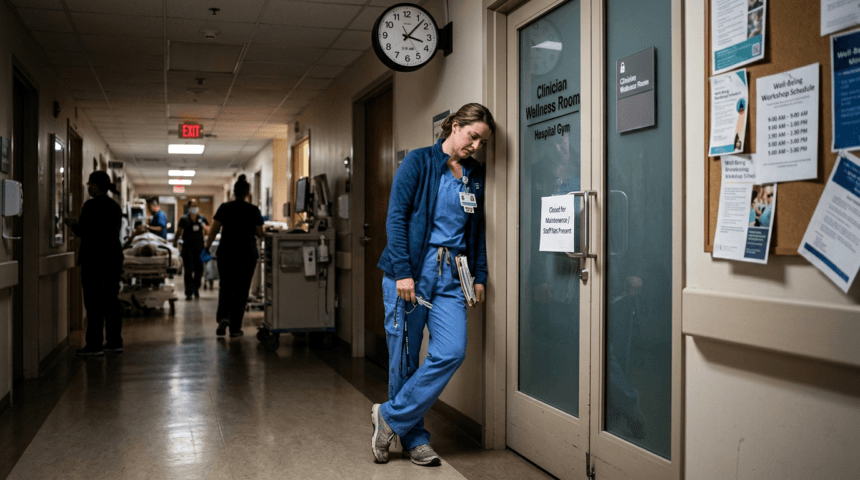
Ask a charge nurse what she thinks of the hospital’s new wellness initiative and watch her face. The webinar is at two in the afternoon. She works nights. The meditation app assumes a quiet morning she does not get. The healthy recipe newsletter suggests a leisurely Sunday meal prep, on the one Sunday a month she is not on the floor. The intent is good. The fit is terrible.
Burnout among healthcare workers is not a secret anymore. The U.S. Surgeon General issued a formal advisory on it. The World Health Organization lists it as an occupational phenomenon, the result of chronic workplace stress that has not been managed well. The problem is named, studied, and widely acknowledged. What has not caught up is the advice.
Self-Care Written for the Wrong Life
Most wellness guidance quietly assumes a normal schedule. Sleep at night. Eat at regular hours. Have evenings that belong to you. That describes almost no one in direct patient care. A rotating shift worker cannot wind down by ten when ten is the middle of her workday. Telling an exhausted resident to prioritize eight hours of sleep is not support. It is a reminder of a thing he cannot have, which lands as one more failure on an already long list.
You can see the mismatch in the small things. The cafeteria closes before a night shift starts, so dinner is vending machine crackers. The quiet room for decompressing is three floors away and built with day shift in mind. The gym discount is for a location that is closed by the time the shift ends. Each one is minor. Together they send a clear message: this program was designed for someone else.
More Read

There is a deeper issue underneath the scheduling one. A lot of wellness programming puts the whole burden on the individual clinician, as if burnout were a personal shortcoming to be fixed with better habits. It is not. It is largely structural, driven by staffing ratios, documentation loads, and the moral injury of being unable to give the care you were trained to give. No amount of box breathing fixes a broken staffing model, and it is worth saying that plainly.
Support That Fits the Shift
That said, the individual layer still matters, and it is the one a person can actually control tonight. The trick is to stop importing habits from a nine to five life and start building ones that survive a twelve hour shift. Water and a real snack stashed where you can reach them at hour nine. A two minute reset between patients instead of a thirty minute practice you will never schedule. A wind down routine anchored to the end of your shift, whenever that falls, rather than to a clock that assumes you are asleep by eleven.
A few platforms have started designing for this reality instead of ignoring it. It’s a Healthy Lifestyle, for one, runs a wellness hub built specifically for medical professionals rather than the general public. The resources are organized around the way clinicians actually live: short, stackable habits, nutrition guidance that does not require a calm kitchen, and mental wellness tools sized for the ten minutes you get instead of the hour you do not. Even the text message reminders are pitched at people whose weeks do not follow a normal pattern.
None of that replaces the structural work, and it is not meant to. But there is a real difference between telling a nurse to be more resilient and handing her something that fits into the day she is genuinely having. The first is a slogan. The second is a tool.
Design for the Day People Actually Have
The lesson travels well beyond any one app. If you run a wellness program for clinicians, the first question is not what content to offer. It is when your people are awake, hungry, and stressed, and whether anything you are offering reaches them at that moment. A brilliant resource nobody can open at 3 a.m. is not a resource. It is a line item.
Small design choices signal whether you actually see the people you are trying to help. Timing a message to shift changes. Making it usable on a phone in a hallway. Letting someone pick a habit back up after a brutal stretch without feeling like they failed a program. Those are not features. They are respect, made concrete.
Healthcare workers are among the most disciplined people in any building. They do not need a lecture about health. They need support that respects their schedule instead of quietly shaming them for having it. Build for the shift they work, not the one you wish they worked. Everything else is a poster in the break room.