


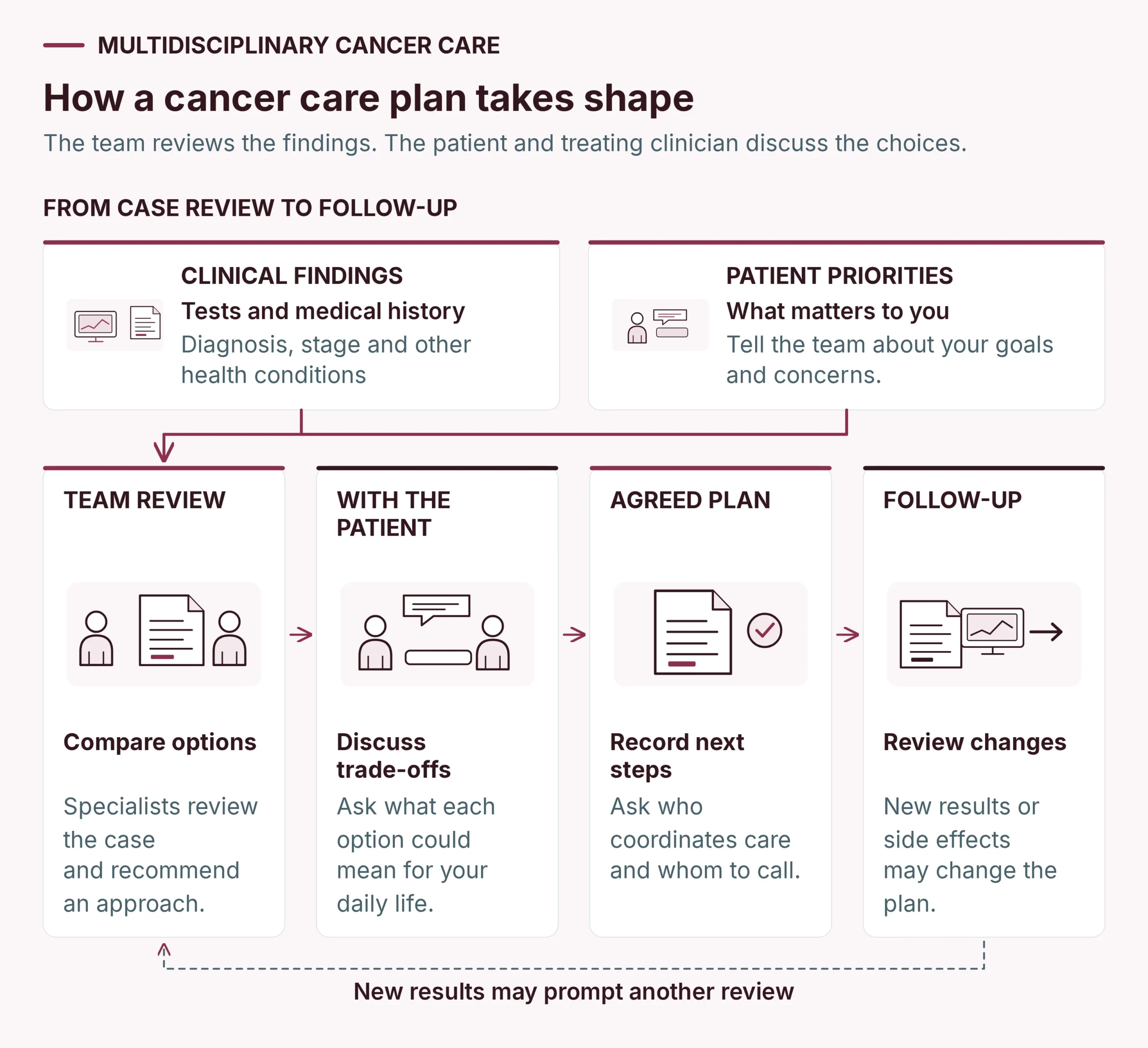
Multidisciplinary cancer care is an approach in which specialists review your diagnosis together and recommend which treatments may fit, in what order and with what support. Your care team should explain the recommendation and discuss your options with you. Ask who will coordinate the next steps.
- Understanding multidisciplinary care in cancer treatment
- How collaborative care improves treatment planning
- What the team weighs when comparing treatments
- Making cancer treatment more personal
- Supporting quality of life throughout treatment
- Improving communication and adjusting the plan
- Planning recovery and long-term follow-up
- What to ask your cancer care team
- Frequently asked questions
Multidisciplinary cancer care brings specialists together to review a person’s cancer diagnosis, other health conditions and personal priorities. A tumor board can recommend a plan. Your treating clinician should explain the choices and how each one might affect your daily life so you can decide together.
- Ask whether your case has been reviewed and what evidence shaped the recommendation.
- Tell your team early about concerns that could affect your choice, including fertility, mobility or time away from work.
- Palliative care can help manage symptoms and side effects while you receive cancer treatment.
- Ask who coordinates your care and whom to call about symptoms between appointments.
Understanding multidisciplinary care in cancer treatment
Team makeup shifts based on the cancer type, its stage, and how complex the case is.
Who is involved in a multidisciplinary cancer care team?
A National Cancer Institute definition describes a tumor board as a group of specialists who review cases and discuss treatment. Members and their roles vary by service. Your broader team may include:
- Medical oncologists, who assess whether medicines such as chemotherapy, targeted therapy or immunotherapy may help.
- Surgeons, who assess surgical options, and radiation oncologists, who consider radiation treatment.
- Radiologists, who interpret scans, and pathologists, who examine tissue and can help establish the cancer type.
- Specialist nurses, who explain the next steps and can help coordinate care, depending on the service.
- Dietitians, rehabilitation specialists and other professionals who can help with needs such as eating, mobility or recovery.
A tumor board is a case discussion. Patients do not usually attend the meeting itself, and practices vary by center. For example, at King’s College Hospital, the team discusses the case and a member explains the options to the patient afterward. Ask your own service how it will bring your concerns into the discussion.
How collaborative care improves treatment planning
Planning cancer care relies on far more than the first diagnosis. Clinicians have to weigh tumor traits, disease progression, medical history, and the likely effects of each therapy.
Working together lets the team review all of those details before treatment starts.
Your team may need another test or a pathology review before it can recommend a plan. Ask what information is still needed and when a decision is expected. If a decision is urgent, ask your clinician which steps need to happen promptly. After you discuss the options, ask for a written summary of the plan and who will coordinate the next steps. NCI’s questions to ask about treatment can help you prepare for that discussion.
Evaluating different treatment options
Two people with the same cancer don’t always need the same plan. Surgery fits some cases well, while others call for radiation, drug therapy, or a mix of methods.
Prostate cancer treatment in Abu Dhabi is one example of a service where specialists can assess several approaches. Depending on the cancer and a person’s health, prostate cancer options can include active surveillance, surgery, radiation or hormone therapy, sometimes in combination. The NCI prostate cancer treatment guide explains how options vary. Active surveillance is a plan for scheduled monitoring and reassessment if results change.
What the team weighs when comparing treatments
| Planning factor | What the team considers | What you can ask |
|---|---|---|
| Cancer findings | Type, stage and relevant test results | Which findings changed the options you recommend? |
| Health and daily function | Other conditions, current medicines and ability to manage everyday activities | Will I need extra monitoring or help at home? |
| Patient priorities | Concerns such as fertility, mobility, sexual health or time away from work | What are the trade-offs among the options that fit my case? |
Determining the treatment sequence
For some cancers, medication or radiation is given before surgery. This is called neoadjuvant therapy. One possible aim is to shrink the tumor before the operation. In other cases, the team may recommend adjuvant therapy after the main treatment to lower the chance of the cancer coming back. Ask what each step is meant to achieve and what could change its timing.
Making cancer treatment more personal
Even when two diagnoses look alike on paper, patients bring different medical needs, daily routines, and goals. Multidisciplinary teams account for those personal realities right alongside clinical findings.
Tell your team about ongoing conditions and all medicines you take. Ask whether a condition or medicine changes how the team weighs options or what monitoring you may need. This example of treatment planning for metastatic colorectal cancer illustrates why cancer-specific findings matter when the team reviews options.
Patients often have real worries about fertility, mobility, independence, sexual health, or staying at work. Those concerns belong at the table when comparing medically sound options. If having children in the future matters to you, raise it before treatment starts. Ask which options may affect fertility and whether there is time to discuss preservation with a specialist. NCI has guidance on fertility concerns for women and men.
Supporting quality of life throughout treatment
Fatigue, trouble eating, emotional strain, and physical limits can disrupt everyday routines.
Support can include help with nutrition during cancer treatment, physical rehabilitation or emotional support. Ask which services your cancer center offers and whom to call if a symptom is making it hard to eat, sleep or get around.
The NCI guide to palliative care in cancer explains that palliative care can help with symptoms and side effects during active treatment. It can be offered alongside treatment for the cancer. Hospice care has a different purpose and eligibility. Ask your team how a palliative care referral would work at your center.
Improving communication and adjusting the plan
When referrals cross facilities, ask how each team will receive the reports and recommendations.
Shared access to medical records, pathology reports, imaging scans, and treatment summaries shows every specialist the reasoning behind earlier clinical decisions.
Records may need to be requested or sent when you see clinicians in different facilities. Ask who will send the pathology and imaging reports, who will tell you about new results and whom to contact between visits. NCI’s guide to finding cancer care discusses sharing test results and other records when arranging a second opinion.
Liz Salmi, a brain cancer survivor and study investigator with Beth Israel Deaconess Medical Center, explained the value of reading your clinical notes to NCI in 2020. “For patients who do not take notes during a doctor visit or are feeling overwhelmed, clinical notes can be meaningful.” Ask how to access notes or a written summary after your appointment.
The team may revisit the plan if test results, treatment response or side effects change. Ask for written instructions about urgent symptoms and an after-hours number. NCI advises people receiving cancer treatment to contact their team promptly if they have signs of an infection. Your team can tell you which symptoms need urgent attention during your treatment.
Planning recovery and long-term follow-up
Ask for a written treatment summary and follow-up plan after active treatment. The plan can explain who will see you next, which checks are recommended, and which short- or long-term effects to discuss. Share the summary with your primary care clinician if that person will help with follow-up or ongoing health conditions.
What to ask your cancer care team
- What is the goal of the recommended treatment, and what other options fit my case?
- What should happen first, and what might cause the order to change?
- How could the options affect the parts of daily life that matter most to me?
- Who will explain my results and whom should I call between visits?
- How soon do I need to decide, and is there time to seek a second opinion?
One reason to seek a second opinion is to check the diagnosis itself. “Sometimes patients just want their pathology slides reviewed to make sure they have the correct diagnosis,” says Gillian Roxas, Director of Patient Access Service at Memorial Sloan Kettering Cancer Center.
Patient education note. This guide explains how teams plan cancer care. Your oncology team can explain which choices and timelines apply to your diagnosis.
Frequently asked questions
How does collaborative care improve cancer treatment planning?
Collaborative care improves cancer treatment planning by giving specialists a shared review of pathology, scans and medical history. They can compare the expected benefits, side effects and timing of each option. Ask your treating clinician why the team recommended a particular order and what could still change.
Would a second opinion or a clinical trial fit my situation?
A second opinion can help clarify a cancer diagnosis or compare treatment options. Ask how soon you need to decide and which records the new specialist needs. A clinical trial is a research study with eligibility criteria and its own benefits and risks. Your oncologist can explain whether a trial may fit your case and when you would need to decide.