
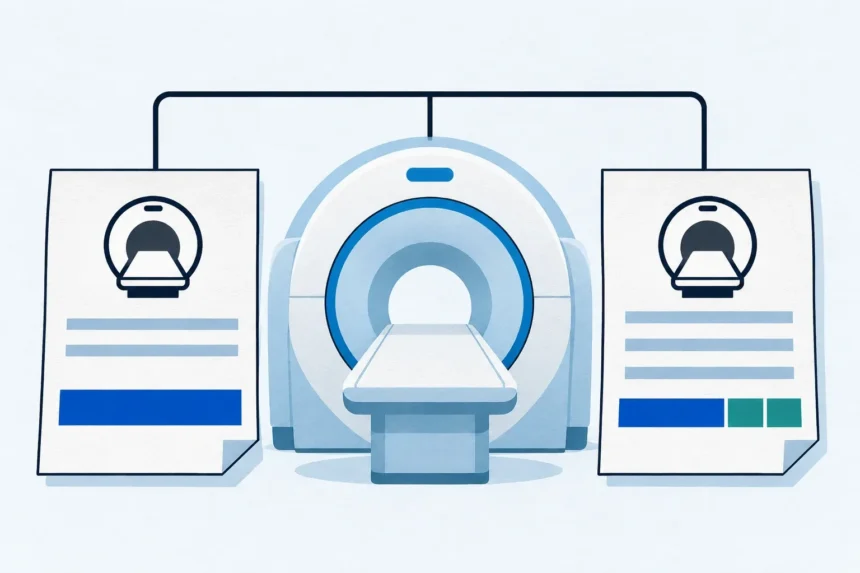
Your clinician orders an MRI, the imaging center pulls your insurance details, and an estimate lands before you’ve checked your remaining deductible. Meanwhile, a second clinic quotes a lower cash rate. Which number makes sense? Start by getting two written quotes for the exact same exam, then check how each choice shifts your insurance balances.
If you have a high deductible, compare the written, all-in cash price for the MRI your clinician ordered with what your insurer estimates you’ll owe for that same exam. Self-pay can cost less today, but insurance may be the better choice if you’ve met your deductible or expect more covered care before the plan year ends.
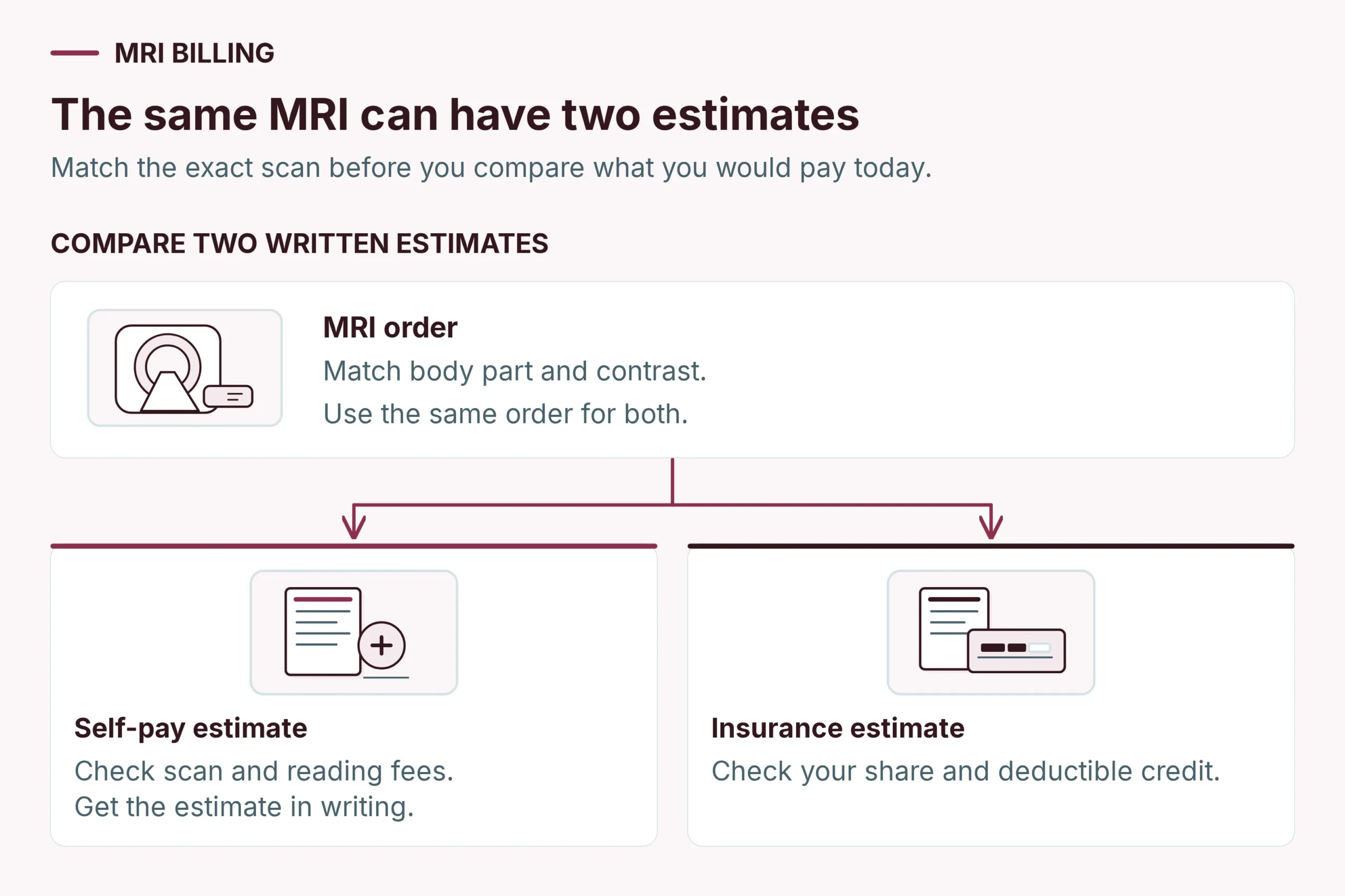
- Compare two written estimates for the exact same scan.
- Ask whether each estimate includes the radiologist’s reading fee.
- Confirm what your plan would credit toward your deductible before choosing the payment route.
A written insurance estimate and an itemized self-pay quote let you compare what you would owe for the same appointment.
Data from the Expected Health Imaging Price Index reported a median of $590 in its November 2026 update, based on self-reported clinic prices. Your estimate will depend on the scan and provider. For context on what insured patients can pay, the 2026 KFF Employer Health Benefits Survey reported a $2,912 average deductible for single coverage among workers in employer HSA-qualified plans. If you haven’t hit your deductible yet, putting cash quotes side by side with your insurer’s estimate often pays off.
Start with the MRI your clinician ordered
Start by getting the exact exam name, target body part, and contrast details from the ordering office. When staff can share the procedure code, pass that exact code to your insurer and the imaging center alike. You’ll also want to verify the center can run that specific scan, take your doctor’s order, and route the images and report back to them. Keep those exact exam specs identical every time you ask for a quote.

Get the insurance estimate first
Call your insurer to find out three numbers: your remaining deductible, the estimated allowed amount at that clinic, and your out-of-pocket share. That allowed amount is the rate your plan recognizes for a covered service. While you’re on the line, check if the facility and any separate radiology billing group sit in network, and confirm whether you need prior authorization. On a family plan, double-check which deductible tracks your care. Jot down the call date and reference number so you’ve got a paper trail if the bill shifts later. Read HealthCare.gov’s deductible definition.
Ask what the self-pay MRI price includes
Next, ring the imaging center and ask for its all-in self-pay rate for that exact exam. Make sure the quote covers the scan itself, the radiologist’s read, and any contrast or add-on fees tied to the order. Tools like Expected Health’s platform let you look up local imaging centers, stack up self-pay MRI quotes, and send appointment requests online.
Paying outside of insurance usually entitles you to request a written good faith estimate before your scan, as CMS notes for uninsured and self-pay patients. When a clinic and radiologist send separate bills, grab a written quote from each office. You should also check when payment is due and how refunds work if your exam changes or gets canceled. Source
Compare the bill today and your costs later
Suppose the clinic quotes $550 for self-pay and your insurer estimates you would owe $720, all of which would be applied to your deductible. The cash quote saves $170 today. If your plan would give the self-pay charge no credit, you would still have the same remaining deductible afterward. The $720 credit could matter if you expect more covered care that plan year.
If you have already met your deductible and owe 20 percent coinsurance on an $800 allowed amount for a covered scan, your bill would be $160. In that example, the $550 cash rate costs more. Read HealthCare.gov’s explanation of coinsurance.
| Payment Route | Upfront Cost to Patient | Impact on Annual Deductible | Prior Authorization & Scheduling |
|---|---|---|---|
| Self-pay cash pricing | Use the written estimate for the scan and any separately billed services | Ask the plan whether a self-paid bill can be submitted and credited | Ask the clinic for the first available appointment and any ordering requirements |
| High-deductible insurance | Use the insurer’s estimate for what you would owe at that location | Confirm how much of the covered claim applies to your deductible | Check whether prior authorization is required and who will request it |
Frequently Asked Questions
How to know if insurance will pay for MRI?
Call your insurer with the exact exam name or procedure code and ask whether your plan covers that MRI at the center you’ve chosen. RadiologyInfo’s cost guide explains why you should check prior authorization and network status before booking. Coverage alone doesn’t tell you what you’ll owe: ask for the allowed amount and your estimated share after your remaining deductible is applied.
What does the self-pay MRI price include?
A self-pay quote may cover the scan without covering the radiologist’s read. Ask for a written good faith estimate and check it against your order, including any charge for contrast. CMS says each estimate lists charges for a single provider or facility, so request a separate estimate if the radiologist bills separately.
Decide how you want the exam billed
Before locking anything in, check with your insurer on whether you can file a self-pay receipt later and whether any of it counts toward your deductible or out-of-pocket max. You’ll also need to confirm with the clinic whether it files a claim under your chosen payment route. Confirm the billing route and what the clinic expects you to pay before the appointment. Hang on to your written quote and itemized receipt, particularly if your plan allows self-submitted claims.
When a slow insurance estimate or prior authorization stalls your booking, check with your doctor’s office on how soon they need the results. Pass that deadline along to the imaging center and ask for open slots under both payment paths. You’ll get a clear look at wait times alongside price without disrupting the original order or follow-up plan.
Carrying health insurance doesn’t always lock in the lowest upfront rate for diagnostic imaging. Putting self-pay quotes, insurer estimates, deductible credit, and open appointment dates on the same page lets patients pick the route that fits their budget and timeline. If the cash quote looks better, check what you’d save today against what would count toward your deductible if you used insurance.