
Chronic venous conditions rarely appear overnight. They creep in slowly, often starting with signs that are easy to shrug off as plain fatigue. Occasional ankle swelling, leg heaviness, itching, or dull soreness after a long shift can feel routine, yet repeated symptoms often point to trouble inside the veins carrying blood back toward the heart.
- Understanding Chronic Venous Conditions
- Common Warning Signs You Shouldn’t Ignore
- Why Early Diagnosis Makes a Difference
- How Duplex Ultrasound Aids Diagnosis
- Understanding the Risk Factors
- How Untreated Venous Conditions Can Progress
- Modern Treatment Options for Chronic Venous Conditions
- Why Personalized Vein Care Matters
- Lifestyle Changes That Support Long-Term Vein Health
- Regular Follow-Up and Monitoring
- Taking Early Steps for Better Vein Health
- Frequently Asked Questions
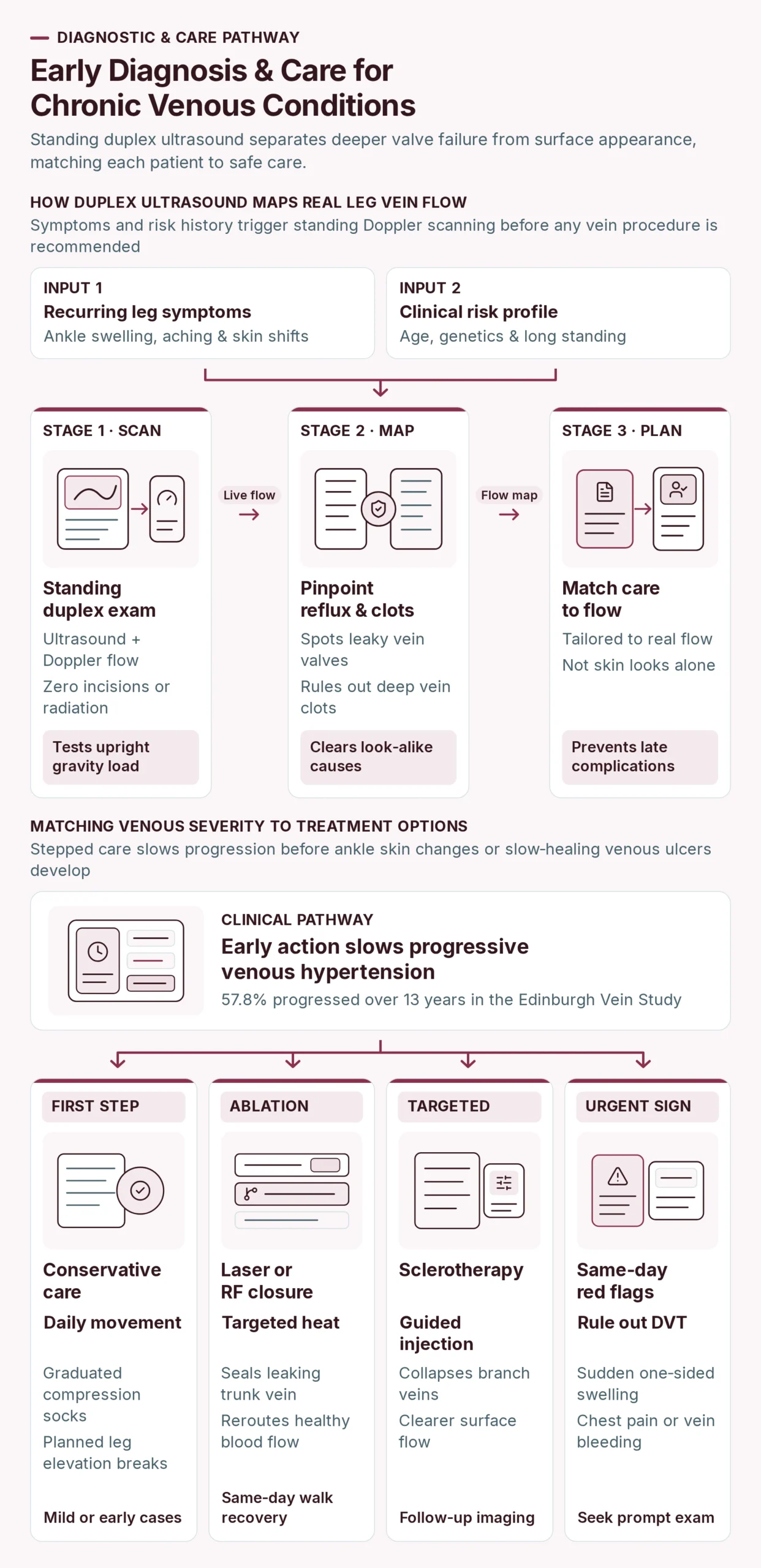
Recurring ankle swelling, calf heaviness, or skin changes around the lower legs call for an evaluation for chronic venous conditions. Clinicians rely on standing duplex ultrasound to map venous reflux and rule out hidden blood clots before picking a plan. Mild cases often respond to daily walking and compression stockings, while persistent valve failure may warrant targeted endovenous ablation or sclerotherapy.
- One in twenty adults lives with chronic venous insufficiency, and valve leakage worsens pressure inside lower leg veins over time.
- Visible surface veins cannot reveal which deeper saphenous trunks are leaking without Doppler flow mapping.
- Standing duplex ultrasound checks valve closure direction and screens for deep vein thrombosis in a single painless exam.
- Early compression therapy, leg elevation, and regular calf movement help curb progressive skin discoloration and venous ulcers.
Left unaddressed, elevated pressure inside leg veins steadily affects circulation, comfort, and mobility. Modern ultrasound imaging lets doctors pinpoint where valve leakage occurs and align care with the root cause. When leg swelling or aching keeps returning, reviewing personalized vein treatment for Frisco patients shows what a focused vascular evaluation covers and which targeted therapies address varicose veins.
Understanding Chronic Venous Conditions
Your venous system returns oxygen-depleted blood from your extremities back up to the heart. Down in the legs, veins work upward against gravity every minute you stand or walk, relying on calf muscle contractions to squeeze blood forward and one-way valves to stop backward flow.
As the American Venous Forum explains, weak or damaged vein valves allow retrograde flow, known clinically as venous reflux, which raises sustained venous pressure inside the lower legs. Cleveland Clinic notes that while roughly 1 in 3 adults has varicose veins, overall chronic venous insufficiency affects about 1 in 20 adults, and roughly 1 in 50 adults with varicose veins progress to chronic venous insufficiency each year.
More Read

Spider veins, varicose veins, chronic venous insufficiency, and ankle ulcers sit along a connected spectrum. Even though their surface appearance differs sharply, they frequently stem from shared valve dysfunction and rising venous pressure beneath the skin.
| Condition | What happens inside the vein | What you might notice | Primary evaluation step |
|---|---|---|---|
| Spider veins | Tiny surface capillaries widen near the skin | Fine red, blue, or purple web lines without leg ache | Visual inspection and symptom review |
| Varicose veins | Superficial veins dilate and twist under backward pressure | Rope-like bulging veins accompanied by throbbing or heaviness | Focused history plus duplex ultrasound screening |
| Chronic venous insufficiency | Faulty valves let blood pool persistently in the lower legs | End-of-day ankle swelling, itching, and darkened ankle skin | Standing venous duplex ultrasound reflux mapping |
| Venous ulcers | Sustained venous pressure breaks down overlying ankle tissue | Slow-healing shallow open sores near the inner ankle | Vascular assessment, DVT screening, and wound care |
Common Warning Signs You Shouldn’t Ignore
Early venous disease seldom starts dramatically. Discomfort often begins as an end-of-day leg heaviness, dull calf ache, skin itching, or ankle puffiness that improves briefly overnight and worsens after hours of standing or sitting still.
As venous pressure lingers over months or years, tissue changes appear around the lower calf and ankle. Skin near the inner ankle can darken with brownish pigment deposits, turn dry or irritated, or feel noticeably firm and thickened.
When persistent ankle discomfort shows up week after week, bring it to a clinician instead of blaming age or long hours on your feet. Left untreated, fragile ankle tissue can break down into slow-healing venous ulcers, a complication Yale Medicine notes affects roughly 1% of US adults and rises after age 65.
Why Early Diagnosis Makes a Difference
Prompt evaluation identifies what is driving leg symptoms before skin breakdown or stubborn swelling sets in. According to the Society for Vascular Surgery, early detection and management help prevent complications, lower the odds of painful ankle ulcers, and protect everyday quality of life.
Clinicians also rely on early workups to rule out look-alike causes of lower-limb swelling. Ankle fluid can stem from heart strain, kidney impairment, lymphedema, joint inflammation, or prescription side effects, so engaging patients early in chronic condition diagnosis cuts out guesswork and avoidable care delays.
How Duplex Ultrasound Aids Diagnosis
Modern vascular imaging takes the guesswork out of vein assessment. Venous duplex ultrasound pairs traditional grayscale B-mode imaging with color and spectral Doppler technology to map both vessel anatomy and live blood flow direction during a single outpatient exam.
Clinicians perform the scan while you stand upright so gravity loads the leg veins realistically. A technician gently squeezes and releases your calf to test whether vein valves snap shut or allow backward flow to persist, while checking deep and superficial veins for hidden blockages or clots.
Because duplex ultrasound requires zero incisions and zero radiation, specialists depend on it to base treatment plans on real circulation patterns instead of surface appearance alone.
Understanding the Risk Factors
Several inherited and everyday factors increase your odds of developing valve failure in the lower legs. Advancing age gradually reduces vein wall elasticity, while family history raises baseline susceptibility to weak superficial valves.
Prolonged desk work or standing shifts keep calf muscles quiet for hours at a time, letting gravity slow venous return. Pregnancy raises abdominal venous pressure through hormone shifts and extra blood volume, and carrying excess weight puts steady mechanical load on lower-leg veins.
People who stand or sit for long periods of time throughout the day are at risk for it because veins return blood from our feet to our heart and rely on our leg muscles and muscle activity like walking to help squeeze the blood against gravity back to our heart.
Elizabeth L. Chou, MD, Everyday HealthA prior blood clot is another major driver. Cleveland Clinic estimates that 20% to 50% of people who experience deep vein thrombosis go on to develop post-thrombotic syndrome within one to two years as scarred valves impair leg drainage.
How Untreated Venous Conditions Can Progress
Longitudinal cohort studies show how often untreated venous disease advances when early signs are ignored. In a peer-reviewed clinical review in the Annals of Phlebology covering the 13-year Edinburgh Vein Study, 57.8% of 334 adults with baseline chronic venous disease experienced measurable progression, and the 6.6-year Bonn Vein Study II found 31.8% progression from CEAP C2 varicose veins with saphenous reflux compared with 19.8% without saphenous reflux.
Early swelling that initially faded overnight begins lingering through the afternoon. Surface varicose veins enlarge, ankle skin grows darker or tighter, and localized superficial thrombophlebitis can trigger tender cords just beneath the skin.
Clinicians draw a clear safety boundary between surface inflammation and deep vein thrombosis. Recognize urgent warning signs that require same-day evaluation or emergency care:
- Sudden one-sided leg swelling paired with calf tenderness, warmth, or skin redness can signal deep vein thrombosis.
- Shortness of breath or sharp chest pain after calf swelling demands emergency medical attention for possible pulmonary embolism.
- Brisk bleeding from a dilated ankle vein needs immediate leg elevation, firm direct gauze pressure, and prompt clinical care.
Modern Treatment Options for Chronic Venous Conditions
Care choices depend on reflux severity on ultrasound, symptom burden, and your overall health profile. When discomfort remains mild, clinicians generally begin with medical-grade graduated compression stockings, structured walking, leg elevation, and periodic follow-up.
When persistent aching, swelling, or skin changes stem from a failing saphenous vein, vascular specialists often recommend minimally invasive outpatient closure under local numbing medicine. Endovenous laser ablation and radiofrequency ablation seal the leaking trunk using targeted heat so blood reroutes automatically through healthy adjacent veins, while sclerotherapy closes smaller tributary branches with an injected sclerosant.
| Care approach | How it works | Typical candidate | Recovery & follow-up |
|---|---|---|---|
| Conservative care & compression | Graduated stockings, leg elevation, and walking ease venous pressure | Mild swelling, early spider or varicose veins, or pregnancy support | Daily wear during upright hours with routine symptom check-ins |
| Endovenous laser ablation (EVLT) | Laser fiber heats and seals a refluxing superficial trunk vein | Confirmed great or small saphenous reflux on duplex ultrasound | Walk same day; follow-up ultrasound checks vein closure and DVT exclusion |
| Radiofrequency ablation (RFA) | Radiofrequency catheter delivers uniform thermal closure to faulty vein | Symptomatic varicose veins or chronic venous insufficiency with reflux | Same-day discharge; short compression period and light activity resume fast |
| Sclerotherapy | Injected solution irritates and collapses targeted branch veins | Spider veins, reticular veins, or residual branches after trunk closure | Quick office session; compression hosiery supports smoother vein resolution |
Why Personalized Vein Care Matters
Two patients with nearly identical surface varicose veins can have completely different ultrasound findings underneath. One person’s symptoms may come from isolated branch veins, whereas another carries widespread saphenous reflux driving ankle skin changes.
Individualized planning keeps care proportional to anatomy and daily demands. Vascular clinicians review duplex maps, medical history, past clotting events, and activity goals before recommending compression alone versus a vein closure procedure.
Lifestyle Changes That Support Long-Term Vein Health
Daily habits cannot rebuild worn vein valves once reflux develops, yet steady routines reduce pooling pressure and amplify clinical treatment results. Regular movement, especially brisk walking, activates the calf muscle pump with every stride.
Take short two-minute walking breaks every hour during long desk sessions, or pump your ankles repeatedly while seated. People who stand for most shifts benefit from shifting weight often, wearing properly fitted compression socks if advised, and propping legs above heart level at rest.
Maintaining a steady healthy weight and staying hydrated lighten mechanical stress across lower-body veins alongside your clinician’s plan.
Regular Follow-Up and Monitoring
Chronic venous disease requires periodic check-ins even after successful symptoms relief or endovenous treatment. Follow-up visits confirm targeted veins stay sealed, track skin healing near the ankles, and catch new reflux segments early.
Report spreading warmth, fresh ankle sores, or sudden calf tightness promptly instead of waiting for an annual visit. Ongoing vigilance matters most for anyone with prior deep vein clots, healed venous ulcers, or recurrent inflammation.
Taking Early Steps for Better Vein Health
Addressing recurring leg heaviness and ankle swelling early keeps chronic venous conditions far simpler to manage. Standing duplex ultrasound clarifies the exact circulation problem so conservative habits or minimally invasive procedures work where they count most.
This article provides general patient education and does not replace an individualized evaluation by a qualified vascular clinician.
Frequently Asked Questions
What are the different types of chronic venous conditions?
Chronic venous conditions form a spectrum ranging from mild superficial spider veins and enlarged varicose veins to advanced chronic venous insufficiency with ankle edema, hyperpigmentation, and open venous ulcers. Superficial thrombophlebitis and post-thrombotic syndrome following deep vein clots also belong to this group because they elevate leg venous pressure.
How does duplex ultrasound diagnose venous insufficiency?
Duplex ultrasound helps diagnose venous insufficiency while you stand by combining structural B-mode vein imaging with Doppler flow velocity readings during gentle calf squeezes. That real-time mapping detects leaking valves allowing backward reflux, locates involved saphenous or branch segments, and rules out deep vein thrombosis without incisions or radiation.
Is there a cure for chronic venous insufficiency or venous stasis?
There is no permanent structural cure that regenerates worn native vein valves, so medical care for chronic venous insufficiency and venous stasis focuses on reducing backward blood pooling and protecting ankle skin. Sealing leaking superficial trunks with thermal ablation or sclerotherapy alongside daily compression therapy relieves symptoms long-term when deep veins remain patent.
When does leg swelling require urgent medical care instead of a routine vein visit?
Rapid one-legged swelling accompanied by warmth, skin redness, or deep calf pain requires same-day urgent assessment to rule out deep vein thrombosis. Immediate emergency evaluation is essential if leg swelling occurs with sudden shortness of breath, chest pain, dizziness, or brisk bleeding from an ankle vein.