
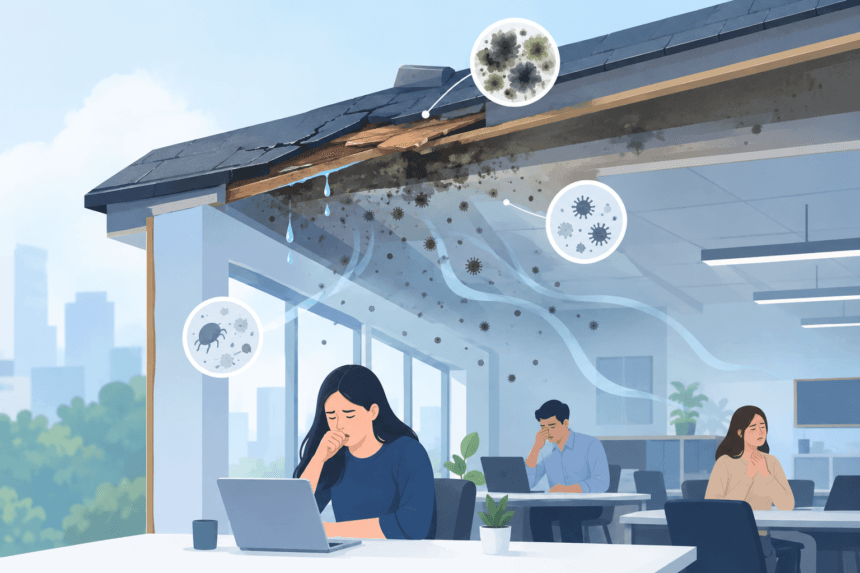
When water enters through a failing roof and wet materials do not dry, indoor air quality can decline and mold can grow in insulation, ceiling cavities, and drywall. The health risks of a roof leak begin with that moisture. People spend a significant portion of their time indoors, and the air in those spaces is shaped by ventilation, humidity, biological contaminants, and the structural integrity of the building itself. When the roof fails to keep moisture and outdoor elements out, the internal environment can deteriorate before the cause is visible.
The roof is the primary barrier between a building’s interior and the outdoor environment, and its condition directly determines how well that barrier performs. A roof that is aging, damaged, or structurally compromised allows moisture to infiltrate the building. Moisture is the central driver of many indoor air quality problems that affect health. What begins as a small area of failed flashing, worn membrane, or damaged shingles can wet roof decking and insulation within months. Building owners and facility managers often underestimate how quickly roofing problems can become health concerns for the people inside.
When Roofing Damage Requires a Structural Solution
Not every roofing problem can be resolved through targeted repairs. When deterioration is widespread, materials have reached the end of their service life, or repeated leaks have damaged the roof deck and insulation, partial fixes may not restore the water barrier the building needs. As defined by roofsoveryourhead.com, when an assessment confirms that damage is too widespread for repairs to be effective, a roof replacement becomes the appropriate course of action for the structure and for the people who occupy it.
Delaying that decision carries real health consequences. A deteriorating roof that continues to admit water gives mold and other moisture-related contaminants more time to establish themselves in insulation, wood framing, and paper-faced drywall. “Mold requires water. No water, no mold. Mold is the result of a water problem. Fix the water problem. Clean up the mold. And you have fixed the mold problem.” wrote Joseph Lstiburek, Ph.D., P.Eng., founding principal of Building Science Corporation, in a Building Science report.
More Read

The U.S. Environmental Protection Agency advises that wet materials should be dried within 24 to 48 hours to help prevent mold growth. If roof damage has soaked insulation or ceiling materials beyond that window, repair work may need to include removal and replacement of affected materials, not just a patch at the leak point.
How Moisture Infiltration Creates Biological Hazards
Roof leaks and mold are closely connected because mold needs moisture, a food source such as wood or drywall, and time. A compromised roof can supply those conditions in one concealed area, especially around roof valleys, penetrations, and wall-to-roof joints where flashing has failed. Once mold grows in structural materials, spores and other irritants can move through openings around ducts, ceiling fixtures, and return-air pathways.
Mold exposure can cause or worsen respiratory symptoms, though the effects differ from person to person. The Centers for Disease Control and Prevention reports that people in damp buildings have reported respiratory symptoms, worsening asthma, allergic rhinitis, and other health problems. “Research has found that people who spend time in damp buildings report health problems including respiratory symptoms and infections,” states the National Institute for Occupational Safety and Health.
The health risks associated with prolonged mold exposure are not limited to people with pre-existing conditions. Healthy adults and children may experience nasal irritation, coughing, wheezing, or eye irritation in damp spaces, while people with asthma or mold allergies may have stronger reactions. “When water sits in a garage or basement or areas of a building that are excessively damp or humid, mold, bacteria and dust mites may thrive,” said Joseph Laquatra, professor of design and environmental analysis at Cornell University, in a Cornell Chronicle article.
Identifying When the Building Is Affecting Occupant Health
Certain patterns of illness or discomfort among building occupants are worth taking seriously as possible signs a building is making people sick. When several people report respiratory irritation, fatigue, or recurring headaches that improve after they leave the building, the indoor environment deserves review. In workplaces, clinicians can also consider whether symptoms follow time spent in a specific area or shift.
A building health assessment should begin with a visual moisture inspection, not an air test alone. Inspectors can check upper-floor ceiling stains, attic decking, insulation, roof drains, flashing, and HVAC return paths, then use moisture meters or infrared imaging to find wet materials behind finishes. “Evidence did not validate current interpretations of spore count data for identifying single damp homes,” wrote Mark J. Mendell of the California Department of Public Health and Rachel I. Adams of the University of California, Berkeley, in their 2022 review of mold spore-count testing.
Visible signs of roofing-related moisture damage are sometimes found well away from the roof itself. Water staining on ceilings, warped materials, musty odors in upper-floor spaces, and unexplained humidity below the roof line can all point to water damage and mold. Readers dealing with persistent headaches or stale air may also find useful guidance in poor ventilation and afternoon headaches, since ventilation problems can worsen the effects of a damp building.
Building managers and homeowners who notice these signs and act quickly can limit structural damage and shorten occupant exposure. David Weissman, M.D., director of the National Institute for Occupational Safety and Health Respiratory Health Division, said in a NIOSH update that “implementing regular visual inspections for dampness can help to identify trouble areas before they become major problems and help to prioritize maintenance and repair.”
The Long-Term Health Argument for Structural Maintenance
Buildings maintained to a high structural standard provide healthier indoor environments than buildings where water entry is allowed to continue. The roof affects moisture control and insulation performance, and it can also affect how ventilation systems perform. A roof that has degraded past its functional lifespan does not just allow water in. It can wet insulation, create cold surfaces where condensation forms, and send odors or particles into ceiling cavities near mechanical systems.
For facility managers responsible for employees, patients, or students, the building envelope is a health management issue as well as a facilities concern. In a study of office workers in a water-damaged building, the rate of adult-onset asthma increased from 1.9 to 14.5 cases per 1,000 person-years after occupancy. Jean M. Cox-Ganser, a National Institute for Occupational Safety and Health researcher and lead author, wrote in Environmental Health Perspectives that “occupancy of the water-damaged building was associated with onset and exacerbation of respiratory conditions, confirmed by objective medical tests.”
That evidence does not mean every roof stain causes illness, and it does not replace medical care for a person with breathing problems. It does show why recurring leaks, damp ceiling systems, and occupant complaints should be tracked together. For more on protecting indoor air, see how AC systems can help prevent sick building syndrome.
Treating the Building as Part of Health Infrastructure
A building’s structural integrity is part of the health environment for the people it houses. Its condition shapes what occupants breathe, how comfortable they are, and whether water remains trapped above ceilings or within wall assemblies. Riitta Sauni, M.D., of the Finnish Institute of Occupational Health, wrote in a Cochrane review that “dampness and mould in buildings have been associated with adverse respiratory symptoms, asthma and respiratory infections of inhabitants.”
The health argument for structural investment becomes plain once the connection between roof deterioration and indoor air quality is clear. Start with the source of water, document the affected materials, and verify that wet areas are dry after repair. A roof inspection after a leak, storm, or recurring ceiling stain can prevent a small maintenance problem from becoming a longer-term indoor air quality problem for everyone inside.