We use cookies, including third-party cookies from Google to serve personalized ads through AdSense, to operate this site and understand how it is used. By continuing to browse, you accept this use. See our Privacy Policy and Terms of Use for details, including how to opt out of personalized advertising.
Accept
Health Works CollectiveHealth Works CollectiveHealth Works Collective
  • Health
    • Mental Health
  • Policy and Law
    • Global Healthcare
    • Medical Ethics
  • Medical Innovations
  • News
  • Wellness
  • Tech
Search
© 2023 HealthWorks Collective. All Rights Reserved.
Reading: Social Media To Be The Most Common Source Of Continuing Medical Education
Share
Notification Show More
Font ResizerAa
Health Works CollectiveHealth Works Collective
Font ResizerAa
Search
Follow US
  • About
  • Contact
  • Privacy
© 2023 HealthWorks Collective. All Rights Reserved.
Health Works Collective > eHealth > Social Media > Social Media To Be The Most Common Source Of Continuing Medical Education
Social Media

Social Media To Be The Most Common Source Of Continuing Medical Education

drneelesh
drneelesh
Share
3 Min Read
Image
SHARE

Social Media is the most common use of Internet. Everyone uses the internet to access their emails and Facebook accounts. A Google search engine is the gateway to all information for most of us. These platitudes of an everyday normal life also apply to physicians. Communication technology has made things easy for doctors. Keeping up-to-date with medical advances has become an easy part of everyday life and not restricted to events like conferences or receiving prints of journal publications.

Social Media is the most common use of Internet. Everyone uses the internet to access their emails and Facebook accounts. A Google search engine is the gateway to all information for most of us. These platitudes of an everyday normal life also apply to physicians. Communication technology has made things easy for doctors. Keeping up-to-date with medical advances has become an easy part of everyday life and not restricted to events like conferences or receiving prints of journal publications. Recent publications have highlighted the importance of social media in continuing medical education. In a recent large study, 70% of doctors were found to have accessed new medical content via social mediaevery month.

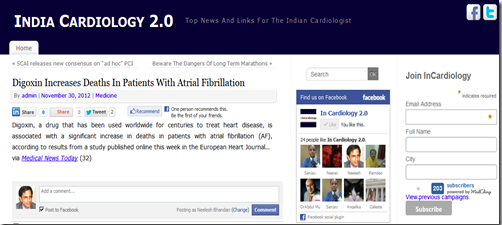
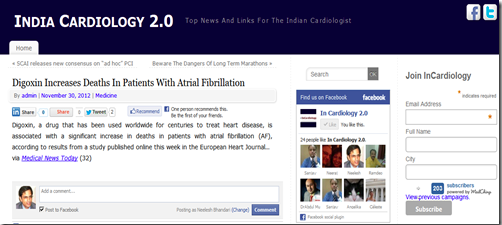
Social media integrated medical content platforms like India Cardiology 2.0 and India Rheumatology 2.0 make it easier to read, share and discuss the latest studies and articles within the niche. Such platforms let readers (which in most cases are doctors) recommend and easily share the relevant study on their Facebook wall. Reader recommendations on the website are used to list the most visible studies. On such social media integrated medical content platforms, Readers can choose to stay updated via email (enewsletter) or via Facebook page or Twitter. So, for example, on liking India Cardiology 2.0 Facebook page the latest news and articles in Cardiology shall be visible to readers on their Facebook wall stream. Readers can also use common social media platforms including LinkedIn and Google plus to recommend the article to his/her own friend circle with pertinent comments.
Image

More Read

ehealth
Is Facebook a Predictor of Your Health?
Social Media and Healthcare: Inbound vs. Outbound Marketing
Beyond the Buzz: 12 Ways To Search For Health-Related Content On Twitter
Social Media, Diet and Cancer
Teaching Social Media to Cardiologists: Opening (My) Eyes and Dropping Jaws in Gotham

Similarly, following @incardiology on Twitter will let a reader receive all new updates in his/her twitter stream/wall. Such platforms make finding and sharing relevant items so much simpler for medical professionals.

Social media and emails are well ingrained into our daily lives. Its time doctors make professional uses of such tools too.

Original Post


Share This Article
Facebook Copy Link Print
Share

Stay Connected

1.5KFollowersLike
4.5KFollowersFollow
2.8KFollowersPin
136KSubscribersSubscribe

Latest News

Flat editorial illustration: The article's core relationship is that substantial clinical testing of thymosin alpha-1 did not est
Thymosin Alpha-1 Got the Big Trials Most Peptides Never Get
Global Healthcare
October 12, 2026
Flat editorial illustration: The article examines how researchers study tissue repair through growth factors and peptide-based re
How Researchers Study Tissue Repair: From Growth Factors to Peptide-Based Research
Health
October 12, 2026
Workers Comp Claim Denied – Now What?  -- AI-generated illustration
Workers Comp Claim Denied – Now What? 
Policy & Law
October 9, 2026
The Case for Proactive Nutrient Support and Where IV Therapy Fits In -- AI-generated illustration
The Case for Proactive Nutrient Support and Where IV Therapy Fits In
Health Therapies
October 5, 2026

You Might also Like

Have You Claimed Your Hospital’s Location On Local Directories?

August 22, 2013
HospitalWebsite
eHealthNewsSocial Media

15 Hospitals with Great Blogs

April 6, 2016

More Than a 50/50 Chance, the Emergence of the e-Patient

January 28, 2012

Fine-Tune Your Facebook Following Through Smart Contact

December 22, 2014
Subscribe
Subscribe to our newsletter to get our newest articles instantly!
Follow US
© 2008-2026 HealthWorks Collective. All Rights Reserved.
  • About
  • Contact
  • Privacy
Welcome Back!

Sign in to your account

Username or Email Address
Password

Lost your password?