Providing value to patients has always been the name of the game whenever we talk about patient engagement and patient access. We at Carestream recently met with our Medical Advisory Board—comprised of thought leaders from around the world in the area of radiology, IT, and healthcare administration—to discuss trends taking place in the medical imaging and healthcare IT industries, and the needs of patients was one of the most in-depth focus points.
Providing value to patients has always been the name of the game whenever we talk about patient engagement and patient access. We at Carestream recently met with our Medical Advisory Board—comprised of thought leaders from around the world in the area of radiology, IT, and healthcare administration—to discuss trends taking place in the medical imaging and healthcare IT industries, and the needs of patients was one of the most in-depth focus points.
The Office of the National Coordinator for Health Information Technology (ONC) has outlined what patients are looking for from tools such as portals and EHRs. These include the following:
- “Less paper work”
- “Better care coordination among healthcare providers.”
- “Fewer unnecessary tests and procedures.”
- “Easy electronic access to medical records and greater control over personal health.”
If you’re thinking that this is all well and good, but asking whether patients will adapt to these technologies, here are some supporting statistics:
- 80% of Americans who have access to their health information via EHR technology use it
- 65% of Americans who don’t have electronic access to their healthcare information say that it is important to have
- 2 out 3 people would consider switching to a physician who offers access to medical records through a secure internet connection.
These kinds of statistics tell a story in which patients are clamoring for access to healthcare information and those demands, which have evolved into needs, are not being met. According to a Harris Interactive poll from 2012, that will also cited in a recent infographic we created, very few patients have access to technologies that address their most sought after needs. For example, only 17% of patients have online access to clinical data while 65% of patients qualify that need as being “important” or “very important.” Another testament to this issue has only 12% of patients with capabilities to email their doctor, even though 53% of patients classify that ability as being “important” or “very important.” As you can see, we have a long way to go when it comes to meeting patient needs.
As a company focused on medical imaging, we wanted to gauge whether or not these images are seen as vital to access by patients. From the survey we conducted, we saw that about 79% of people who said they wanted either online access to medical images, or access to both online and hard copy versions of medical images. When asked what they would do with these medical images, 88% said they would share them with their physicians, and about 61% said that they would share them with their family, while only about 4% said that they wouldn’t share the images at all.
This information tells us that medical images need to be included in the conversations about patient access and patient engagement. Knowledge has always been power, and by providing patients with the ability to access, view, share their medical images we are providing them with more knowledge and control over their own healthcare.
We asked the members of the Medical Advisory Board to rank what role imaging can play in patient engagement and chose what’s most important:
- Education (prior and after procedure/episodic care)
- Provide services to reduce patient wait time (ex. Kiosk for check-in)
- Patient online access and self-management
- Concierge healthcare (personalized phone calls, reception, follow up etc)
- Create multidisciplinary teams with referring community to create referral plan
- Social networking such as Facebook, Twitter
Here were the results:
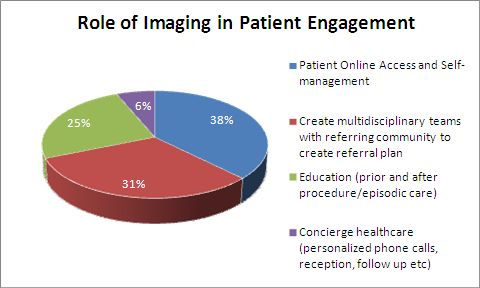
What do you think is the most important role imaging can play?
If you like this post, please read other posts in the series on the Person-Centered HealthCare main page. And if you have a story to tell that may be a fit with our series, please comment below or email me at joan@socialmediatoday.com