After either a realistic or pessimistic Day 1 keynote, depending on whether you’re a glass half full or half empty kind of person, Day 2 at the MHealth Summit started with a difficult topic but a much more inspiring message and continued with presentations stressing that patients are already connected and engaged.
After either a realistic or pessimistic Day 1 keynote, depending on whether you’re a glass half full or half empty kind of person, Day 2 at the MHealth Summit started with a difficult topic but a much more inspiring message and continued with presentations stressing that patients are already connected and engaged. A bonus for those of you who are counting (XX in Health, Halle Tecco), is that ¾ keynote speakers on this day were women.
Confronting Mental Illness Online

First up was Jen Hyatt (@jennyhyatt) CEO and co-founder of Big White Wall, and online community for mental health. Big White Wall provides an online community for people who are mentally distressed and sometimes suicidal. Jen relayed a heart-breaking story of a possibly preventable suicide, if the person had just had an anonymous place to share what he was feeling. Big White Wall provides a community of people who are trying to self-manage their mental distress with support from clinical process and staff. It does so confidentially and anonymously. Anonymity is a key part of how Big White Wall works. People are more comfortable sharing when they know they won’t be judged and sometimes talking to a machine rather than a person can provide that, to illustrate, Hyatt shared the story of the young autistic boy who made friends with Siri. Hyatt has compared the accuracy of the data behind Big White Wall to predict depression and suicide risk to that of standardized tests, and says that interactions on Big White Wall provide enough information to be as accurate as the tests. Considering the difficulty of getting people to take these tests, and especially those who might not be seeking help for mental illness, this holds great promise for the power of patient (or people) generated data.

Serving the New Connected Patient
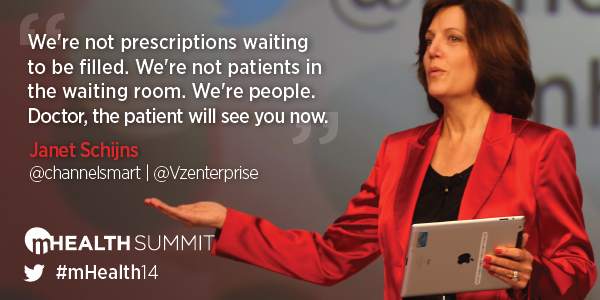
Source: MHealth Summit
The connected patient is already here, and she’s a millennial says Janet Schijns, Vice President of Global Verticals and Channel Marketing at Verizon. Schijns used a recent ER visit by her daughter, a college student to elaborate how patients are outpacing hospitals when it comes to digital care. Schijns daughter sprained her ankle badly, while waiting for a nurse to return with discharge instructions, she had already found and watched a video on how to navigate the world on crutches, ordered groceries online so she wouldn’t have go out, and researched how she would be able to get around campus. Schijns posits that healthcare organizations are spending dollars in the wrong areas online because they don’t really understand what patients are looking for. She talked about how patients are creating their own content through community sites like Patients Like Me and filling in gaps in the information the healthcare system is providing.
Email Is Our Killer Application
Christine Paige, Senior Vice President of Marketing and Internet Services from Kaiser Permanente helped all m-health entrepreneurs in the audience breathe a sigh of relief when she said that Kaiser was not going to get into the m-health app business and instead focus on working with companies that help them improve the patient provider relationship. Paige called email Kaiser’s killer app for two reasons, one is that patients are not able to absorb key information when they’re in the clinic, especially if they’ve had a difficult or surprising diagnosis and second because they want convenience and a connection to their physicians. Kaiser’s patients who engage online are healthier, and only 1/4 emails results in a doctor’s office visit.
While personalized medicine is a hot topic these days, Paige warned against personalization trumping patient privacy and the risk of personalized recommendations being wrong. That is, patients using technology trust their physician with the information, but not necessarily if an application starts intervening and providing recommendations based on that data.
While the day 2 keynote was optimistic about the promise of mHealth, it was definitely cautiously optimistic. Patients and providers are still feeling their way through the role of technology in communication and automating care.