eResponder, cellular based Personal Emergency Response System (PERS)
eResponder, cellular based Personal Emergency Response System (PERS)
Typical Personal Emergency Response Systems (PERS) work well around the house. They communicate reliably with a base station that’s connected to a landline and the units have long battery life. The technology is old but reliable, and the systems provide peace of mind for those who are living alone and for their kids. A greater challenge arises when trying to develop a system that works well for people who want to leave their homes and get out of range of their base stations.
The obvious solution is to use cellular technology. But cellphones are complicated for many elderly folks to use, and they have to be charged up at least every few days. Cellular service also isn’t as reliable as a landline.
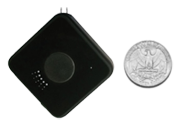
For the last couple months I’ve been trying out the eResponder by Securus. It’s a small, 1.2 ounce cellphone based pendant device that you can hang around your neck or from a belt. I’ve been pretty impressed with it. In case of emergency you simply press the single button on the unit for two seconds. Within about 10 seconds you are connected to an “emergency care specialist” who asks if you need help. I’ve gotten through right away every time I’ve pressed the button. (I tell them I’m just testing the unit –and they seem cool with that.)
There is a speaker and a microphone on the device – it’s essentially a mini speaker phone. The voice on the other ends comes through loud and clear and they have had no problem hearing me. The eResponder is designed to be worn in the shower, which is a good feature since that’s where someone is likely to fall. Some, but not all other PERS systems are water resistant.
The battery life really is excellent. The company advertises that the battery will last up to 2 months between charges. I’ve been using mine a little longer than that and I didn’t even charge it up when it arrived. That’s a really great feature.
Of course, there are some potential drawbacks. The system uses the T-Mobile network. I haven’t had any trouble but if you’re not near good T-Mobile service that could be an issue for getting through to the center. Also cellphone signals don’t always reach inside of buildings in case you’re using it inside. In addition, the eResponder center uses the same location-finding system as 911 operators. That’s good but at least in my case the eResponder does not deliver pinpoint accuracy.
When I activated the eResponder from an urban area yesterday I asked the operator to tell me if he knew where I was calling from. He answered, “Within four tenths of a mile of 284 Harvard Street.” In fact I was about 4/10 of a mile away – which would not have been good enough for an ambulance to find me. I asked if that was typical and he said that it was in fact pretty typical. He offered that he had seen situations where it located the person to within 1.2 miles of their location. I tried again this morning from the same location and was told I was within 0.6 miles of 881 Commonwealth Avenue.
Presumably a unit with GPS would be bigger, more expensive and use more battery power but would also provide much better accuracy. (In fact, Securus does make an eCare+Voice device with a GPS, but its battery lasts only a few days.)
I haven’t done a rigorous head to head test of PERS systems, but based on my experience I can recommend the eResponder for people who want a PERS system that can be carried outside of the house, is easy to use and does not need to be charged frequently. Those concerned with precise location finding or who don’t reside near decent T-Mobile service should select a different solution.