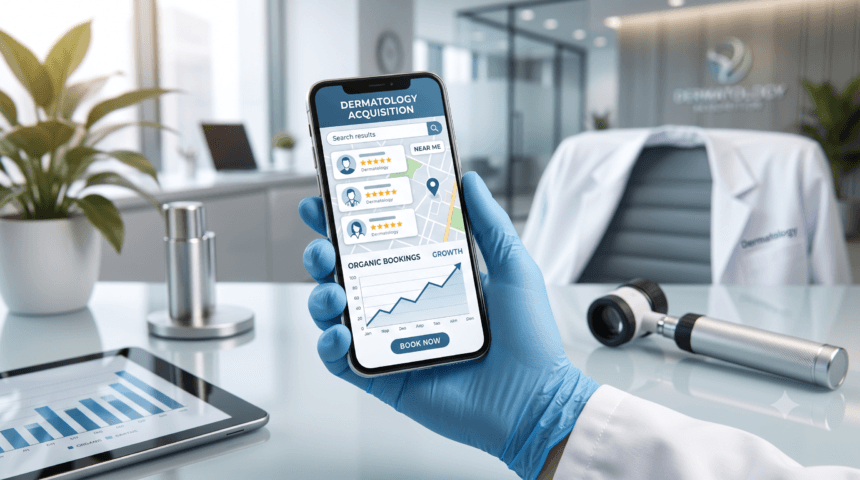
The landscape of healthcare marketing has underwent a permanent shift. For specialized medical practices—particularly dermatology—relying solely on traditional word-of-mouth referrals, print directories, or legacy media is no longer sufficient to maintain growth.
- 1. High-Intent Local SEO: Winning the Google Map Pack
- 2. Generative Engine Optimization (GEO): Ranking in Google AI Overviews & LLMs
- 3. Building Online Trust: Reputation Management & Social Proof
- 4. Technical Web Performance & Conversion Rate Optimization (CRO)
- 5. Establishing Clinical E-E-A-T Through Educational Content Marketing
One of the most significant drivers of this transformation is search engine optimization (SEO). When a prospective patient experiences a sudden skin flare-up or seeks cosmetic treatments, their first instinct is to search Google for local specialists. If a clinic does not appear on the first page of search results, it is virtually invisible to these active searchers. Specialized agencies like Derm Digital help dermatology practices dominate their local markets by optimizing their online presence, ensuring they rank at the top of search results when patients need them most. This specialized approach ensures that marketing budgets are spent targeting high-intent local patients rather than generic national traffic.
Today, patient acquisition is fundamentally digital. Industry data shows that 77% of patients use search engines prior to booking an appointment, evaluating clinical credentials, reading patient reviews, and researching treatment options before reaching out. To stay competitive in an increasingly crowded market, modern practices must deploy cutting-edge Search Engine Optimization (SEO) strategies designed to capture patients at every stage of their care journey.
1. High-Intent Local SEO: Winning the Google Map Pack
When prospective patients experience a sudden skin outbreak or search for cosmetic options like laser resurfacing, their immediate response is to search Google for local specialists. If your clinic does not appear at the top of local search results, it remains invisible to high-intent prospective patients.
More Read

┌─────────────────────────────────────────────────────────────┐
│                 LOCAL SEARCH CLICK BREAKDOWN                │
├──────────────────────────────────┬──────────────────────────┤
│ Google Local Pack (Top 3 Map)    │ 42% of All Clicks        │
│ Position 1 Organic Result        │ 14.2% of Clicks          │
│ Remaining Organic Results        │ 43.8% of Clicks          │
└──────────────────────────────────┴──────────────────────────┘
Search benchmark studies show that 42% of all local search clicks go directly to the Google Local Pack (the top 3 map listings). Position 1 in the Local Pack earns a 17.8% click-through rate (CTR) on its own. Specialized agencies like Derm Digital emphasize local SEO hyper-targeting to ensure marketing budgets capture local, high-intent patients rather than waste ad spend on irrelevant national traffic.
📊 Case Study Spotlight: Multi-Location SEO Transformation
A multi-specialty healthcare campaign executed by Socialsect demonstrated that restructuring local landing pages, cleaning up NAP (Name, Address, Phone) citations, and optimizing Google Business Profiles yielded a 350% increase in organic traffic and a massive rise in local appointment inquiries within 12 months.
2. Generative Engine Optimization (GEO): Ranking in Google AI Overviews & LLMs
Search behavior is shifting from simple keyword inputs to long-tail, conversational queries. With the rollout of Google’s AI Overviews and AI assistants like ChatGPT, patients regularly ask complex questions such as “What is the recovery time for CO2 laser resurfacing vs. chemical peels for acne scars?”
To capture visibility in AI-generated search summaries, dermatology websites must adopt Generative Engine Optimization (GEO) tactics:
- Direct Answer Blocks: Structure headers (H2/H3) as direct questions and answer them in concise, 40-to-50-word summary paragraphs immediately following the heading.
- Structured Data & Schema Markup: Implement
MedicalCondition,MedicalProcedure, andPhysicianSchema markup so AI crawlers can accurately parse and cite your medical content. - Entity-Based Keywords: Focus on semantic context—linking dermatological terms (e.g., hyperpigmentation, isotretinoin, Mohs surgery) to clear clinical definitions and treatment pathways.
3. Building Online Trust: Reputation Management & Social Proof
Medical decisions are deeply personal, making trust the primary currency in patient acquisition. Prospective patients heavily evaluate online star ratings, review recency, and overall volume before scheduling a consultation.
| Review Profile Status | Relative Click-Through Rate (CTR) | Consumer Trust Level |
| 4.5 – 4.9 Star Rating | Highest Peak Performance (+270% CTR vs. No Reviews) | 94% |
| 5.0 Star Rating | -12% vs. 4.5 Stars (Perceived as “Too Perfect”) | 68% |
| Below 3.5 Star Rating | -59% vs. 4.5 Stars | 14% |
(Data source: Searchlab 2026 Local SEO Benchmark Study)
Automated review request workflows (sent via SMS or email post-appointment) help clinics scale positive feedback naturally. Research indicates that clinics maintaining 50+ Google reviews are 266% more likely to rank in the Google Local Pack compared to competitors with sparse review profiles.
4. Technical Web Performance & Conversion Rate Optimization (CRO)
A high-ranking website will fail to generate revenue if site speed is sluggish or the scheduling experience is frustrating. A practice’s website serves as its virtual front door; it must deliver seamless mobile responsiveness, fast load speeds, and intuitive navigation.
Key elements for turning casual visitors into confirmed appointments include:
- Mobile-First Design: Over 64% of local searches originate from smartphones.
- Click-to-Call Buttons: Strategically placed call buttons increase phone inquiries by up to 3x on mobile devices.
- Seamless Direct Scheduling: Integrating real-time online booking software directly onto service landing pages eliminates friction and lowers drop-off rates.
📊 Case Study Spotlight: Direct Traffic and Conversion Lifts
In a digital optimization study featured byThrive Agency, implementing structural UX enhancements and Conversion Rate Optimization (CRO) on a medical practice site led to a 49% increase in direct traffic and achieved a 23% conversion rate on key Contact and Booking pages.
5. Establishing Clinical E-E-A-T Through Educational Content Marketing
To satisfy Google’s strict YMYL (Your Money or Your Life) guidelines for healthcare, digital content must demonstrate E-E-A-T (Experience, Expertise, Authoritativeness, Trustworthiness). Publishing medically vetted, high-quality content regarding common dermatological conditions (e.g., eczema, psoriasis, skin cancer screenings) establishes clinical authority before a patient ever sets foot in your clinic.
A longitudinal study published in the National Center for Biotechnology Information (NCBI) revealed that physician websites publishing authoritative, educational articles experienced a direct positive correlation ($\beta = 0.410, p < 0.001$) with overall patient conversion rates.
By consistently answering patient concerns, providing clear clinical guides, and maintaining accurate medical citations, dermatology clinics build early relationships with patients, lower cost-per-acquisition (CPA), and secure a resilient organic market presence.