The FutureMed format included keynotes, several short presentations on one theme, breakout workshops, and evening collaborative activities. Days were long, starting at 8:30 with sessions sometimes until 8pm. The span of topics was vast from genomics, to devices, to patient engagement, to health IT. What was great about this was some topics pushed the imagination while some were actionable today. Similar to HealthTech, attendees were health industry folks, investors, and startups, although we definitely noticed more health industry than the other two groups.
The FutureMed format included keynotes, several short presentations on one theme, breakout workshops, and evening collaborative activities. Days were long, starting at 8:30 with sessions sometimes until 8pm. The span of topics was vast from genomics, to devices, to patient engagement, to health IT. What was great about this was some topics pushed the imagination while some were actionable today. Similar to HealthTech, attendees were health industry folks, investors, and startups, although we definitely noticed more health industry than the other two groups. The collective experience and wisdom at the conference was intimidating and inspiring at the same time.
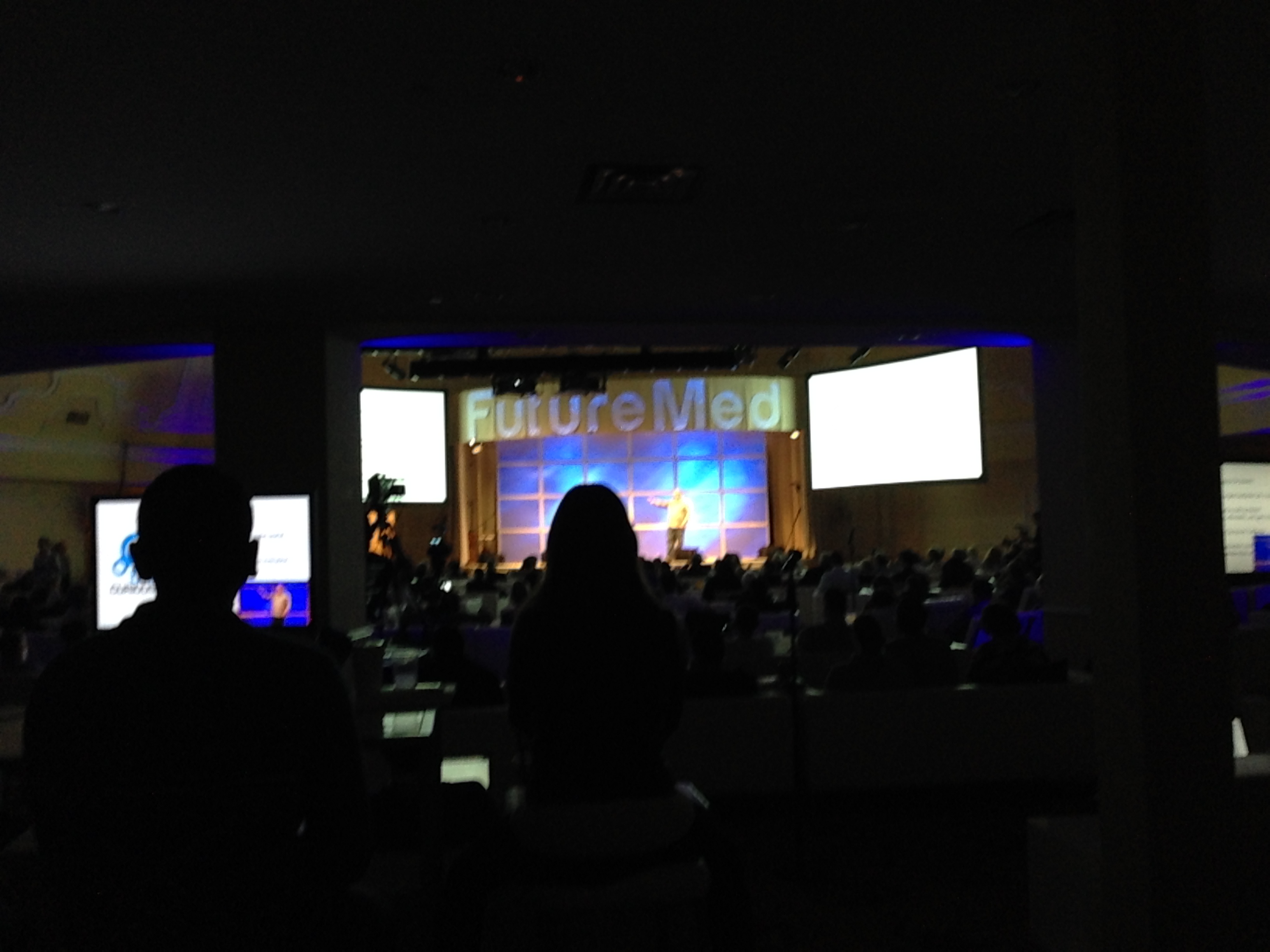
FutureMed Main Hall from the cheap seats
It’s hard to summarize this conference since the topics were so diverse and so much was covered over the three days. Some of the highlights for us were of course Eric Topol talking about the creative destruction of medicine, and demonstrating an iPhone ottoscope on conference chair Daniel Kraft, and the focus on building tools that are engaging and highly usable for providers and patients alike. Topol’s session was a tweet a minute, saying things like “DNA is the ultimate in preventative medicine” and “average is over” to decry the end of population health.
One-size fits all population health was seen as being replaced by personalized health. Treatments and instructions that are specific to a patient; drugs designed for your own genome. Big data is key for truly personalized medicine as well as the ability to find individuals that are similar to your patient. Natural language search for EMRs was seen as a way to unlock the data that’s in them. (For example, ask the EMR to find you a patient that’s like the one you are seeing right now to compare treatments and outcomes.)
One point of contention we heard at the conference was whether the doctor of the future needed to be a data scientist. According to Marty Kohn of IBM’s Watson project 1 Trillion connected devices generate 2.5 quintillion bytes/day and 90% of the world’s data was generated in the last two years but 80% of it is unstructured! Proponents of doctor as data scientists took these facts to their logical conclusion that everyone would need to understand big data yet opponents pointed to computers (like Watson for example) far superior ability to parse this data as an indication that the role for doctors was in providing empathy and care, not in number crunching. A few sessions talked about the need to screen medical school candidates not just on intellectual horsepower but on empathy.

This theme also came up in the Future of Health IT session led by Kaiser’s Mattison. We felt very fortunate to join this workshop of 30 people talking casually about the problems and opportunities in health IT. Kaiser has been doing “big data” since before they implemented electronic records keeping so when they say things like “you are 26% less likely to die in a Kaiser institution than another one” you believe they can prove this. Mattison’s solution for how to manage the increasing amounts of data is to move to an agnostic data model and then do intelligent queries rather than starting with a structured model. One reason for this is that 50% of the data that is being created now is images and machines are much better at evaluating images than machines are.
What was inspiring about FutureMed was that the solutions ranged from exponential changes in genomics and neurology to common sense solutions, like those presented by Dean Ornish who has proven through long term studies that the simplest interventions around diet and exercise can have a profound impact, or Esther Dyson’s HICCup project to apply these types of interventions to an entire community to improve their health. There were dreamers and pragmatists but everyone at the conference was united in one goal: improve our health and quality of life.
Who to follow:
@EricTopol
@daniel_kraft
@MSKohn
@kpshare
@futuremedtech
@DeanOrnishMD
@edyson