By using this site, you agree to the Privacy Policy and Terms of Use.
Accept
Health Works CollectiveHealth Works CollectiveHealth Works Collective
  • Health
    • Mental Health
  • Policy and Law
    • Global Healthcare
    • Medical Ethics
  • Medical Innovations
  • News
  • Wellness
  • Tech
Search
© 2023 HealthWorks Collective. All Rights Reserved.
Reading: Growth versus Volume in Medtech
Share
Notification Show More
Font ResizerAa
Health Works CollectiveHealth Works Collective
Font ResizerAa
Search
Follow US
  • About
  • Contact
  • Privacy
© 2023 HealthWorks Collective. All Rights Reserved.
Health Works Collective > Business > Growth versus Volume in Medtech
BusinessTechnology

Growth versus Volume in Medtech

PatrickDriscoll
PatrickDriscoll
Share
3 Min Read
SHARE

One of the more interesting aspects of well-established markets that have significant volume in medical technology product sales is that the revenue and the caseload are sufficient to drive fairly a continuous range of technologies that will meet patient demand. As a result, there tends to be a continuum between high-volume, low-growth and low-volume high-growth. This significance should be apparent to active or potential market participants.

One of the more interesting aspects of well-established markets that have significant volume in medical technology product sales is that the revenue and the caseload are sufficient to drive fairly a continuous range of technologies that will meet patient demand. As a result, there tends to be a continuum between high-volume, low-growth and low-volume high-growth. This significance should be apparent to active or potential market participants.

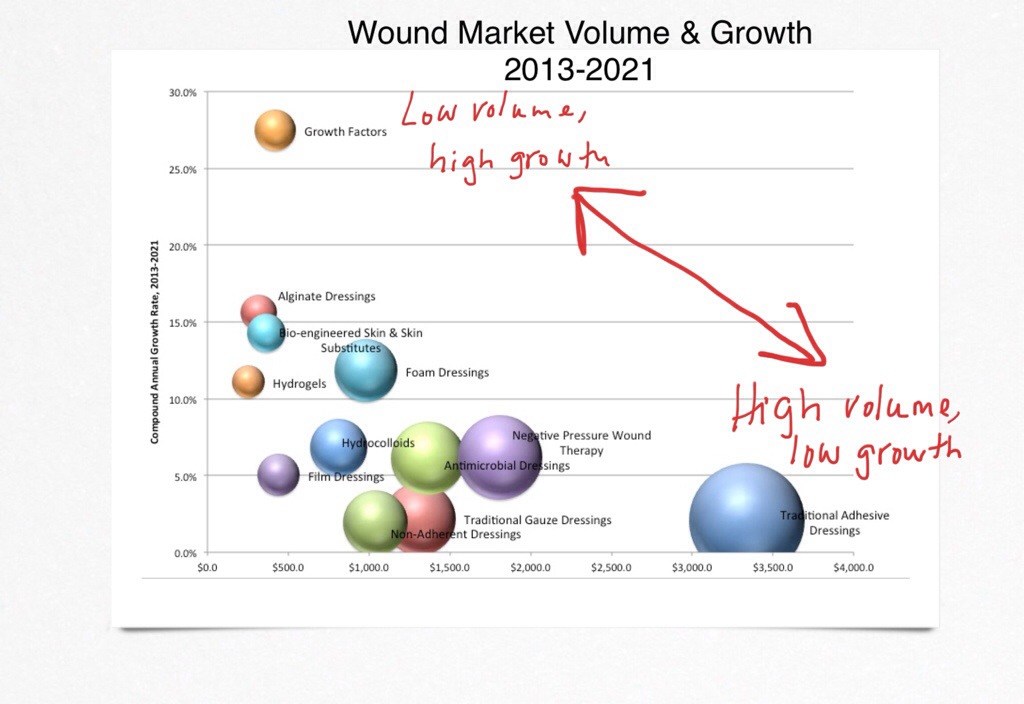
This continuum can be represented in two noteworthy ways, each of which illustrates the inverse relationship between the size of a market segment and its growth. For example, one of the most well established medtech markets is traditional bandages and dressings in wound management. These are simple to manufacturer, applicable to a wide range of wound types, require little clinician knowledge to use and, therefore, widely used throughout the world. They represent very large volume, in the $billions worldwide. At the other end of this spectrum are emerging technologies such as the use of growth factors in wound management. They have a large, as yet untapped potential, so their anticipated growth is high, while their current volume still remains very low, at least by comparison to traditional wound dressings.

Here is how these two technologies appear at the ends of the spectrum in wound management, between which are large numbers of different wound management technologies.
wound market volume
Source: MedMarket Diligence, LLC; Report #S249.

More Read

rash caused by drug
Medical Complications Torture Doctors, Too
Medical Image Archiving in the Cloud? Consider the 4 S’s
$3 Trillion in Lost Benefits Suffered by Caregivers
HIMSS 13: HHS Final Ruling Changes the Rules & Roles for HIPAA Hosting
Multibriefs: Exclusives for Healthcare Administration Associations

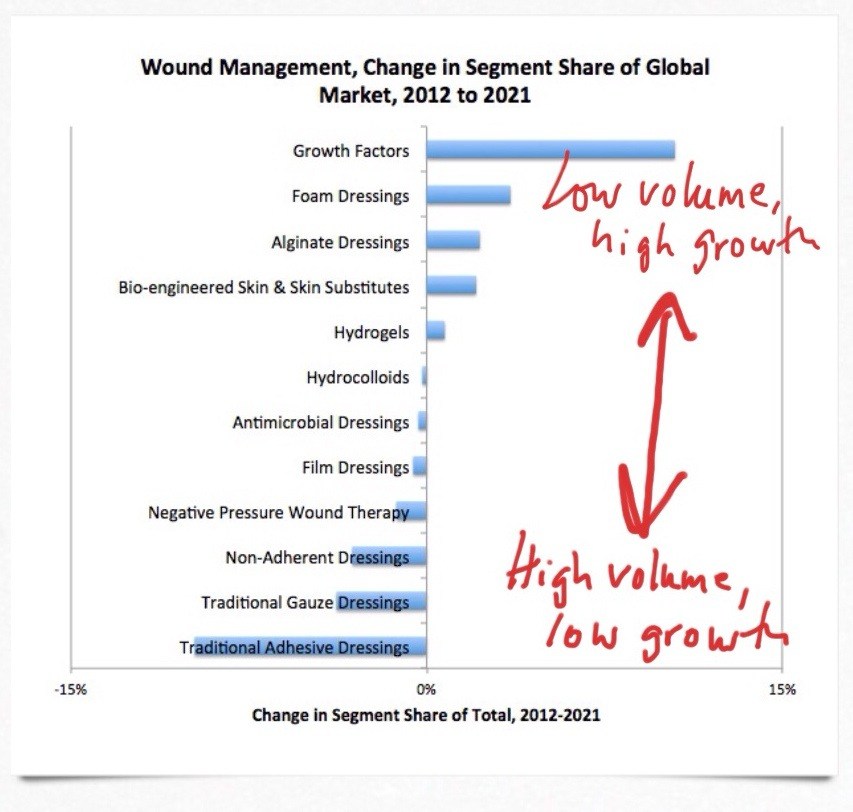
The second way this can be represented is the relative share of the market represented by each as they change over time given their differing sales growth rates. Below is an illustration of the net change in share of the total market for wound management products by each product type. Again, there is a noticeable continuum.
wound management

Source: MedMarket Diligence, LLC; Report #S249.

TAGGED:medtechwound market
Share This Article
Facebook Copy Link Print
Share
By PatrickDriscoll
Follow:
I serve the interests of medical technology company decision-makers, venture-capitalists, and others with interests in medtech producing worldwide analyses of medical technology markets for my audience of mostly medical technology companies (but also rapidly growing audience of biotech, VC, and other healthcare decision-makers). I have a small staff and go to my industry insiders (or find new ones as needed) to produce detailed, reality-grounded analyses of current and potential markets and opportunities. I am principally interested in those core clinical applications served by medical devices, which are expanding to include biomaterials, drug-device hybrids and other non-device technologies either competing head-on with devices or being integrated with devices in product development. The effort and pain of making every analysis global in scope is rewarded by my audience's loyalty, since in the vast majority of cases they too have global scope in their businesses.Specialties: Business analysis through syndicated reports, and select custom engagements, on medical technology applications and markets in general/abdominal/thoracic surgery, interventional cardiology, cardiothoracic surgery, patient monitoring/management, wound management, cell therapy, tissue engineering, gene therapy, nanotechnology, and others.

Stay Connected

1.5KFollowersLike
4.5KFollowersFollow
2.8KFollowersPin
136KSubscribersSubscribe

Latest News

The Clinical and Interpersonal Skills That Define Excellence in Patient-Centered Care
Health
June 2, 2026
The Advanced Nursing Credentials That Open Doors to Leadership Roles
Nursing
June 2, 2026
The Advanced Practice Nursing Roles Worth Knowing About Before You Specialize
Nursing
June 2, 2026
Language Access in Healthcare: What Hospitals Still Get Wrong in 2026
Hospital Administration Technology
May 29, 2026

You Might also Like

Lessons Learned: The Hard Way

November 9, 2011

Interim CMS Director Steps Down, Problems Remain

November 29, 2011
eHealthMobile HealthTechnology

The Role Of The Internet Of Medical Things In Healthcare

February 5, 2019

Bacteria and Mobile Devices

June 26, 2011
Subscribe
Subscribe to our newsletter to get our newest articles instantly!
Follow US
© 2008-2025 HealthWorks Collective. All Rights Reserved.
  • About
  • Contact
  • Privacy
Welcome Back!

Sign in to your account

Username or Email Address
Password

Lost your password?