
Healthcare compensation in the United States reflects a balance of clinical responsibility, procedural complexity, and years of post-secondary training. While specialized surgical and medical subspecialties command the highest baseline earnings, advanced practice nursing and healthcare executive roles now offer some of the strongest income-to-training efficiency profiles across the modern medical system.
- Tier 1: Specialized Physicians and Surgeons (M.D. / D.O. Pathways)
- 1. Pediatric Surgeons ($559,030 Median Annual Wage)
- 2. Cardiologists ($496,010 Median Annual Wage)
- 3. Radiologists ($420,860 Median Annual Wage)
- 4. Anesthesiologists ($391,490 Median Annual Wage)
- 5. Orthopedic Surgeons ($358,550 Median Annual Wage)
- 6. Emergency Medicine Physicians ($335,550 Median Annual Wage)
- 7. Dermatologists ($328,730 Median Annual Wage)
- 8. Psychiatrists ($281,870 Median Annual Wage)
- Tier 2: High-Paying Nursing and Advanced Clinical Roles (Top ROI Pathways)
- 9. Certified Registered Nurse Anesthetists (CRNA) ($236,590 Median Annual Wage)
- 10. Cardiovascular Perfusionists ($138,400 Median Annual Wage)
- 11. Physician Assistants (PA) ($135,880 Median Annual Wage)
- 12. Nurse Practitioners (NP) ($132,300 Median Annual Wage)
- 13. Radiation Therapists ($101,090 Median Annual Wage)
- Tier 3: Dental and Oral Health Specialists
- 14. Oral and Maxillofacial Surgeons ($352,220 Median Annual Wage)
- 15. Orthodontists and Prosthodontists ($237,420 – $311,180 Median Annual Wage)
- 16. General Dentists ($170,950 Median Annual Wage)
- Tier 4: Pharmacy, Allied Health and Healthcare Executive Leadership
- 17. Medical and Health Services Managers ($110,680 – $216,750+ Top Decile Wage)
- 18. Clinical Pharmacists and Pharmacy Directors ($140,910 Median Annual Wage)
- Comprehensive 18-Career Compensation and Training Benchmark Table
- Educational ROI: Balancing Training Length Against Lifetime Earning Trajectories
- Frequently Asked Questions About High-Paying Healthcare Careers
Executive Summary: Key Compensation Takeaways
The highest-paying healthcare jobs in 2026 are led by surgical subspecialties such as Pediatric Surgeons ($559,030 median) and Cardiologists ($496,010 median), followed by dental surgeons and high-ROI advanced practice roles like Certified Registered Nurse Anesthetists ($236,590 median).
- Highest Earning Medical Roles: Pediatric Surgeons ($559,030 median) and Cardiologists ($496,010 median) lead all domestic professions, requiring 13 to 15 years of post-secondary study and clinical fellowship.
- Top Earning Non-Physician Role: Certified Registered Nurse Anesthetists (CRNAs) earn a median annual wage of $236,590, representing the highest return on educational investment in healthcare.
- Fastest Employment Growth: Nurse Practitioners (+38%) and Physician Assistants (+28%) show the fastest projected 10-year job growth across the Bureau of Labor Statistics (BLS) Occupational Outlook Handbook.
- Non-Clinical Leadership: Medical and Health Services Managers at the executive level command top-decile compensation exceeding $216,750 without patient-care malpractice liability.
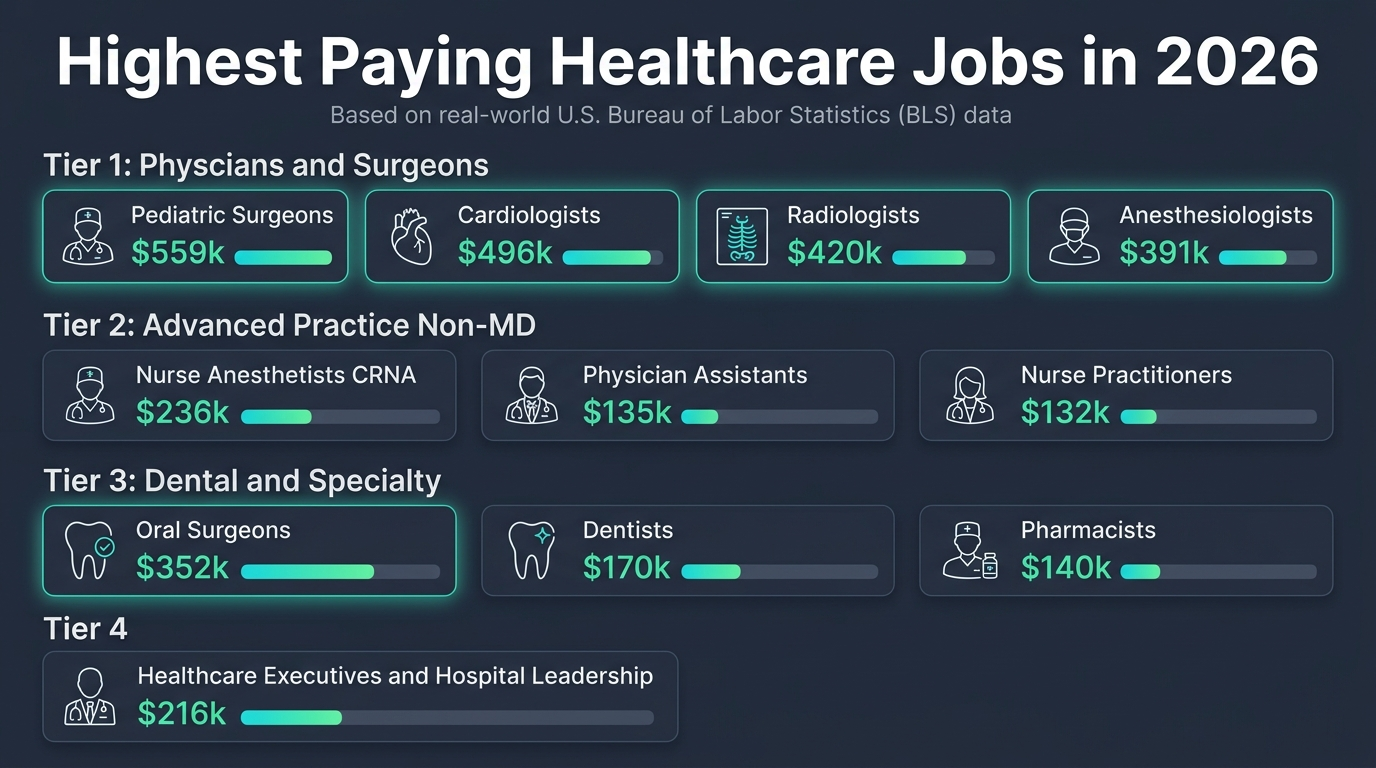
Tier 1: Specialized Physicians and Surgeons (M.D. / D.O. Pathways)
Physicians and surgeons occupy the highest wage brackets tracked by the federal government. Becoming a board-certified physician requires completing a four-year undergraduate degree, four years of accredited medical school, and three to seven years of residency and subspecialty fellowship training. Reviewing medical school admissions requirements underscores the academic and interpersonal criteria needed before navigating early career clinical milestones like resident physician compensation.
1. Pediatric Surgeons ($559,030 Median Annual Wage)
Pediatric surgeons treat surgical conditions in infants, children, and adolescents, ranging from congenital abnormalities to acute trauma. Because neonatal and pediatric physiology requires precise operative intervention, pediatric surgery ranks as one of the most competitive surgical fellowships in North America, requiring a five-year general surgery residency followed by two years of dedicated pediatric surgical fellowship.
2. Cardiologists ($496,010 Median Annual Wage)
Cardiologists diagnose and manage cardiovascular disorders, including coronary artery disease, heart failure, and congenital defects. Invasive and interventional cardiologists, who perform catheter-based interventions such as angioplasty and stenting, earn compensation substantially above general non-invasive cardiologists. Training demands three years of internal medicine residency followed by three to four years in cardiovascular disease fellowships.
3. Radiologists ($420,860 Median Annual Wage)
Diagnostic and interventional radiologists interpret advanced medical imaging including computed tomography (CT), magnetic resonance imaging (MRI), positron emission tomography (PET), and ultrasound. Beyond diagnostic interpretation, interventional radiologists perform minimally invasive image-guided vascular procedures. Education involves four years of diagnostic radiology residency and often a one-year subspecialty fellowship.
4. Anesthesiologists ($391,490 Median Annual Wage)
Anesthesiologists manage patient life support, hemodynamics, and pain relief before, during, and after surgical operations. They evaluate pre-operative cardiopulmonary risk, maintain intraoperative physiological stability, and oversee post-anesthesia recovery units. Clinical insights into why anesthesia monitoring is a vital part of surgery highlight the continuous vigilance required in operating theater environments.
5. Orthopedic Surgeons ($358,550 Median Annual Wage)
Orthopedic surgeons perform operative interventions on the musculoskeletal system, including total joint arthroplasty (hip and knee replacements), spinal reconstruction, and sports medicine procedures. Compensation reaches the upper decile for surgeons subspecializing in spine surgery and joint reconstruction.
6. Emergency Medicine Physicians ($335,550 Median Annual Wage)
Emergency physicians provide acute resuscitation and unscheduled emergency medical care for traumatic injuries, cardiac arrests, acute strokes, and undifferentiated life-threatening illnesses in hospital emergency departments. Training requires a rigorous three to four-year emergency medicine residency.

7. Dermatologists ($328,730 Median Annual Wage)
Dermatologists diagnose and treat skin disorders, cutaneous malignancies, and complex systemic dermatological diseases, frequently performing Mohs micrographic surgery for skin cancer. With high demand and favorable procedural reimbursement, dermatology remains one of the most competitive residency matches.
8. Psychiatrists ($281,870 Median Annual Wage)
Psychiatrists specialize in mental health, substance use disorders, and neurobehavioral conditions, combining psychopharmacological management with psychotherapy and neuromodulation therapies such as Transcranial Magnetic Stimulation (TMS). The nationwide shortage of mental health providers sustains strong salary trajectories across hospital and private practice settings.
Tier 2: High-Paying Nursing and Advanced Clinical Roles (Top ROI Pathways)
Not every lucrative healthcare career demands ten to fifteen years of medical school and surgical residency. Advanced practice registered nurses (APRNs) and mid-level clinicians achieve exceptional compensation profiles with significantly lower student debt burdens and shorter educational pipelines.
9. Certified Registered Nurse Anesthetists (CRNA) ($236,590 Median Annual Wage)
Certified Registered Nurse Anesthetists represent the highest-earning nursing discipline in healthcare. Working in hospital operating rooms, outpatient surgery centers, and military medical facilities, CRNAs safely administer anesthesia in collaboration with surgical and dental teams or as autonomous practitioners in rural facilities. Becoming a CRNA requires a Bachelor of Science in Nursing (BSN), at least one year of critical care ICU nursing experience, and completion of an accredited doctoral program in nurse anesthesia (DNAP or DNP), taking approximately seven to eight total years.
“Certified Registered Nurse Anesthetists (CRNAs) are advanced practice registered nurses who administer anesthesia to patients for surgery or other medical procedures.”
Sarah Jividen, RN, BSN in Nurse.org10. Cardiovascular Perfusionists ($138,400 Median Annual Wage)
Cardiovascular perfusionists operate heart-lung bypass machines during open-heart surgeries, such as coronary artery bypass grafting, aortic valve replacements, and organ transplants. They maintain artificial circulation, oxygenation, and systemic hypothermia while surgeons operate on the quiescent heart. The role requires a post-baccalaureate certificate or master’s degree in perfusion technology (5 to 6 years total study).
11. Physician Assistants (PA) ($135,880 Median Annual Wage)
Physician Assistants examine patients, diagnose illnesses, formulate treatment plans, prescribe medications, and assist in surgical operations across every medical specialty. Master’s-level PA programs typically span 27 months following an undergraduate degree with prerequisite healthcare clinical hours. With a projected 28% growth rate over the decade, PAs represent one of the nation’s fastest-growing healthcare careers.
12. Nurse Practitioners (NP) ($132,300 Median Annual Wage)
Nurse Practitioners deliver primary, acute, and specialty healthcare services. In over half of U.S. states, NPs hold full practice authority to evaluate patients, diagnose conditions, order diagnostic tests, and initiate medications autonomously without physician supervision. Driven by provider shortages, the BLS projects 38% growth for nurse practitioners through 2034.
13. Radiation Therapists ($101,090 Median Annual Wage)
Radiation therapists administer targeted radiation treatments to oncology patients using linear accelerators under the prescription of radiation oncologists. With an associate or bachelor’s degree in radiation therapy (2 to 4 years), graduates enter six-figure clinical positions delivering oncology care.
Tier 3: Dental and Oral Health Specialists
Dental professions operate outside the standard medical physician hierarchy, offering private practice autonomy and procedural earning potential comparable to surgical subspecialties.
14. Oral and Maxillofacial Surgeons ($352,220 Median Annual Wage)
Oral and maxillofacial surgeons perform complex surgical reconstructions of the face, jaws, mouth, and neck. Their scope spans wisdom tooth extractions and dental implants to corrective jaw surgery, facial trauma reconstruction, and cleft palate repairs. Training requires completing dental school (DMD/DDS) followed by a four- to six-year surgical residency, with six-year dual-degree programs awarding an M.D. alongside surgical certification.
15. Orthodontists and Prosthodontists ($237,420 – $311,180 Median Annual Wage)
Orthodontists correct dentofacial irregularities, malocclusions, and jaw misalignments using clear aligners and fixed appliances. Prosthodontists specialize in oral prostheses, restoring complex dentition and cosmetic maxillofacial structures. Both dental specialties require three years of specialized residency following dental school.
16. General Dentists ($170,950 Median Annual Wage)
General dentists diagnose and treat diseases of the teeth, gums, and oral cavity, performing restorations, endodontic therapy, crown preparations, and periodontal screenings. Practice owners routinely exceed median compensation benchmarks through practice equity.
Tier 4: Pharmacy, Allied Health and Healthcare Executive Leadership
Administrative leadership, pharmacy directors, and allied health directors govern health delivery operations, drug supply chains, and clinical compliance protocols.
17. Medical and Health Services Managers ($110,680 – $216,750+ Top Decile Wage)
Medical and health services managers plan, direct, and coordinate business activities for healthcare providers, hospital networks, and medical group practices. While median pay begins around $110,680, executive hospital leaders, vice presidents of clinical operations, and health system CEOs earn top-tier salaries exceeding $216,750, plus executive performance bonuses. Candidates with a Master of Health Administration (MHA) or healthcare-focused MBA enjoy strong mobility across healthcare administration careers.
18. Clinical Pharmacists and Pharmacy Directors ($140,910 Median Annual Wage)
Clinical pharmacists dispense medications, monitor drug interactions, calculate pharmacokinetic dosages, and consult on clinical medical rounds in hospital intensive care units. In ambulatory care clinics, clinical pharmacists manage chronic medication therapies under collaborative practice agreements. Becoming a licensed pharmacist requires a four-year Doctor of Pharmacy (Pharm.D.) degree followed by post-graduate residency training.
Comprehensive 18-Career Compensation and Training Benchmark Table
The table below summarizes official wage data from the U.S. Bureau of Labor Statistics (BLS) Occupational Employment and Wage Statistics (OEWS) survey, comparing median compensation, top-decile earning potential, minimum post-secondary educational requirements, and projected 10-year job outlook.
| Rank | Occupation Title | BLS Median Salary | Top 10% Earning Potential | Minimum Education Level | 10-Yr Job Growth |
|---|---|---|---|---|---|
| 1 | Pediatric Surgeons | $559,030 | >$650,000 | M.D. / D.O. + 7-Yr Residency | +3% (Stable) |
| 2 | Cardiologists | $496,010 | >$600,000 | M.D. / D.O. + 6-7 Yr Fellowship | +3% (Stable) |
| 3 | Radiologists | $420,860 | >$520,000 | M.D. / D.O. + 5-Yr Residency | +4% (Average) |
| 4 | Anesthesiologists | $391,490 | >$480,000 | M.D. / D.O. + 4-Yr Residency | +3% (Stable) |
| 5 | Orthopedic Surgeons | $358,550 | >$500,000 | M.D. / D.O. + 5-Yr Residency | +3% (Stable) |
| 6 | Oral and Maxillofacial Surgeons | $352,220 | >$450,000 | DDS/DMD + 4-6 Yr Residency | +5% (Average) |
| 7 | Emergency Medicine Physicians | $335,550 | >$420,000 | M.D. / D.O. + 3-4 Yr Residency | +3% (Stable) |
| 8 | Dermatologists | $328,730 | >$450,000 | M.D. / D.O. + 4-Yr Residency | +3% (Stable) |
| 9 | Prosthodontists and Orthodontists | $289,140 – $311,180 | >$400,000 | DDS/DMD + 3-Yr Residency | +4% (Average) |
| 10 | Psychiatrists | $281,870 | >$380,000 | M.D. / D.O. + 4-Yr Residency | +7% (Faster) |
| 11 | Nurse Anesthetists (CRNA) | $236,590 | $275,000 | Master’s / DNP (7-8 Yrs) | +9% (Faster) |
| 12 | General Dentists | $170,950 | >$239,200 | DDS / DMD (8 Yrs) | +4% (Average) |
| 13 | Cardiovascular Perfusionists | $138,400 | $180,000 | Post-Baccalaureate (5-6 Yrs) | +6% (Average) |
| 14 | Physician Assistants (PA) | $135,880 | $175,000 | Master’s Degree (6-7 Yrs) | +28% (Much Faster) |
| 15 | Nurse Practitioners (NP) | $132,300 | $168,000 | Master’s / DNP (6-8 Yrs) | +38% (Much Faster) |
| 16 | Clinical Pharmacists | $140,910 | $172,000 | Doctor of Pharmacy (7-8 Yrs) | +3% (Stable) |
| 17 | Medical and Health Services Managers | $110,680 | >$216,750 | Bachelor’s / MHA / MBA (4-6 Yrs) | +28% (Much Faster) |
| 18 | Radiation Therapists | $101,090 | $140,000 | Associate / Bachelor’s (2-4 Yrs) | +4% (Average) |
Educational ROI: Balancing Training Length Against Lifetime Earning Trajectories
When evaluating healthcare career paths, prospective students must weigh cumulative training costs, lost opportunity income, and student debt obligations against anticipated lifetime earnings. While surgical subspecialists like pediatric surgeons and orthopedic surgeons earn over half a million dollars annually, they incur hundreds of thousands in medical school tuition while delaying full attending compensation until their early thirties.
In contrast, high-ROI non-MD clinical careers allow graduates to enter the workforce years earlier. An allied clinician or nurse anesthetist who completes schooling in 6 to 8 years begins accumulating compound investment returns, practice retirement equity, and six-figure earnings almost a decade ahead of surgical fellows. Incorporating in-demand healthcare certifications can further accelerate promotions into specialized supervisory and clinical operations management.
Similarly, evaluating roles like physical therapy requires examining long-term outcomes; clinical research into clinical mobility and physical rehabilitation protocols demonstrates that therapists deliver essential functional recovery despite earning lower baseline wages than procedural specialists.
Frequently Asked Questions About High-Paying Healthcare Careers
What is the highest-paying healthcare job that does not require medical school?
Certified Registered Nurse Anesthetists (CRNAs) are the highest-earning healthcare professionals who do not attend medical school, earning a national median salary of $236,590. CRNAs complete a BSN, critical care nursing experience, and a doctoral nurse anesthesia degree (DNAP or DNP) over approximately seven to eight years.
Which high-earning healthcare jobs are experiencing the fastest job growth?
Nurse Practitioners (38% projected 10-year growth), Physician Assistants (28% projected growth), and Medical and Health Services Managers (28% projected growth) are expanding far faster than the national average for all occupations, driven by population aging and expanded healthcare access.
How much do hospital CEOs and healthcare managers earn?
While the median annual wage for medical and health services managers is $110,680 according to the BLS, top-decile hospital administrators, vice presidents of medical affairs, and health system CEOs earn well over $216,750 annually, with large health system chief executives receiving compensation packages in excess of $1 million.