

.jpg)
 Unlike many other healthcare annual confabs, the 2014 Healthcare Information and Management Systems Society (HIMSS) meeting and exhibition in Orlando, Fla. seems dominated by the North American market. But what about the international thirst for healthcare IT?
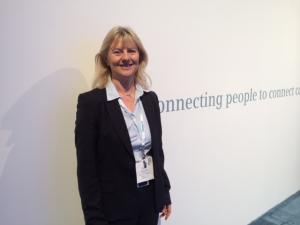
Unlike many other healthcare annual confabs, the 2014 Healthcare Information and Management Systems Society (HIMSS) meeting and exhibition in Orlando, Fla. seems dominated by the North American market. But what about the international thirst for healthcare IT? To find out, I went to the Siemens booth and sought out Senior Vice President Hartmut Schaper and Vice President Ursula Sieberg of International Health Services.
Schaper said the international market is “very diverse,” meaning some countries are very advanced in data connectivity, as in the well-managed state systems of western Europe and Scandinavia. “If you look at the majority of the rest of the world, they have to get basic infrastructure in place: basic access to healthcare, basic connectivity,” he said. “The market is very heterogeneous and it’s driven by the difference in payment, reimbursement and healthcare systems. You have everything from totally state-run, as in Scandinavia, and more complex systems like in Germany. And in my experience, the more complex systems make it harder to be at the forefront of innovation in healthcare IT.”
Sieberg noted that the Scandinavian countries are all “centrally driven, with the same strategic direction” in healthcare. High GDP is also a good indicator of growth potential for healthcare IT. The markets with the highest growth potential are the UK, Germany, Scandinavia and the Benelux countries. “Japan is a big market, but it’s not growing,” said Schaper. “China is growing in healthcare spending but not so much in IT; even by 2020 its IT demand will be smaller than Germany’s.”

Developing countries often are spending so much on building healthcare systems that they do not have the capacity to grow IT. In Latin America, Schaper cited growth markets in Mexico, Columbia, Chile and Brazil — somewhere in the middle range after the Europeans and ahead of China.
I asked Schaper and Sieberg whether their customers understand the benefits of IT or whether they find they must educate them on this score. “Most of them understand this will create new efficiencies,” Schaper said. “Because there is a shortage of skilled nurses and physicians in Europe, they understand that IT can reduce the processing burden on the staff.”
The Aha! moment for providers in North America discovering IT was how it simplified and accelerated billing processes. Not so for the Europeans. “I think this isn’t true in Europe because it’s a different pay system,” said Schaper. “Rather, I would say it’s ease of use, higher standards of care, and the use of mobile devices, like tablets, and the ability to spend more time with patients.” Sieberg added.
Mobile use will grow, and another key trend will be increasing interconnectivity among providers and also for patients seeking access to their medical records, they said. In other words, Sieberg and Schaper are very optimistic about the global growth of healthcare IT.






.jpg &description=HIMSS14%3A+Bullish+on+Growth+in+the+International+Healthcare+IT+Market)