

By using this site, you agree to the Privacy Policy and Terms of Use.
Accept
Health Works CollectiveHealth Works CollectiveHealth Works Collective
  • Health
    • Mental Health
  • Policy and Law
    • Global Healthcare
    • Medical Ethics
  • Medical Innovations
  • News
  • Wellness
  • Tech
Search
© 2023 HealthWorks Collective. All Rights Reserved.
Reading: How to Extend a CAP Checklist for Increased Research Capabilities
Share
Notification Show More
Font ResizerAa
Health Works CollectiveHealth Works Collective
Font ResizerAa
Search
Follow US
  • About
  • Contact
  • Privacy
© 2023 HealthWorks Collective. All Rights Reserved.
Health Works Collective > Business > Hospital Administration > How to Extend a CAP Checklist for Increased Research Capabilities
BusinessHospital AdministrationMedical Records

How to Extend a CAP Checklist for Increased Research Capabilities

Tim_Edlund
Tim_Edlund
Share
3 Min Read
CAP checklist
SHARE

CAP checklistSynoptic reporting offers benefits that reach beyond simple accuracy and compliance with the College of American Pathologists (CAP) checklist.

CAP checklistSynoptic reporting offers benefits that reach beyond simple accuracy and compliance with the College of American Pathologists (CAP) checklist. The synoptic format’s structured data also provides a simple way to analyze individual diagnostic and prognostic elements for a variety of research and administrative purposes. If your software allows, you can extend a CAP checklist in synoptic template to include parameters that aid individual and shared clinical research.

Extending CAP Checklists to Facilitate Research

Pathology is a critical component of collaborative oncology stage data collection, particularly in regards to lung cancer. With software that allows you to extend synoptic reporting templates according to your clinical research needs, you can easily add extra fields that facilitate current and future outcome studies.

More Read

3 Tips To Getting The Best Results From Your Independent Medical Reviewer
Anatomy of a Doctor – Infographic
Long Term Care Commission Report Falls Short
Breakthroughs, Back-slapping and Bioluminescence
Health Care Social Media – How to Engage Online Without Getting into Trouble (Part I)

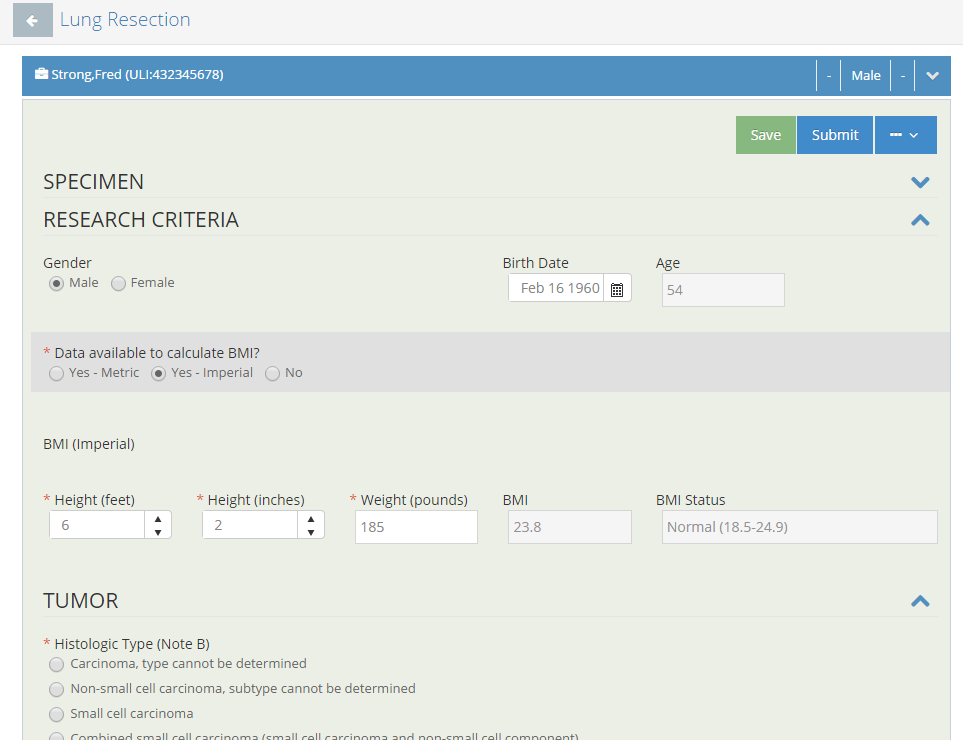
The following screenshot shows how parameters may be added to the CAP checklist for non–small cell carcinoma of the lung to evaluate correlations between tumor size and basic patient characteristics.
cap checklist

The parameters added to the synoptic checklist in the example include:

  • Gender: Radial buttons allow you to indicate if a patient is male or female.
  • Birth date: Date picker allows dates to be accurately selected from a multi-year calendar.
  • Age at diagnosis: Derived from the birth date by a simple formula placed into the extended template
  • Body mass index (BMI): In this instance, the system asks the pathologist if they have sufficient data to calculate a patient’s BMI. If the pathologist selects the “No” radial button, they simply move on to the next question. If they have the information—in either metric or imperial—the values for height and weight become available for entry. 
  • BMI status: The template is extended with a formula for calculating the BMI raw value and status score based on the height and weight entered. The status indicates if the BMI falls into the normal, underweight, overweight or obese ranges, and provides the numerical values for each range.

In this example, the additional research values are organized into a separate heading—”Research Criteria”—to distinguish them from the content of the base CAP template. 

Synoptic reporting and the CAP checklist support not only excellent reporting quality, but also outcome research to improve clinical decision making. In a future post, we will discuss how you can further analyze synoptic report data.


TAGGED:synoptic reporting
Share This Article
Facebook Copy Link Print
Share

Stay Connected

1.5KFollowersLike
4.5KFollowersFollow
2.8KFollowersPin
136KSubscribersSubscribe

Latest News

The Riskiest Part of Getting Sick Isn't the Diagnosis. It's the Handoff
The Riskiest Part of Getting Sick Isn’t the Diagnosis. It’s the Handoff
Health
July 20, 2026
Patient Acquisition and digital-marketing
The Future of Patient Acquisition: Modern SEO & Digital Marketing for Dermatology Practices
Health Marketing Medical Innovations Technology
July 20, 2026
a person putting a bandage on a woman s head
The Long-Term Health Consequences of Untreated Personal Injuries
Health care
July 17, 2026
medicare mistakes seniors usually make
The Hidden Healthcare Costs Seniors Should Plan For
Global Healthcare Senior Care
July 15, 2026

You Might also Like

Business

Tips to Buy Various Types of Hospital Medication Units

July 11, 2017
onlinebrand-1.jpg
BusinesseHealthSocial Media

7 Simple Ways to Strengthen Your Hospital’s Online Brand

April 27, 2016
AMN Healthcare’s 2013 Survey of Social Media and Mobile Usage by Healthcare Professionals: Job Search and Career Trends, is a follow-up to two prior surveys in 2010 and 2011. It provides hospitals and other healthcare organizations, along with leaders in the field, with an inside look at clinicians’ job search methods, career development activities and social media practices, as well as how their behaviors have changed over time.
BusinesseHealthHospital AdministrationSocial Media

HCP Use of Social Media for Recruitment [INFOGRAPHIC]

April 5, 2014

Medical Advancement: 6 Things to Know About Your Body

March 21, 2016
Subscribe
Subscribe to our newsletter to get our newest articles instantly!
Follow US
© 2008-2026 HealthWorks Collective. All Rights Reserved.
  • About
  • Contact
  • Privacy
Welcome Back!

Sign in to your account

Username or Email Address
Password

Lost your password?