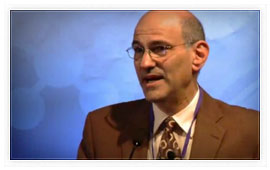
 This month I was honored to be the master of ceremonies at the Personalized Medicine World Conference in Silicon Valley, California. for the second time. About 850 scientists, venture capitalists and physicians attended and most all of them, have many more letters after their name for advanced degrees than I have!
This month I was honored to be the master of ceremonies at the Personalized Medicine World Conference in Silicon Valley, California. for the second time. About 850 scientists, venture capitalists and physicians attended and most all of them, have many more letters after their name for advanced degrees than I have! These smart folks have been building the technology and processes to enable all of us to receive preventive medicine and treatments that, when needed, are an exact match for our individual biology. Yes, we humans are largely the same, genetically speaking, but those subtle differences can make all the difference for our health risks, and for what type of disease we have when we develop one.
Increasingly, as I heard at the conference, companies are developing very targeted drug therapies that are designed to be used on people who were positive on companion new, very specific tests. In other words, the FDA is now being asked to approve tests and medicines as a package. It makes sense: know if the medicine is right for a specific patient and then prescribe it. If it is not right, avoid the expense and the risk of serious side effects.
I had a message for these mostly techy folks: Partner with us patients right now – even if widespread genetic screening or analysis of a patient’s illness is not ready for prime time. We want to know what’s coming and we want to advocate for its use for us when it becomes available. Start supporting education about personalized medicine right now.
The technology folks are zooming in their progress. One speaker said they now can sequence a patient’s entire genome in a day. Next year it will probably be much faster and much cheaper. But there’s an obstacle: current clinical practice. You doctor – in most cases – has had little or no training in applying genetic information to risk reduction or treatment. Will they adapt and if so, how fast? As for us patients, it is in our best interes to know our specific health risks and to demand current or experimental therapies that have the best chance for matching up with a genetic signature of a disease when one shows up on a test. We can drive personalized medicine at our local clinic.
Right now genetic sequencing is starting at university cancer clinics. That’s the basis for melanoma patients with BRAF getting a new drug for that mutation; or lung cancer patients getting a new drug for the ALK mutation. This is just the beginning.
As a patient, I am cheering on the folks I met at the conference. Develop the computing power and genetic analysis, ever faster and cheaper. Make it irresistible for clinics. Educate doctors and patients as to what’s significant. And push forward with the approval of new tests and companion drugs that can match up with specific patient types for a realization of true targeted, precision medicine.
So the news I bring you is that all this is possible if we can move the creaky battleship of healthcare delivery into the 21st century and if we, as consumers, demand, in genetic terms, the use of approaches that are right for us as individuals.
Wishing you and your family the best of health!
Andrew
Follow Patient Power’s ongoing coverage of Personalized Medicine