Editor’s note: Jennie Bragg is one of our guest contributors and will be contributing regular exclusive posts for the series Person-Centered HealthCare. Jennie is a former CNN producer, currently pursuing her Masters in Public Health at the University of Southern California.)
Editor’s note: Jennie Bragg is one of our guest contributors and will be contributing regular exclusive posts for the series Person-Centered HealthCare. Jennie is a former CNN producer, currently pursuing her Masters in Public Health at the University of Southern California.)
Remember when kids walked or rode their bikes everywhere- to school, to a friend’s house, to dance class or football practice? In 1968, 48 percent of school-aged children walked or rode their bike to school. By 2009, the number of kids commuting to school by bike or on foot had declined to 13 percent.
“The childhood obesity epidemic occurred in the last 30 or so years. In the same time frame, there was a decline in kids walking or biking to school,” says Dr. Jason Mendoza, associate professor of pediatrics at the University of Washington School of Medicine. “That leads us to believe that, perhaps, the decline in walking and biking to school may be contributing to the rising rates of obesity.”
According to the CDC, the number of overweight children in the U.S. has increased by 68 percent in the past 30 years. Mendoza notes that the rising rates of obesity in the United States can be attributed to a variety of different factors, but he and his former colleagues at Baylor University in Houston, Texas set out to measure what, if any, impact walking to school has on elementary school children.
The researchers recruited 4th graders from 8, low-income Houston schools to participate in a walking school bus 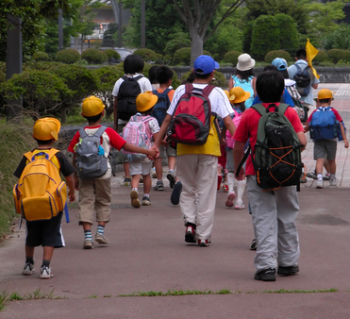 program. On a walking school bus, students walk to and from school chaperoned by parents or other volunteers who can ensure the safety of the kids.
Kids who live within a mile of their elementary school are picked up along a specified route by the adult “driver” and the walking bus is followed by a “conductor.” Similar to a standard school bus, it has bus stops and regular pick up times.
“It is kind of like a carpool, only you leave your car at home and you pick up children at their home or at a designated stop along the route,” says Mendoza. “If you have enough parents or other adults involved, you may only have to walk the kids once a week.”
Mendoza and his team were able to show that rates of active commuting, such as walking or biking to school, increased by 30 percent in the schools that implemented the walking school bus program. Not only was there an increase in active commuting, but there was also increase in the children’s daily minutes of moderate to vigorous physical activity. In control schools, active commuting decreased by 8 percent throughout the school year.
A portion of the funding for this research came from the National Cancer Institute. “They are very interested in and committed to preventing and reducing obesity in the population at large because it is a risk factor for multiple different types of cancers,” says Mendoza.
Kids are not the only ones who have quit moving and put themselves at risk. Adult Americans have grown increasingly sedentary over the past few decades, mostly due to improvements in our transportation and communication systems. And as our physical activity declines, so does our health. The CDC reports that nearly 80 percent of Americans do not get the recommended amount of exercise each week.
A study in The Lancet last year found that one in ten deaths worldwide are due to physical inactivity. Researchers concluded that a failure to spend just 150 minutes on physical activity each week led to about 6 percent of coronary heart disease cases, 7 percent of Type 2 diabetes cases, and 10 percent of breast and colon cancers.
Getting up and moving each day can also aid in the prevention of diseases like osteoporosis, Alzheimer’s and Parkinson’s.
According to Mendoza, keeping our kids healthy and active is the best tactic for creating a nation of healthy, active adults. “By tackling this issue in childhood, the strategy is to prevent kids from becoming obese,” says Mendoza. “Obese children and adolescents become obese adults and once obesity is established it can be very difficult to address. If you can prevent it, it is much more cost effective and doesn’t take quite as much intensive intervention to address it.”
If you like this post, please read other posts in the series on the Person-Centered HealthCare main page. And if you have a story to tell that may be a fit with our series, please comment below or email me at joan@socialmediatoday.com
Sources:
http://saferoutesinfo.org/sites/default/files/resources/NHTS_school_travel_report_2011_0.pdf
http://pediatrics.aappublications.org/content/128/3/e537.full.pdf
http://www.thelancet.com/journals/lancet/article/PIIS0140-6736%2812%2961031-9/abstract
image: schoolkids/shutterstock