For the second year in a row, M and I were lucky enough to attend the Living Well with MPNs event held in Chicago. This event was hosted by Northwestern University, Robert H. Lurie Comprehensive Cancer Center, presented by Patient Power. Just like last year, the event started with registration, a little networking with other patients, then into the meeting at 10 am.
For the second year in a row, M and I were lucky enough to attend the Living Well with MPNs event held in Chicago. This event was hosted by Northwestern University, Robert H. Lurie Comprehensive Cancer Center, presented by Patient Power. Just like last year, the event started with registration, a little networking with other patients, then into the meeting at 10 am.
As the name of the event suggests, the focus is on encouraging us to live our lives as well as we are able. In order for anyone to do this, they need to be willing to seek out the things that will help them to live their best life. Most importantly, one needs to be informed and not afraid to ask questions.
I know it can be scary to ask questions at times. Appearing uninformed has always been a fear of mine. But that’s the beauty of this event. We are all in the same boat. We are all either patients or caregivers. We have all felt overwhelmed by the sheer number of questions that we had when we were diagnosed. The knowledge that we are in a room full of our peers makes it much easier to open up about the things that scare us or the things we don’t quite understand.
There were lots of very good questions asked, and our presenters gave concise, easy-to-understand answers. The doctors explained that cognitive symptoms are a lot more common in MPNs than previously thought. As more and more patients have been reporting mood disturbances, it has been more strongly connected to the MPNs themselves. Rather than sending patients from doctor to doctor (leaving us to feel rather like ping pong balls…) doctors are acknowledging that the mood disorders may be more directly connected to MPNs and are more openly collaborating for treatment with other physicians.
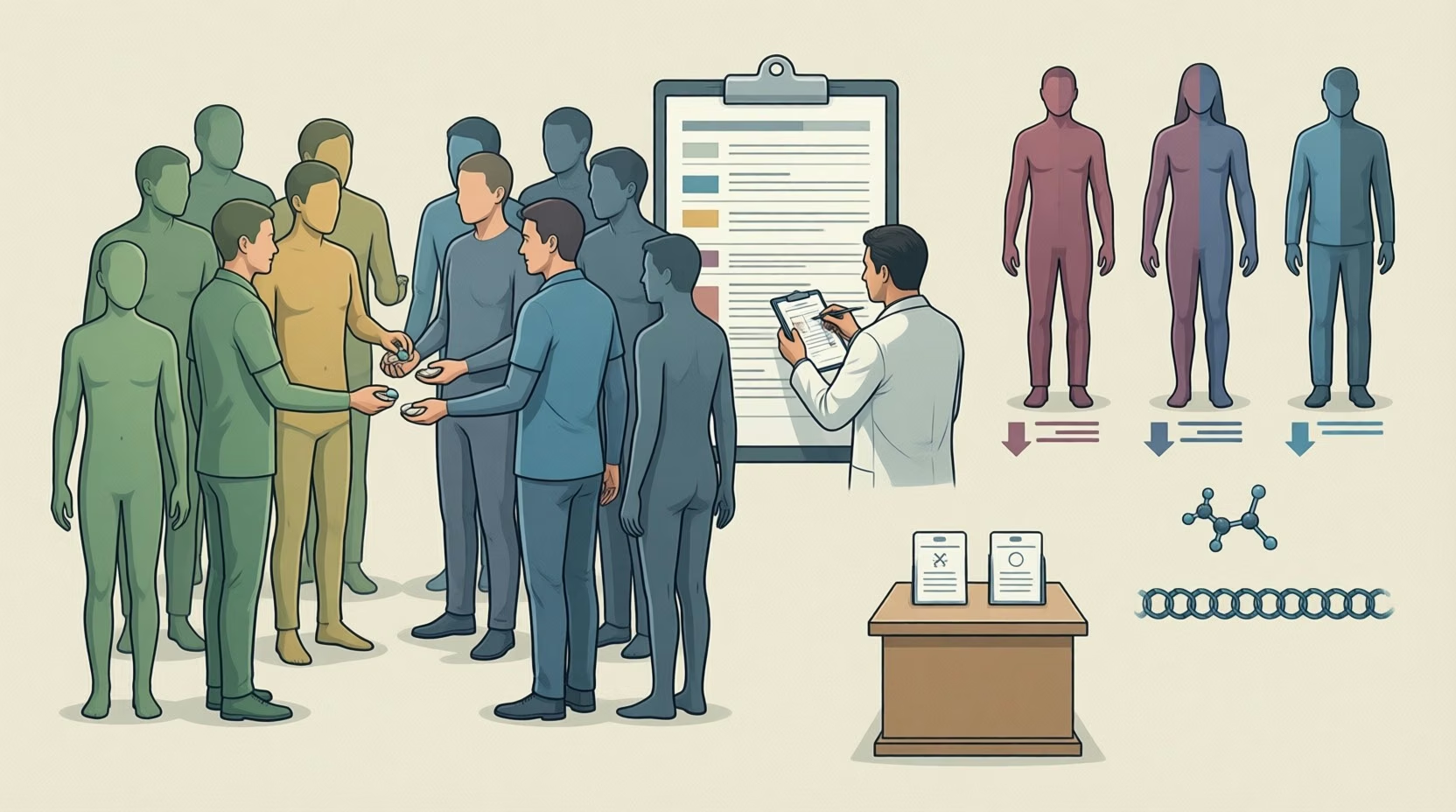
We also discussed the genetic factors of our diseases. There often seems to be a little confusion between something being genetic and something being hereditary. Our diseases are genetic, meaning they are caused a genetic mutation (JAK, CALR, etc.). That does not necessarily mean our diseases are hereditary, meaning passed from generation to generation.
The answer that seemed to stand out most to me had to be to this question: How should you decide on a course of treatment for an MPN? The consensus among the doctors presenting is that the history of the patient, and the way they are feeling, are more important when determining treatment plans than lab values alone. For instance, an ET patient with platelets in the upper 900Ks, but who has no history of blood clots, headaches or other thrombotic events, and feels well, does NOT necessarily need prescription treatment. While an ET patient with platelets in the 500-600K range, with history of blood clots, and constant disruptive symptoms, may require prescription intervention.
There are new advances, more research and better information available every day. This is why it is in our best interest to be as well informed as possible. Without knowledge, how can we expect to live well with MPNs? It is our responsibility to be proactive and assertive when it comes to our health. If you are not comfortable with the direction that your treatment is going, then speak up. If you do not feel that your doctor is receptive to your thoughts on treatment, then seek another doctor. We deserve to feel that we are heard, and that we are respected. The doctor/patient relationship needs to be a relationship of mutual respect—it needs to be a partnership.
I would like to take this opportunity to thank Patient Power again for presenting this event and for all of the information and videos available on their site. I also invite you to visit my blog, linampn.com for more thoughts and ramblings from a fellow patient.
As always, you are your own best advocate. If you do not stand up for yourself, who will?
Until next time,
Lina