
More and more of the people who sit in my consultation chair bring the same question before we get to anything medical: will my employer’s plan cover this? I’m a nurse injector, and I can’t read anyone’s benefits documents. What I can do is explain what a supervised weight-loss program involves, so the employee asking the question and the person at work deciding whether to offer it are describing the same thing.
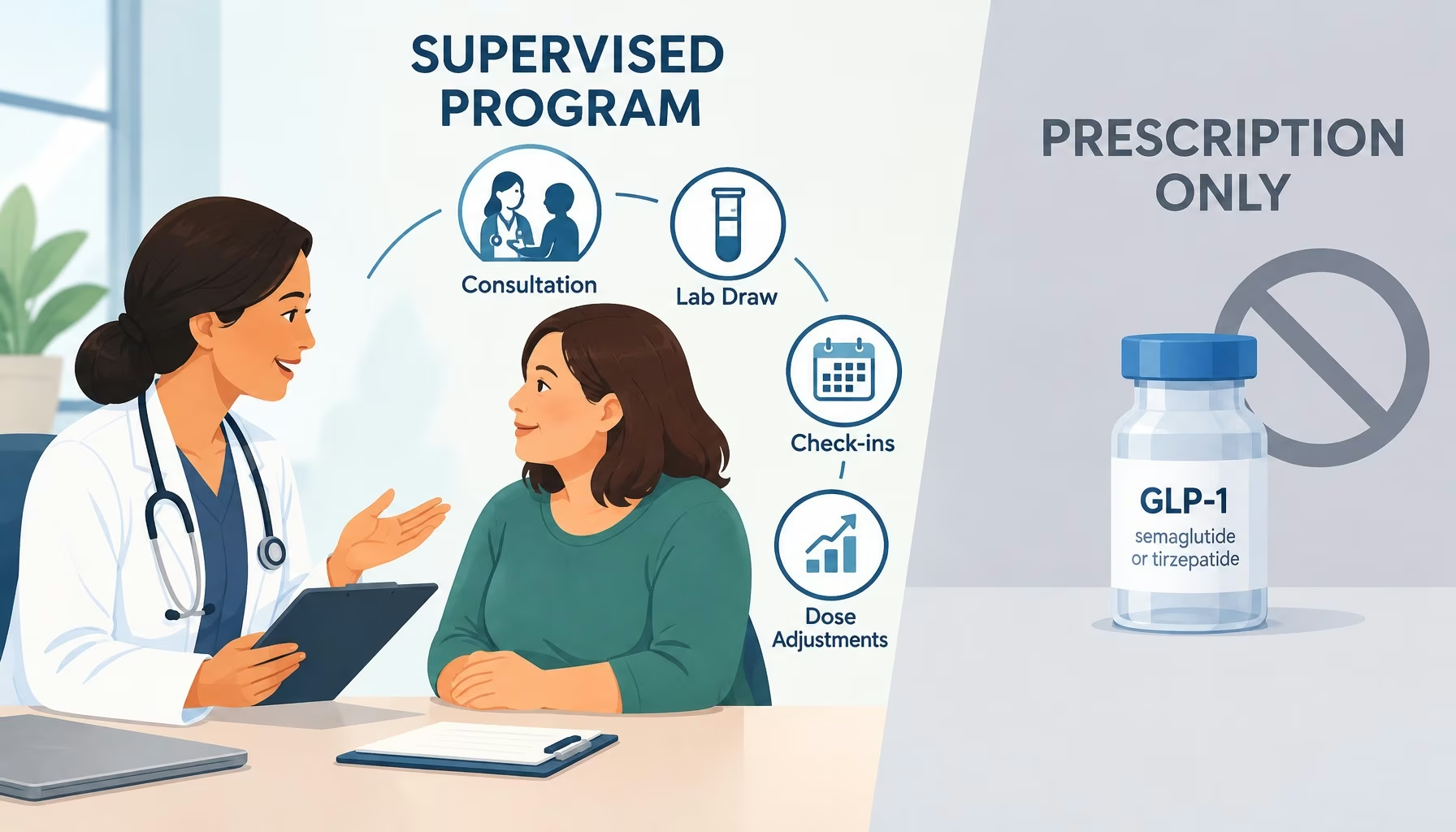
A medical weight loss benefit should be evaluated as a supervised program, not a dispensed medication. It applies to employers and employees weighing coverage for GLP-1 drugs such as semaglutide and tirzepatide. The deciding constraint is that supervision costs time: consultation, lab draw, check-ins, and dose adjustments, so plans must specify whether they fund clinical oversight or only the prescription vial.
- A medication is not a program: Pharmacy coverage for a weekly injection does not automatically cover clinical oversight.
- Supervision requires active clinical steps: Supervised care includes a medical history review, baseline labs, scheduled check-ins, side-effect support, and provider-led dose management.
- Compare written descriptions: Employees should set a written program description beside the benefit plan to see which clinical services are covered.
The question employees bring in
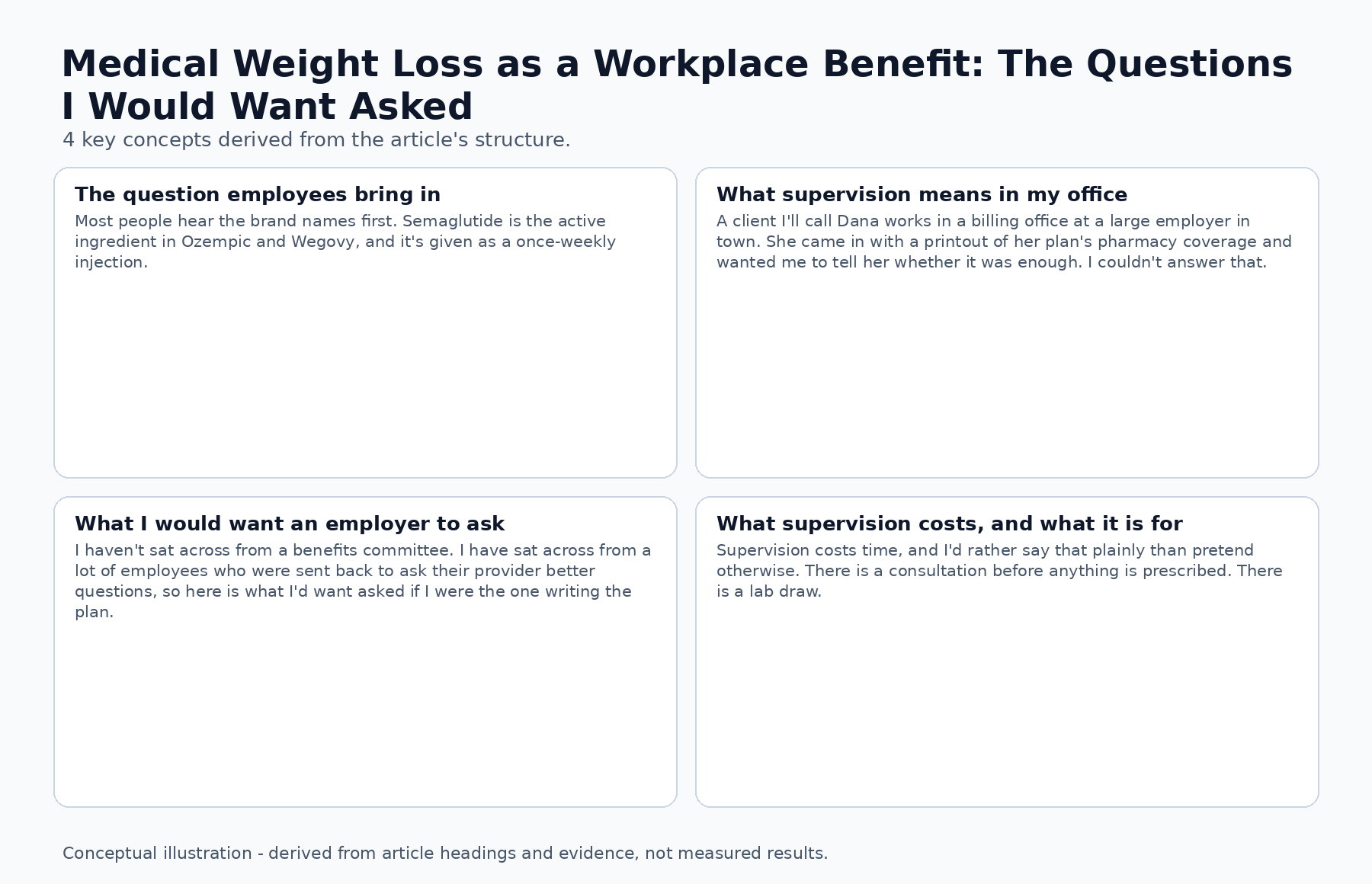
Most people hear the brand names first. Semaglutide is the active ingredient in Ozempic and Wegovy, and it’s given as a once-weekly injection. Tirzepatide is the active ingredient in Zepbound and Mounjaro, and it works on both GIP and GLP-1 receptors instead of one. Both medications mimic a hormone the body releases after eating, which reduces hunger, increases fullness, and helps regulate blood sugar.
That part takes two minutes to explain. The harder part? A medication is not a program. A plan that pays for one is not the same as a plan that pays for the other, and most of the questions I get about coverage are really questions about which of those two things the employee is asking for.
What supervision means in my office
A client I’ll call Dana works in a billing office at a large employer in town. She came in with a printout of her plan’s pharmacy coverage and wanted me to tell her whether it was enough. I couldn’t answer that. I could walk her through what she’d be asking the plan to cover, and the first thing I told her is that I do not know yet whether she’s a candidate.

The weight-loss program at Sarah Hitchcox Aesthetics starts with a consultation that reviews medical history and goals, and only candidates are started. The booking menu includes a lab draw. After the first injection there are regular check-ins, dose adjustments, side effect management, and lifestyle coaching. Nausea, diarrhea, and a drop in appetite are common with tirzepatide, and the way we ease them is to start at a low dose and increase gradually. Someone has to be watching for those side effects, and someone has to be making the dose decision each time.
In the emergency department I assessed every patient from the chief complaint, their vital signs, and what they told me about their pain. Supervision in weight loss is the same habit at a slower pace. History first, then labs, then a plan, then a schedule of looking again. The medication is the smallest part of the appointment.
What I would want an employer to ask
I haven’t sat across from a benefits committee. I have sat across from a lot of employees who were sent back to ask their provider better questions, so here is what I’d want asked if I were the one writing the plan.
Who reviews the medical history before the first dose, and who decides whether the person should start at all? A program that starts everyone who asks is a prescription service, and that’s a different product.
Who answers the phone in week two when the nausea shows up? Side effects are the point where people quit on their own, and a program that manages them is doing something a vial cannot do.
How are dose changes made, and does the provider making them have the labs and the check-in notes in front of them? Dose adjustment is the day-to-day work of supervision. If nobody is doing it, nobody is supervising.
What exactly is being paid for? Medication alone, or the consultation, the lab draw, the check-ins and the coaching as well? That one question clears up most of the confusion I see, because the employee and the plan are often using the word “program” to mean different things.
| Benefit Component | Medication-Only Coverage | Supervised Program Coverage |
|---|---|---|
| Medical History Review | Often limited to basic prescription screening | Provider reviews history and goals before the first dose to confirm candidacy |
| Lab Work | Frequently billed separately or omitted | Baseline lab draw included in the booking and evaluation workflow |
| Regular Check-Ins | No scheduled follow-up required to refill | Scheduled clinical visits after the first injection to track patient progress |
| Dose Management | Standardized escalation without chart context | Provider starts at a low dose and adjusts gradually using labs and check-in notes |
| Side-Effect Support | Patient manages nausea or appetite drops alone | Direct clinical contact in early weeks to manage nausea and prevent quitting |
| Paid Services Scope | Dispensed pharmacy drug only | Consultation, lab draw, weekly injections, check-ins, and lifestyle coaching |
What supervision costs, and what it is for
Supervision costs time, and I’d rather say that plainly than pretend otherwise. There is a consultation before anything is prescribed. There is a lab draw. There is a weekly injection, and there are check-ins on top of that. For a shift worker or someone with a long commute, that’s a real schedule, and it’s fair for an employer to ask how much of it happens during the workday.
What it buys is less visible, and I want to be careful not to claim more than my practice pages say. It buys a medical history review before the first dose, so people who aren’t candidates don’t start. It buys a provider who adjusts the dose instead of leaving the employee to guess. It buys someone to call about side effects, and it buys lifestyle coaching alongside the medication, not instead of it. None of that is a promise about what happens on the scale. It’s a description of who is paying attention, and how often.
FAQ
What does a supervised weight-loss program involve?
A supervised program starts with a medical history review and candidate selection before any medication is prescribed. It includes a baseline lab draw, regular check-ins after the first injection, gradual dose adjustments based on lab results and clinical notes, direct support for side effects like nausea, and lifestyle coaching.
What should employers ask about weight-loss benefits?
Employers should ask for a written program description and verify whether the plan covers clinical supervision or only the dispensed medication. Key questions include who reviews the medical history to determine candidacy, who handles week-two side effects, how dose changes are decided, and whether labs and check-ins are paid.
A fair way to settle it
When Dana left, she had a one-page description of the program to take back to her HR department. That is what I’d suggest for anyone in her position: ask the provider to write down what the program includes, and ask the plan which of those pieces it pays for. The two answers side by side settle the question better than either one alone.
For an employer, the same page is the thing to ask for before deciding anything. A drug name tells you what the pharmacy will dispense. The program description tells you what your employee will actually be doing every week, and who is responsible when something needs adjusting. That is the benefit you’re deciding on.