We use cookies, including third-party cookies from Google to serve personalized ads through AdSense, to operate this site and understand how it is used. By continuing to browse, you accept this use. See our Privacy Policy and Terms of Use for details, including how to opt out of personalized advertising.
Accept
Health Works CollectiveHealth Works CollectiveHealth Works Collective
  • Health
    • Mental Health
  • Policy and Law
    • Global Healthcare
    • Medical Ethics
  • Medical Innovations
  • News
  • Wellness
  • Tech
Search
© 2023 HealthWorks Collective. All Rights Reserved.
Reading: Power Suit
Share
Notification Show More
Font ResizerAa
Health Works CollectiveHealth Works Collective
Font ResizerAa
Search
Follow US
  • About
  • Contact
  • Privacy
© 2023 HealthWorks Collective. All Rights Reserved.
Health Works Collective > eHealth > Power Suit
eHealth

Power Suit

Regina Holliday
Regina Holliday
Share
4 Min Read
SHARE
The other night at dinner my youngest son Isaac said from the depths of his seven year old wisdom, “A human is the only animal that wears clothes.”  He then went back to chewing his food as I nodded in agreement.  Clothes and the adornments we place upon them say so much about the person.  They can place a person on an economic scale and give a sense of belonging.  Clothes can mark us as different and rebellious.  If an outfit is strong and becoming it may be called a “Power Suit,” as though the clothes can make the man.
 
I think its works the other way within The Walking Gallery.  Recently I painted a jacket story for Ian Eslick.  Ian plans to wear that jacket for his dissertation defense at MIT.  Ian is really smart, as in getting a doctorate from MIT smart; but Ian does not flaunt his mental abilities.  He speaks from a patient view as he talks of data aggregation and the possibilities if we harness the power in patient reporting within scientific research.
 
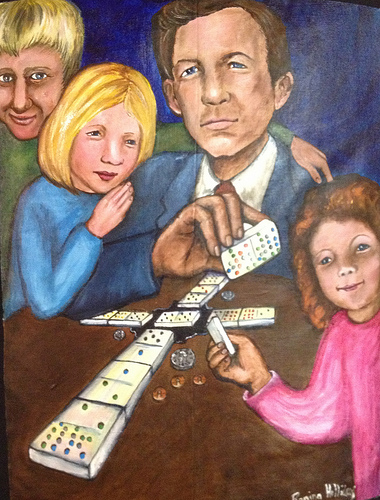
The painting for Ian is entitled: “The Highest Double.”
 

In this painting, I placed Ian, his mother-in-law and his two twin daughters.  They are playing a game of Mexican Train.  Have you played Mexican Train?  I love it.  I love it because it looks so hard at first but it is so easy.  Someone had the brilliant idea to color code the dominoes.  Each color is also a number, so seniors, children and parents can all play.  I learned to play this game with my in-laws.  I told my boss at the toy store we should carry it.  He brought it in reluctantly.  He said it wasn’t a very hard game, why would anyone want to play it?  I told my boss it had some good addition drill and it was fun, but most important of all anyone could play.  So if you look closely at these dominoes you will see they begin to morph from regular dominoes into patient reported diagrams.  How can a chronic condition be affected if we remove one agent of causation and compare outcomes?  What if we start comparing patient populations and look for doubles?  Look for patterns? Think of that train of knowledge. 
 
You see Ian is looking for that highest double.  He is looking at entire patient populations just as you or I would look upon a pile of dominoes.  He is looking for the match, the pattern, the train.
 
You might notice coins are laid upon this table (you also might notice they equal 73 cents).  My family uses coins as markers when we play Mexican Train.  If a coin is placed upon my domino track, I am unable to play on it and it becomes a train held in common.  Anyone can play on it.  In the game upon this table all trains are private.  Ian has a train and his two daughters have trains.  That final train with its foreshortened perspective facing the viewer; whose train is that?  It is yours.  It belongs to all of you who look upon Ian’s jacket.  You are welcome to join this game of data. 
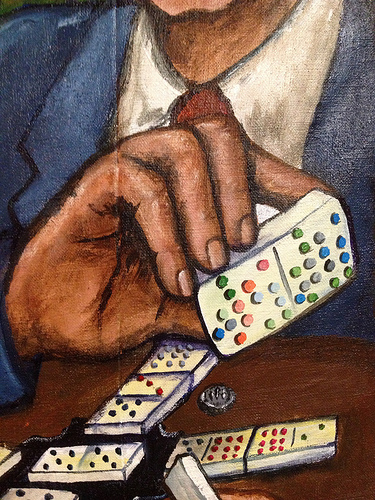
 

Finding a match

Ian wants you to play.  
TAGGED:ePatient
Share This Article
Facebook Copy Link Print
Share

Stay Connected

1.5KFollowersLike
4.5KFollowersFollow
2.8KFollowersPin
136KSubscribersSubscribe

Latest News

The Case for Proactive Nutrient Support and Where IV Therapy Fits In -- AI-generated illustration
The Case for Proactive Nutrient Support and Where IV Therapy Fits In
Health Therapies
October 5, 2026
Biofeedback Technology in Addiction Treatment: What the Evidence Shows So Far -- AI-generated illustration
Biofeedback Technology in Addiction Treatment: What the Evidence Shows So Far
Addiction Addiction Recovery
September 28, 2026
Charity Care Is Written Into Hospital Policy. It Rarely Makes It Onto the Bill. -- AI-generated illustration
Charity Care Is Written Into Hospital Policy. It Rarely Makes It Onto the Bill.
Business Hospital Administration
September 25, 2026
A Global Perspective on Medicine: Lessons Learned Across Borders -- AI-generated illustration
A Global Perspective on Medicine: Lessons Learned Across Borders
Medicines
September 23, 2026

You Might also Like

HIPAA Cloud
Medical RecordsPolicy & Law

HIPAA Data Breaches Result in Hit to Patient Loyalty and High Costs

October 24, 2013
Doctor and scribe, source New York Times
eHealthMedical RecordsTechnology

Flipping the Clinic Visit

January 21, 2014
BusinesseHealthHealth ReformHospital AdministrationMedical EducationMobile HealthPublic HealthWellness

Cliff Diving for Healthcare Innovation

January 6, 2013
eHealthSocial MediaTechnology

SEO vs Paid Search vs Social Media – Which is Better for Healthcare Marketing

May 23, 2017
Subscribe
Subscribe to our newsletter to get our newest articles instantly!
Follow US
© 2008-2026 HealthWorks Collective. All Rights Reserved.
  • About
  • Contact
  • Privacy
Welcome Back!

Sign in to your account

Username or Email Address
Password

Lost your password?