I am warning you now: This is going to be a rant.
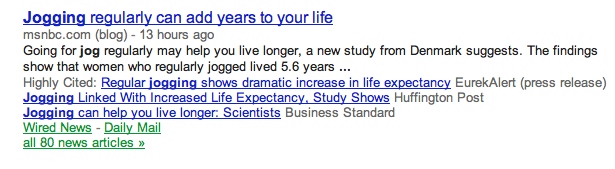
Yesterday’s Wall Street Journal had a front page story on observational data, and how researchers are growing more concerned about its accuracy even as the volume of such research is growing exponentially. And then today, there was this from multiple news outlets:
I am warning you now: This is going to be a rant.
Yesterday’s Wall Street Journal had a front page story on observational data, and how researchers are growing more concerned about its accuracy even as the volume of such research is growing exponentially. And then today, there was this from multiple news outlets:
More Read


The HealthDay story quotes the senior author of the study thusly [emphasis mine]:
“The results of our research allow us to definitively answer the question of whether jogging is good for your health,” Peter Schnohr, chief cardiologist of the long-term Copenhagen City Heart Study, said in a news release from the European Society of Cardiology. “We can say with certainty that regular jogging increases longevity. The good news is that you don’t actually need to do that much to reap the benefits.”
And then at the very end it says this:
The study was slated for presentation Thursday at a meeting of the European Association for Cardiovascular Prevention and Rehabilitation, called EuroPRevent2012, in Dublin.Data and conclusions presented at meetings should be considered preliminary until published in a peer-reviewed medical journal.So, let recap. WSJ says that observational data are of concern because they can be tough to confirm, so we should be skeptical. HealthDay and others insist that this observational study shows definitively that jogging prolongs life, so what are we supposed to believe?
The problem and the disconnect, I believe are not with the studies themselves. The problem is with the way these stories are reported and the end result of that: Just like direct-to-consumer advertising from Pharma, these stories call us to immediate action, even when the results are preliminary. We rail against Pharma’s DTC, but take this kind of press coverage as a given. This type of reporting, where half-baked data are presented as the final word, disappointingly enabled by the investigators themselves (who doesn’t want 15 minutes of fame?), makes observational data look like something they are not. On the one hand, we are told that here is the result. On the other, after some contemplation and peer review, we realize that the study did not show what it was said to have showed. Bingo, the sweeping conclusion is that all observational studies are bad and biased, so let’s just throw out the baby with the bath water.
The press are doing a huge disservice to the public and to science itself by presenting everything in such black-and-white terms. We know that it is the initial message that grabs attention; hence “jogging adds years to your life.” To make the next message stick, something powerful needs to be cooked up; hence, “Analytical Trend Troubles Scientists.” Saying that “well, we overstated what the jogging study showed” isn’t nearly as sexy. How about we back up a bit and say it like it is: the devil is in the details, and those details don’t make nifty headlines.
I am grateful to Gary Schwitzer for slapping this kind of sloppy reporting, but he cannot eliminate it alone. We all must speak out against it. We abhor Pharma’s DTC marketing practices. Why do we give the press a free pass for the same behavior? Cover accurately or don’t cover at all!