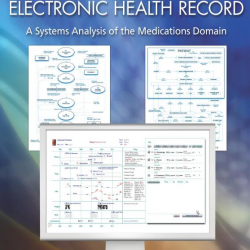
A while back I was provided with a review copy of the book, Electronic Health Record: A Systems Analysis of the Medication Domain, by Alexander Scarlat, MD. This book is intended to serve as a practical book about electronic health/medical records systems as used in acute care settings.
A while back I was provided with a review copy of the book, Electronic Health Record: A Systems Analysis of the Medication Domain, by Alexander Scarlat, MD. This book is intended to serve as a practical book about electronic health/medical records systems as used in acute care settings. (For the purposes of this review, the term EHR is intended to refer to both EHRs and EMRs.)
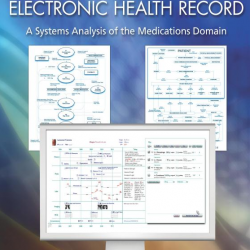 There are two audiences for the book. The first group includes clinicians with little or no expertise in information technology. There are plenty of books for clinicians that provide an introduction into the common capabilities of an EHR. Scarlat’s book goes a step further, providing the understanding and tools to be able to collaborate with the IT folks who are implementing an EHR so that clinicians can actively participate and communicate their needs and preferences in an unambiguous way. The second audience includes IT professionals who lack in depth knowledge and understanding of clinical workflows that are automated in the typical EHR. For them, the book details what is perhaps the most complex and challenging EHR application, medication ordering.
For several years, as EHRs have been implemented and used, there has been a growing awareness of the impact of EHRs on patient safety. This awareness revolves around the fact that how EHRs are implemented, how specific workflows are automated, can have a negative or positive impact on patient safety. The challenge here is that clinicians are not IT professionals and are seldom able to describe unambiguous requirements in a way that is easy to grasp by informaticists. Likewise, the vast majority of IT professionals lack clinical backgrounds, and struggle with understanding clinical workflows and how variations in those workflows can impact patient safety.
Scarlat has done an excellent job of providing a set of basic tools that are easy for clinicians to understand, that can be used by clinicians to define safe and effective workflows as EHRs are implemented in an institution. The tools provided are structured system analysis tools using data flow and entity relationship diagrams. After an introduction to the tools, the book delves into the workflow detail of the medication ordering process – one of the most complex and variable workflows in acute care, and one that has perhaps the greatest impact on patient safety.
As an introduction to EHR design and implementation issues, the book also includes sections on user interface design considerations, clinical decision support systems (a common component in medication orders systems), the various kinds of reporting that results from the workflow, and interoperability standards and vocabularies.
As a consequence of reports of patient deaths resulting from the way EMRs were designed or implemented, and the growing awareness of direct patient safety impacts of EMRs on patient care, there has been growing controversy about the possible regulation of health care IT applications.




.jpg)