We use cookies, including third-party cookies from Google to serve personalized ads through AdSense, to operate this site and understand how it is used. By continuing to browse, you accept this use. See our Privacy Policy and Terms of Use for details, including how to opt out of personalized advertising.
Accept
Health Works CollectiveHealth Works CollectiveHealth Works Collective
  • Health
    • Mental Health
  • Policy and Law
    • Global Healthcare
    • Medical Ethics
  • Medical Innovations
  • News
  • Wellness
  • Tech
Search
© 2023 HealthWorks Collective. All Rights Reserved.
Reading: Shifts in Product Usage in Wound Management, 2012 to 2021
Share
Notification Show More
Font ResizerAa
Health Works CollectiveHealth Works Collective
Font ResizerAa
Search
Follow US
  • About
  • Contact
  • Privacy
© 2023 HealthWorks Collective. All Rights Reserved.
Health Works Collective > Business > Finance > Shifts in Product Usage in Wound Management, 2012 to 2021
BusinessFinanceMedical InnovationsTechnology

Shifts in Product Usage in Wound Management, 2012 to 2021

PatrickDriscoll
PatrickDriscoll
Share
2 Min Read
wound management care
SHARE

Wound management is a field and an industry in a constant state of flux. With so many different technologies involved in addressing wounds, from the chronic to the acute, with technologies from the very well established to the cutting-edge new, the balance of product utilization (and manufacturer revenues) is a constantly moving target.

Wound management is a field and an industry in a constant state of flux. With so many different technologies involved in addressing wounds, from the chronic to the acute, with technologies from the very well established to the cutting-edge new, the balance of product utilization (and manufacturer revenues) is a constantly moving target.

Traditional wound dressings — simple gauze or other inert bandages — represent a huge existing market by virtue of their broad clinical utility and well established presence in the market (literally, centuries), while novel technologies like growth factors, which have just begun to demonstrate their potential to accelerate healing and/or solve the vexing problem of chronic wounds, have not really begun to penetrate clinical practice and generate substantial caseloads, yet. Between the extremes is a continuous range of products across the spectrum from the established to the novel.

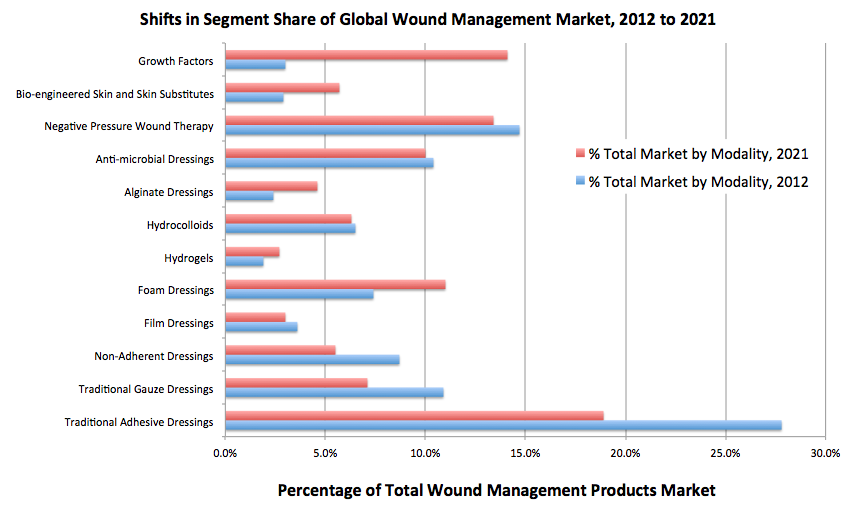
Below is illustrated the 2012 to 2021 shift in the balance of the global wound management products market for the specific product types. The aggregate market is growing over this period at a respectable +7% CAGR, but that aggregate rate belies the individual segment rates ranging from a low of under 2% to a high of over 27%. That makes these share values all the more intriguing.
More Read

One Teeny Bopper, One Vote
The Loophole That’s Made Cancer Drugs Profitable Again
Only 18 percent of Hospital CEO’s are Women
Is Price Competition the Key to Higher Quality?
Open Hardware Body Sensor Platform Is on the Way

wound management care

Source: MedMarket Diligence, LLC; Report #S249.

TAGGED:wound management
Share This Article
Facebook Copy Link Print
Share
By PatrickDriscoll
Follow:
I serve the interests of medical technology company decision-makers, venture-capitalists, and others with interests in medtech producing worldwide analyses of medical technology markets for my audience of mostly medical technology companies (but also rapidly growing audience of biotech, VC, and other healthcare decision-makers). I have a small staff and go to my industry insiders (or find new ones as needed) to produce detailed, reality-grounded analyses of current and potential markets and opportunities. I am principally interested in those core clinical applications served by medical devices, which are expanding to include biomaterials, drug-device hybrids and other non-device technologies either competing head-on with devices or being integrated with devices in product development. The effort and pain of making every analysis global in scope is rewarded by my audience's loyalty, since in the vast majority of cases they too have global scope in their businesses.Specialties: Business analysis through syndicated reports, and select custom engagements, on medical technology applications and markets in general/abdominal/thoracic surgery, interventional cardiology, cardiothoracic surgery, patient monitoring/management, wound management, cell therapy, tissue engineering, gene therapy, nanotechnology, and others.

Stay Connected

1.5KFollowersLike
4.5KFollowersFollow
2.8KFollowersPin
136KSubscribersSubscribe

Latest News

What Geographic and Specialty Variation Reveals About How Nursing Compensation Actually Works -- AI-generated illustration
What Geographic and Specialty Variation Reveals About How Nursing Compensation Actually Works
Career Nursing
August 27, 2026
Could Poor Ventilation Be Behind Your Afternoon Headaches?  -- AI-generated illustration
Could Poor Ventilation Be Behind Your Afternoon Headaches? 
Health
August 27, 2026
The Myth That Keeps People Stuck -- AI-generated illustration
The Myth That Keeps People Stuck
Addiction Recovery
August 25, 2026
What Hospitals Need to Know About EU MDR -- AI-generated illustration
What Hospitals Need to Know About EU MDR
Business Hospital Administration
August 18, 2026

You Might also Like

How to Take Great Smartphone Photos for Social Media

March 1, 2015
BusinessDiagnosticsFinanceSpecialties

The Cost of Colonoscopy: A New Payment Model

July 8, 2013

Healthcare’s Most Disruptive: Next-Gen Genomics, Memory Implants

June 19, 2013
competitive advantage
Social MediaTechnology

3 Often-Neglected (But Powerful) Internet Marketing Tools for Healthcare

November 26, 2014
Subscribe
Subscribe to our newsletter to get our newest articles instantly!
Follow US
© 2008-2026 HealthWorks Collective. All Rights Reserved.
  • About
  • Contact
  • Privacy
Welcome Back!

Sign in to your account

Username or Email Address
Password

Lost your password?