Do you need a good incentive to exercise? Check out this set of pictures. They may well surprise you.
Do you need a good incentive to exercise? Check out this set of pictures. They may well surprise you.
We all know we should exercise. It feels good during and we feel even better after. We know it burns calories and that our bodies were meant to be used. But all too many of us are sedentary; it just the result of modern life. One result, combined with eating too much, is that one third are overweight and one third are frankly obese. And many of us believe that as we age we will just naturally loose muscle mass and strength. It turns out that is just not correct. We can indeed preserve muscle mass and strength.
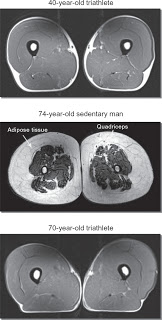
A really well trained athlete has little fat in or around his or her muscles. But a person that does not exercise sees his muscles wither and fat take up the space. That is the obvious conclusion from the images shown below.
More and more Americans are living into what used to be called “old age.” With older age often comes various illnesses, many of them chronic such as diabetes, heart failure or cancer. But these chronic illnesses are often preventable with a good diet and moderate exercise. So to is the “sarcopenia” or muscle loss that comes with aging in a sedentary person.
Wroblewski and colleagues at the University of Pittsburgh evaluated persistent exercise over the years. Their study was reported in The Physician and Sports Medicine journal, September, 2011 and sent to me by Frank Jannotta of Harbor Physical Therapy.

Five men and 5 women were recruited in each 10-year age category (40–49 years, 50–59 years, 60–69 years, and ≥ 70 years). Each was an avid exerciser. They were evaluated for their health history, exercise patterns, body composition using the “Bod Pod” and MRI scans of the thighs. The researchers found that despite the age differences, these individuals did not have a significantly different amount of intramuscular adipose tissue; their body fat, BMI, fat mass and muscle mass were all similar. Clearly, continued exercising into the 70’s maintained muscle mass in these individuals.
Here are three images taken by MRI scanning, i.e., a cross sectional picture. They are of the upper leg to show the quadriceps muscle, the large muscle on the front of the thigh that allows us to lift our leg and bend our knee when we walk or run.

The first image is of a 40 year old triathlete. The second is of a 74 year old sedentary person. And the third is of a 70 year old triathlete. The differences are obvious. Use it or lose it. Muscle to flab.
This proves that being older need not mean having no muscle tone. The difference between the two triathletes and the sedentary 74 year old are striking. It is clear that even an older person who exercises can maintain good muscle tone. And although this is of a triathlete, just good regular activity that combines both aerobic and weight bearing exercise will maintain those muscles up to the very last breath. And it means better health, long life, and much less chance that a fall will lead to a broken bone.
Use it or lose it. Here is the proof.