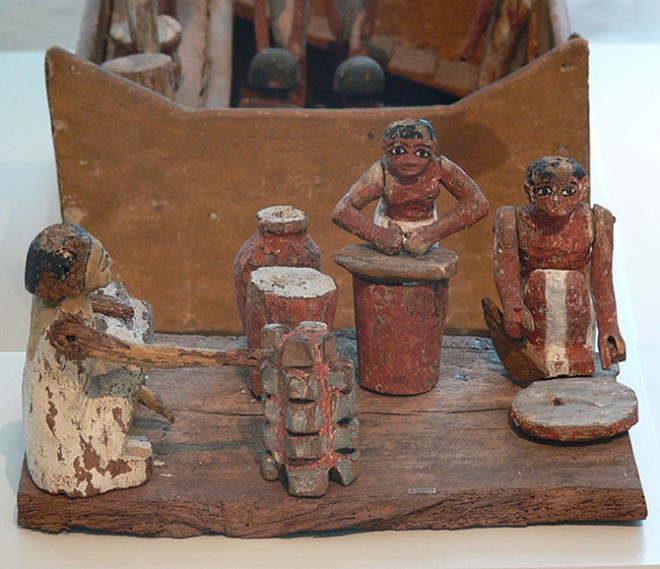
Egyptian kitchen, 3800 years ago.
Egyptian kitchen, 3800 years ago.
For years anthropologists have been basically guessing what the ancients’ diet consisted of. After all, it was a good assumption that since they were hunters and gatherers they must have eaten meat, vegetables, grains, nuts and fruits -depending on geographic and seasonal availability. This has changed. Using sensitive analytical methods (MS/GC of mass spectroscopy/gas chromatography) we even know that with the advent of agriculture about 10,000 years ago farmers in Southern Turkey and Northern Iraq were brewing beer by fermenting various grains. Using high power microscopy of dental surfaces of mummies it was possible to tell, by the micro scratches and pits left by different foods, what types of food were consumed. But was an ancient meal similar to a modern one? Did they have recipes that could be identified in today’s terms? Did the use spices?
The less-known civilization
A report in Science ( vol 337, p, 228-229) on a meeting of the European Association of South Asian Archeology and Art adds significant amount of knowledge on the subject of ancient diets.
Egypt and Mesopotamia are well-known as the first urban civilizations. Blame the pyramids, hieroglyphics, the Epic of Gilgamesh, and the Bible for our quite deep knowledge of those 5000 years old civilizations. There was a third civilizations at the same time -the Indus River civilizations. Why do we know so little about it? Blame the slow pace of archaeological investigations in the area. After all, we are dealing with the modern states of India and Pakistan. Nonetheless, progress is being made, thanks to new analytical techniques that allow amazing new insights into the daily life of people, both aristocracy and humble farmers, who lived there 4500 years ago.
As Andrew Lawler reports in Science ,”archaeologists have long spotted burnt grains such as wheat, barley, and millet at Indus sites, but identifying vegetables, fruits,nuts, roots, and tubers has been more challenging.
Researchers are increasingly using phytoliths—the mineral secretions left by plants—to identify specific plant remains, as well as starch grain analysis . Plants store starch granules as food, and the microscopic leftovers can be identified by researchers. For example, anthropologists Arunima Kashyap and Steve Weber of Washington State University, Vancouver, analyzed starch grains from human teeth from the ancient town of Farmana, west of Delhi, and found remains of cooked ginger and turmeric (which are ingredients of curry). They also found those ingredients inside a cooking pot. Dated to between 2500 and 2200 B.C.E., the finds are the first time either spice has been identified in the Indus.
Cow teeth from Pakistan’s Harappa—a major Indus city—yielded the same material. “It’s like India today,” Weber says. “Cattle wander around eating trash,” including the remains of cooked meals. In some Indian regions such as the western province of Gujarat, some families still leave food remains outside the house as a ritual offering to cattle
I find it fascinating that cooks of the 20th century B.C.E and chefs of the 20th century A.D. prepare the same delicious food, down to the last ingredient. I get the same feeling that I did when I saw the sandals that ancient Egyptians wore 3800 years ago -just like today’s Teva sandals. When it comes to the basics -nothing is new under the sun.
.