First published on MedCityNews.com. As transparency advocates are applauding CMS’s data dump, many doctors, it seems, are yielding lots of questioning phone calls.
That could be both good and bad. The government has said the public release of how $77 billion in federal dollars was doled out to more than 880,000 providers in 2012 through Medicare Part B services will give consumers insights to inform their healthcare decisions and potentially expose fraud.

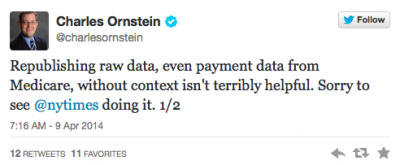
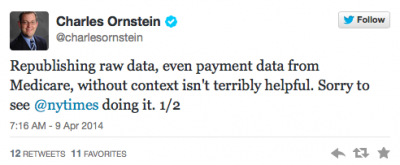
But, the raw data doesn’t tell the whole story, and some doctors worry that people will infer they’re pocketing more money than they actually are and become suspicious.
The American Medical Association has warned that the data could lead people to false conclusions about physicians who receive millions in Medicare payments. “Medicare claims data is complex and can be confusing,” the AMA said in a statement. “The manner in which CMS is broadly releasing physician claims data, without context, can lead to inaccuracies, misinterpretations and false conclusions.”
Dr. Minh Nguyen, a California oncologist, showed up as the tenth highest-paid physician based on the Medicare Part B claims data, receiving $9 million in payments. He told the LA Times his payout is misleading because his name is used to bill for all five physicians at his oncology practice. They’re also billing for expensive chemotherapy drugs, the majority of which goes to pay the drug companies, he said.
Others who cracked the top 10 highest-paid list, like Mayo Clinic Labs director Dr. Franklin Cockerill, told the Washington Post that their numbers are deceptively high because they’re listed as the billing physician for practices, labs or companies comprising multiple physicians. A rep for Mayo Clinic added that Cockerill is salaried, so the Medicare money goes back to the institution.
Yet others, like Dr. Salomon Melgen, are already controversial. The Florida ophthalmologist, who according to the data received $21 million from Medicare Part B in 2012, has been the subject of federal investigations around Medicare fraud and his ties to Sen. Bob Menendez of New Jersey.
The release of the data is an unprecedented move toward healthcare transparency. But it doesn’t come without challenges. It reflects the same issues the healthcare industry is facing with other kinds of data, too. In the hands of the right people with the proper tools to analyze and manage it, it could be very powerful. Yet without proper context, it could lead to false conclusions.
Here’s some more in-depth reading on the data dump:
- The New York Times has formatted the released information into a searchable database by physician name and location.
- USA today mapped out average payment per doctor by state.
- Kaiser Health News pointed out that the data omit just as much information as they include. Not included, for example, are reimbursements for non-Medicare patients, the quality of care that was provided or what procedures were performed.
- MedPage Today surveyed physicians on their reactions and got everything from “a serious breach of privacy” to “a move toward greater transparency.”