The 2014 Ebola outbreak in Africa – the most extensive and deadly since the disease was first described in 1976 – has been making headlines around the world. Now, the first known cases of Ebola infection are coming to U.S. soil – on purpose. One American – Dr. Kent Brantly – is in a special containment unit at Atlanta’s Emory University Hospital, and another is soon to follow. Here’s why we should not be overly worried about this development.
The 2014 Ebola outbreak in Africa – the most extensive and deadly since the disease was first described in 1976 – has been making headlines around the world. Now, the first known cases of Ebola infection are coming to U.S. soil – on purpose. One American – Dr. Kent Brantly – is in a special containment unit at Atlanta’s Emory University Hospital, and another is soon to follow. Here’s why we should not be overly worried about this development.
The Method of Transmission
Ebola is a serious and scary disease; it is highly infectious, has no cure, and has a mortality rate of up to 90%. And there is no vaccine (yet). However, it is not as easily transmitted as the flu or the common cold. One must be clinically ill to transmit the disease. It is possible for an infected person to arrive in the U.S. or another country before showing symptoms, and then become sick after arriving. But before they actually became sick, they would not pass on the infection. This would hardly be a trivial event; but health professionals would promptly suspect Ebola and institute a quarantine of both the index case and all contacts while experts confirmed the diagnosis.
More Read

Infection Control and Containment Standards
Unlike a hot open-air unit in Africa, where workers swelter in their protective gear, the isolation units in Atlanta and similar facilities would certainly have a far lower chance of accidental transmission to caregivers – let alone to outsiders. In fact, the chance of an outside spread is close to zero. The patients will also be kept isolated beyond their apparent recovery, and be confirmed as virus-free before release. They will be closely monitored after release.
Better Supportive Care
This infection causes damage in several ways, including dehydration from fluid loss and coagulopathy. Although there is no specific cure for the infection itself, its effects can be treated.
Supportive care with fluid replacement, correction of electrolyte problems, and management of organ failure will be provided at the standards of a top-level American intensive care unit, and this can substantially improve the mortality rate (still estimated at 30% or more).
Potential for Better Care in Future Outbreaks
The current outbreak may take a long time to be contained. The patients in Atlanta will be studied and monitored with great attention to detail. With these patients under the direct care of American infectious-disease experts, it is possible that improved treatment methods can be developed and applied to other patients in Africa, and in future outbreak episodes. We don’t know if an Ebola reservoir species will ever become established outside of Africa, or if future cases will arrive here. But in any case, what is learned from treating these two Americans will help manage future outbreaks of this disease.
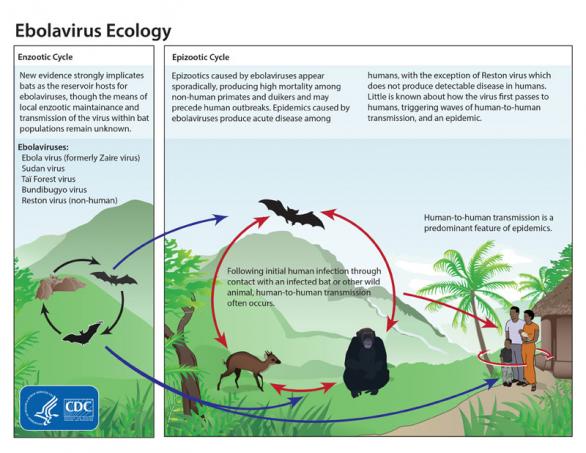
Schematic: Ebola ecology and transmission cycle (via the CDC)