


St
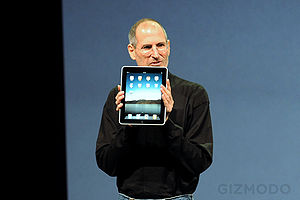
Steve Jobs was referenced several times during the recent State of the Union address. Healthcare was conspicuously absent from the speech, for a variety of reasons. What might Steve thought of electronic medical records? I would imagine he had some thoughts on the healthcare system, having unfortunately needed to access it during his illness. Perhaps we will eventually learn what he thought of it. However, his experience was almost certainly far smoother than an average person’s, given who he was.
Apple products are known for excellent function and design simplicity. Would an Apple-EMR look anything like the presently available products? Probably not. Had he watched a surgeon (as I once did) fumble for 45 minutes trying to put in orders and notes for a procedure that took 30 minutes, his designers would likely receive a profanity-laden tirade.
The trouble with most EMRs is that they are written by techies, and are focused on capturing a large amount of extraneous data that has little to do with the overall care at hand. Healthcare is a complex area that is made up of many fairly simple components. The current generation of EMRs are overly complex and have not been implemented because practitioners or consumers (patients) demand or require them, but because government incentives (and soon, coercion) have been required to force their adoption by a sector that does not have a true need for the product.
Consider the quick-service restaurant sector. Their version of the EMR is ubiquitous and necessary in order to serve customers and compete. It enhances the operator-customer experience. Here’s how it would look if a current EMR was adopted for restaurant use:
(From a recent exchange at McDonald’s. Yes, even doctors occasionally eat there.)
Me: “I’d like a Southern Chicken Sandwich.”
Staff: “Your height and weight please?”
Me: “Six feet four, 205 lbs.”
Staff: [narrows eyes in disbelief]
Staff: “Any pets in the home?”
Me: “What does this have to do with my order?”
Staff: “What color is your couch?”
Me: “Well, I’m still trying to clean a butter stain, and the cat made a mess on it. Let’s call it beige-to-yellow.”
You get the point. This sort of data collection erodes the user experience and impedes the purpose for which the system is supposed to serve.
Future EMRs will solve these problems. It is not that the data is completely useless, but most is unnecessary and collecting it in the current fashion saps productivity and leads to all sorts of unintended consequences. For example, specialists may scan, skip or ignore most of the pre-generated information from EMR referrals, focusing only on the issue for which they are being consulted. Copy-and-paste can lead to absurd rounds of the children’s “Telephone Game”. (Amputees with normal pulses in the limb, etc.)
Healthcare will eventually have full, well-designed EMR adoption. But getting there will take a few more software generations. Here are three easy ideas just by borrowing from what already works in tech.
- Touchscreen navigation: Akin to the old lightpen (precursor to the mouse), this makes it quick and easy to enter information. Hand sanitizer at every workstation will help with germ fears.
- Smart Software: If Amazon knows what products you likely want, the EMR should know your order sets and what medications you typically prescribe. An orthopod shouldn’t sift through a hundred obscure medications to select antibiotics and pain meds, and to put in his standard orders.
- Simplify documentation: When patients are seen for a specific problem, notes only need a small amount of information. Extraneous details can be captured at the initial visit and any changes made later. Put it on the sidebar of the page, so it is visible but does not crowd out the important information.
This is only a start, and larger organizations should lead the way as EMR costs are unfriendly for most offices. Community physicians could use web-based EMRs hosted at the local hospital (free if on staff, perhaps subscription-based otherwise).
The U.K.’s scrapping of their EMR project should be considered carefully. It’s high time for someone with a touch of Steve Jobs’ vision to create an EMR here so good that it won’t need carrots or sticks to be adopted.




