A study published in the Journal of Infectious Diseases found that the introduction of a vaccine to prevent cervical cancer in 2006 has reduced infections with HPV by more than half among girls and young women. Another recent study published online in PLOS ONE discovered vaccination prevented between 1.1 million and 5 million cases of the flu per season over a 6-year period from 2005 to 2011.
As scientific evidence consistently proves vaccine’s significant contribution to public health, negative perceptions about vaccine still lead to fear and refusal of essential vaccination and resulting in outbreaks of preventative diseases across the globe. Last Sunday, two polio vaccine volunteers were killed by extremists in Pakistan, one of only three countries where polio remains endemic, with 58 cases reported in 2012, according to the Global Polio Eradication Initiative. And we all remember in 2011, Michele Bachmann, a republican presidential candidate claimed that the HPV vaccine can lead to mental retardation. These cases highlight the lack of understanding of vaccine is a challenge both developing and developed countries are facing. They also tell us scientific data alone cannot address the public’s concerns with vaccine as these concerns are often deeply rooted in culture, history and political systems.
Effectively communicating information about vaccine and shifting the negative perception rely on a precise understanding of the socioeconomic landscape from region to region and targeted strategies that tackle unique challenges. In order to gain the understanding and insights, public health professionals and healthcare communicators need comprehensive data that capture trends on a global level as well as social, economic and political context for each region.
Big data provides both.
A new study focused on measuring vaccine confidence using global data obtained by a media surveillance system provides valuable insights into how we can develop more effective communication strategy and tactics to enhance the public’s confidence in vaccine.
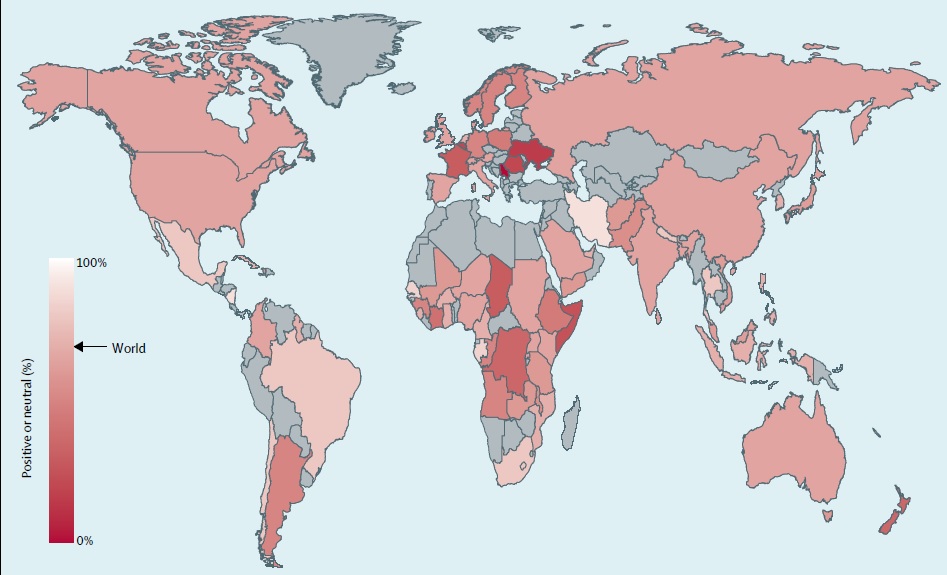
69% of the global reports were positive about vaccine (graphic: http://dx.doi.org/10.1016/S1473-3099(13)70108-7 )
A group researchers have used data collected from HealthMap, a monitoring system developed by Boston Children’s Hospital that use keywords to capture relevant mentions in 15 languages from both traditional and social media about public health events, to detect and characterize early signs of vaccine issues. The study, published online in Lancet Infectious Disease discovered that from May 2011 to April 2012, 7171 (69%) reports contained positive or neutral content and 3209 (31%) contained negative content. Of the negative reports, 1726 (21%) were associated with beliefs, awareness and perception. The researches note these data provide a growing body of evidence of the potential risks of the spread of unchecked rumors, and of failing to address legitimate questions and concerns.
These findings have implications for both healthcare communicators and public health professionals. As digital and social media reshape the media landscape, real-time media surveillance data can detect early signs of concerns before they reach a large audience. Data can also help us understand how critical information travels from one stakeholder group to another and how it gets amplified. These insights are essential for public health strategy planing and program development.
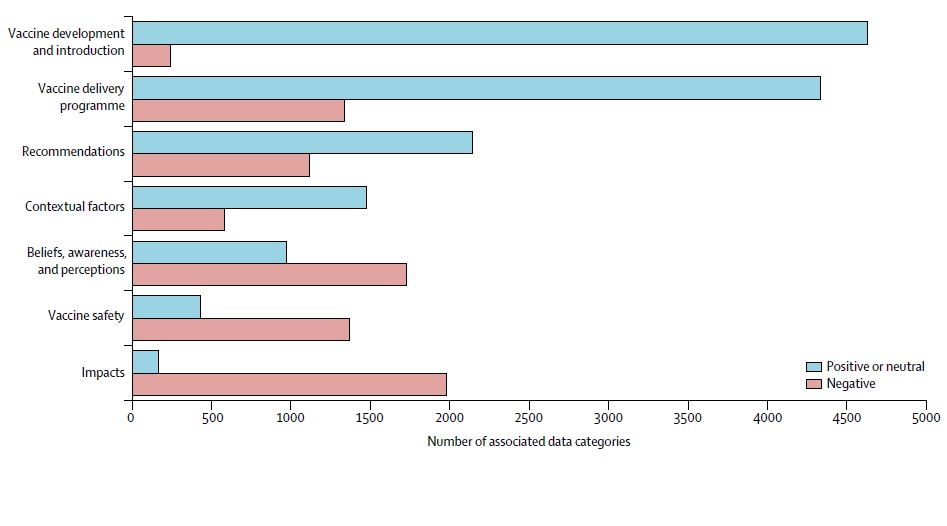
A large proportion of concerns are related to belief systems (graphic: http://dx.doi.org/10.1016/S1473-3099(13)70108-7)
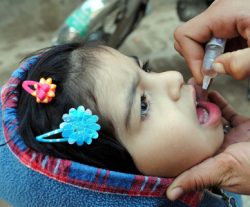
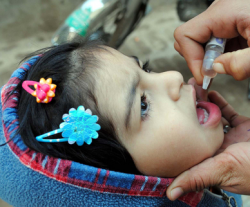
image: vaccination/shutterstock