Here we go again with yet one more device that was spun out of MIT and sure it has some clinical use for some situations and the use in a clinical trial could also apply but I don’t think this is for the average person to be walking around with, shoot I want my phone to make phone calls and to text:) The article does mention a trial for IBS behavior in children.
Here we go again with yet one more device that was spun out of MIT and sure it has some clinical use for some situations and the use in a clinical trial could also apply but I don’t think this is for the average person to be walking around with, shoot I want my phone to make phone calls and to text:) The article does mention a trial for IBS behavior in children.
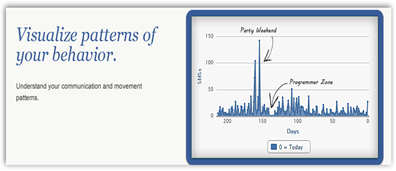
The app is called the DailyData and analyzes what you do, so if you are a regular texting person and you go a few days without sending a message, the phone will ask you if everything is ok. I still people asking me on that account, more personal that way. It says it also tracks loved ones but if not handled correctly we have family members turning into czars instead of being truly helpful sometimes and I see that here and there today even without devices as we are all so busy and have gluts of information flying at us all the time. This is kind of an interesting graphic, does your phone identify that one had a “party weekend” or accuse you of it .
More Read
Sometimes we really need to be practical and figure out and ask ourselves if we need this data, is it being used for treatment or for a way to zero in on a plan? The next image shows what days you were stressed and if I had a couple bad days I would just as soon forget them than dwell on it and move forward.

The usual privacy statement accompanies the use of the software that says they do not sell your data unless you explicitly say so, what ever that means and I am guessing they ask. MIT developed or not, I’ll pass on this one for now and it is still in the beta stage. How many would walk around and use this though at MIT? I ask because so many developers today never touch their own creations and we are seeing this becoming more prevalent and it seems it’s always for “those guys over there”. BD
Ginger.io, a startup spun out of the MIT Media Lab, aims to use data collected automatically from mobile phones to warn users and their physicians that they may be on the verge of a manic episode or a bout of debilitating illness.
The company has developed a mobile-phone app called DailyData that analyzes information on the user’s location and the frequency of calls and text messages to determine whether that person is having health problems. Ginger.io will market the software to health insurers and others who could use the aggregate data to better understand the links between health and behavior.
Accurately predicting the meaning of changes in communication patterns is likely to be challenge. For example, the cell-phone profile of a person who stays home and stops calling friends for several days in order to meet a work deadline would be similar to that of someone who stays in bed and stops answering the phone because his depression is getting worse. But Singh says the algorithms underlying the app are flexible and can be tuned to be more or less sensitive to behavior changes, and that user feedback will also improve them. “With more data and users, we expect to get better at predictions,” says Madan.
Ginger.io plans to market its software to health-care providers, pharmaceutical companies, health insurers, large employers, and chronic-patient communities. These groups would offer the app to patients or employees, and would in turn get a set of aggregate statistics about and trends in the health and behavior of these groups. “For a [health-care] provider or academic researchers, this might help them understand how people behave when they’re symptomatic,” says Madan. A pharmaceutical company might gain insight into links between behavior and medication and health, such as whether physically active people get better faster. “These are all novel data that they never had access to before,” says Madan.
The company is working with Cincinnati Children’s Hospital on a pilot study of patients with inflammatory bowel disorder and Crohn’s disease, both painful intestinal conditions. Physicians will try to determine whether behavior changes prior to a flare-up.
An App that Looks for Signs of Sickness – Technology Review