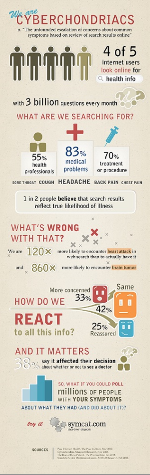
Have you ever felt poorly, given in to the temptation to research your symptoms online, and pulled up a list of absolutely terrifying possible diagnoses? Many of us do it all too often, sometimes scaring ourselves into emergency room visits for ailments that are minor and easily treated.

Have you ever felt poorly, given in to the temptation to research your symptoms online, and pulled up a list of absolutely terrifying possible diagnoses? Many of us do it all too often, sometimes scaring ourselves into emergency room visits for ailments that are minor and easily treated.
The Internet is not meant to replace medical professionals, but as it can engender cyberchondria, it can also battle it. And yes, there’s an app for that. Symcat is a mobile and Web app that uses data from the Centers for Disease Control (CDC) to analyze what patients’ symptoms mean and suggest next steps for care and treatment. (See a larger version of the Symcat infographic here).
Invented and developed by Craig Monsen and David Do, two fourth-year medical students at John Hopkins University Medical School, the app was announced as the top prize winner in the Robert Wood Johnson Foundation’s (RWJF) Aligning Forces for Quality Developer Challenge at June’s third annual Health Data Initiative Forum (aka “Health Datapalooza”) in Washington, DC.

Symcat stands for “SYMptom-based, Computer-Assisted Triage” and works as a way to give patients an alternative to taking an unnecessary trip to the emergency room. Perhaps not for extreme hypochondriacs, Symcat uses sophisticated algorithms to rank the most likely medical conditions “patients” might have based on symptoms entered, and then suggests care alternatives based on AHRQ guidelines. It then goes one step further and provides home care instructions, facilitates appointment scheduling, and maps nearby urgent care and emergency rooms. Symcat is meant to be an accurate, data-driven site that anyone with symptoms can turn to for care and treatment options.
Monsen and Do are friends and colleagues who met when they were first-year med students in anatomy lab at Hopkins. During their ER rotations, they both became familiar with the high rate of hospital readmissions for minor conditions, which became the inspiration for Symcat. Both had engineering backgrounds and had worked togeher for fun on some previous HIT-related projects. They decided to pursue the issue and brainstormed ways for people to better-utilize the Internet for health purposes.
According to Monsen and Do, they were not sure they wanted to commercialize Symcat initially or keep it strictly for academic purposes. Based on positive feedback from colleagues and professors, Monsen and Do opted to pursue commercial opportunities for Symcat and are part of the inaugural startups sponsored by the New York City-based health care venture capital firm Blueprint Health.
Monsen acknowledged that the idea to use technology to improve mobile health is not really new, but said it is important to utilize this technology in ways that can help people accurately harness the extensive universe of health care treatment options.
One of the overarching goals for Symcat’s future is to create a community where patients can find the best method to the quickest treatment to their symptoms, thereby educating themselves and helping others around them with similar conditions. At a time where the marketplace is populated with all sorts of simulation and apps to improve health, Symcat truly stands out as an example of an innovation in the health care sector and in entrepreneurship. Learn more and Symcat and the Symcat team here!
To read other posts in this exclusive ongoing series, please visit the Mobile Health Around the Globe main page.
And if you have a Mobile Health Around the Globe story to tell, please email me at joan@socialmediatoday.com