By using this site, you agree to the Privacy Policy and Terms of Use.
Accept
Health Works CollectiveHealth Works CollectiveHealth Works Collective
  • Health
    • Mental Health
  • Policy and Law
    • Global Healthcare
    • Medical Ethics
  • Medical Innovations
  • News
  • Wellness
  • Tech
Search
© 2023 HealthWorks Collective. All Rights Reserved.
Reading: The Power of Simplicity in mHealth
Share
Notification Show More
Font ResizerAa
Health Works CollectiveHealth Works Collective
Font ResizerAa
Search
Follow US
  • About
  • Contact
  • Privacy
© 2023 HealthWorks Collective. All Rights Reserved.
Health Works Collective > Technology > Medical Innovations > The Power of Simplicity in mHealth
eHealthMedical InnovationsMobile HealthTechnology

The Power of Simplicity in mHealth

StevenShie
StevenShie
Share
4 Min Read
Image
SHARE

“Technology is at its best and the most empowering when it simply disappears.” That is what Jony Ive, Apple’s chief designer said about the new iPhone 5S. Although many may argue whether the technologies used in iPhone 5S are truly the “best” and “most empowering,” Mr. Ive made a good point about the importance of keeping technology simple.

Two recent cases in the mobile health and public health area have suggested that simple and straightforward design can lead to impressive results.

“Technology is at its best and the most empowering when it simply disappears.” That is what Jony Ive, Apple’s chief designer said about the new iPhone 5S. Although many may argue whether the technologies used in iPhone 5S are truly the “best” and “most empowering,” Mr. Ive made a good point about the importance of keeping technology simple.

Two recent cases in the mobile health and public health area have suggested that simple and straightforward design can lead to impressive results.

More Read

Health Care Social Media – How to Engage Online Without Getting into Trouble (Part I)
Patient Engagement Matters
How Blockchain Can Help the National Health Service
Social Media and the Healthcare CEO
HIE: The Information Sharing Imperative

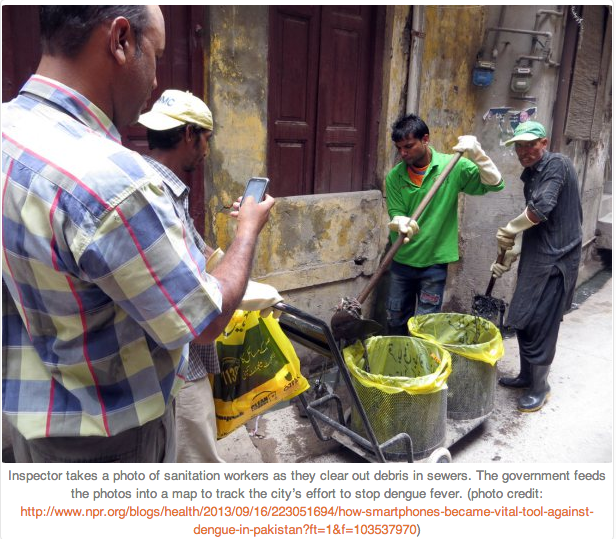
The first case, reported on by NPR, is a mobile application called “Clean Lahore,” which is aimed to reduce the infection of dengue in the Pakistani city. Designed by Umar Saif, a computer scientist, the app includes basic features such as photo-taking, map integration and mobile-uploading. The rationale is also straightforward: a field inspector follows sanitation workers and take before-and-after photos while the workers clean a spot (to ensure they don’t skip a spot where dengue mosquitoes can breed). The inspector then maps this location on the app and sends the information to the program supervisor.
Image
The result has been amazing: two years ago, there were more than 20,000 infections across the city but there have only been a dozen cases recorded in the area. Although other factors may have also played a role to decrease the infections, public health leaders believe “Clean Lahore” should be given much credit. ”There were 67,000 different prevention activities [that] were performed and were photo-logged by the smartphones,” Saif told NPR.

The second case is about an improvement to the website of the ALS Online Genetics Database, a non-profit online entity that provides information about mutation, geographical, and phenotype data on genes associated with or implied to have associations with Amoytrophic Lateral Sclerosis, a devastating fatal motor neuron disorder. There is only one goal for the improvement: to make the website mobile-friendly.  Like the first case, the results are also striking: according to iMedical App, the unique visits increased from 2231 to 2829 (26% change) and the visits from mobile devices increased from 103 to 340 (230% change).

The two cases clearly indicate the most basic mobile communication technologies can still generate significant impact in public health. Actually, some of the most successful mobile health initiatives in the past (e.g., Text4Baby and Mobile 4 Reproductive Health) were solely relied on the most basic features of mobile phone to engage users.

Advanced technologies may be able to handle sophisticated tasks in mobile health; however, what drives outcomes is not technologies but the thorough thinking and planning from health care professionals who possess a deep understanding in their fields.


 

TAGGED:mHealth
Share This Article
Facebook Copy Link Print
Share

Stay Connected

1.5KFollowersLike
4.5KFollowersFollow
2.8KFollowersPin
136KSubscribersSubscribe

Latest News

woman wearing white long sleeved shirt
Common Mistakes When Trying to Treat Hair Fall at Home
Fitness
March 20, 2026
Sunnyside Dentistry For Children: A Pediatric Dentist’s Pacific Northwest Story
Dental health
March 19, 2026
How Expanding Outpatient Nursing Options Is Reshaping Career Trajectories
Career Nursing
March 18, 2026
health care workers working together
How an MBA Healthcare Management Online Program Equips Leaders for Tomorrow
Health
March 18, 2026

You Might also Like

Healthcare IT: Will 2015 Be the Year of Data Breaches?

February 5, 2015

Employee Makes Fun of Patient on Facebook

January 5, 2012

Over $5 Billion in Medical Technology Financing in 2011

December 31, 2011
#OccupyHealthcare a jacket for Ben Miller
Social Media

#OccupyHealthcare

June 18, 2012
Subscribe
Subscribe to our newsletter to get our newest articles instantly!
Follow US
© 2008-2025 HealthWorks Collective. All Rights Reserved.
  • About
  • Contact
  • Privacy
Welcome Back!

Sign in to your account

Username or Email Address
Password

Lost your password?