The controversy over the pricing of Gilead’s Sovaldi for Hepatitis C is a textbook example of price discrimination in action. I hope that my quick review of some of the principles involved will help explain what’s going on.
The controversy over the pricing of Gilead’s Sovaldi for Hepatitis C is a textbook example of price discrimination in action. I hope that my quick review of some of the principles involved will help explain what’s going on.
Gilead sells Sovaldi for high prices in the US: up to $85,000 or so for a course of treatment. The price is a little lower in Europe, substantially lower still in middle income countries and less than $1000, or 1 percent of the US price in poor countries such as India. Such stark differentials set up major financial incentives for people in richer countries to obtain the product in poorer countries. With more than $80,000 per patient at stake, grey marketers could easily make millions of dollars and even an individual patient from a rich or middle income country would find it financially worthwhile to go to a low income country to procure the medicine.
This isn’t just theoretical. I was approached by a consultant representing large US employers who were exploring pharmacy tourism that would send patients abroad for their drugs.
Gilead has responded by taking steps to limit diversion of product. Patients must present IDs showing they are residents of the country to be eligible for the low-income country price. Patients can only get one bottle of medication at a time. Naturally some folks, including Doctors Without Borders, are complaining about the burden on patients and caregivers, and accusing Gilead of being greedy and maximizing profits.
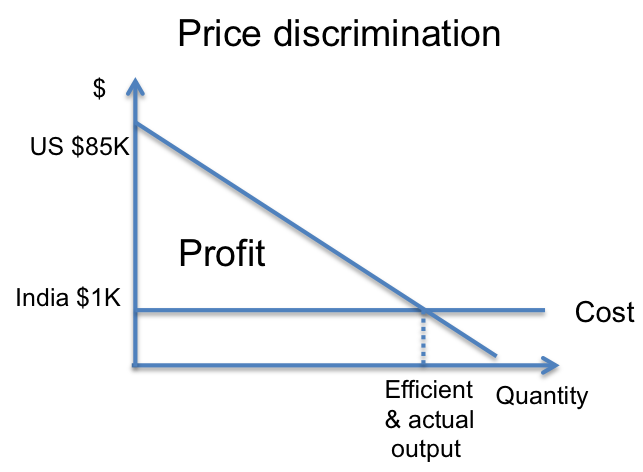
Although the anti-Gilead people have a valid perspective, my sympathy is mainly with Gilead. The concept of price discrimination: charging different prices to different customers based on willingness or ability to pay, maximizes a monopolist’s profits but it also maximizes societal benefit. As the simplified chart below illustrates, Gilead makes the most money if it can sell the medication at different prices in different countries. That also leads it to sell the highest quantity of product, meaning more people can be treated.
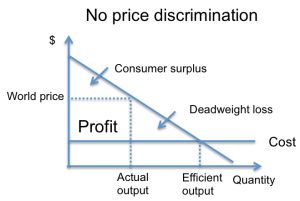
If Gilead were required to charge the same price everywhere in the world –as shown below– it would result in a windfall for consumers in high income countries (“consumer surplus”) and lack of affordability in poorer countries (“deadweight loss”), because patients in poorer countries could not afford to be treated. Even assuming Gilead wanted to maximize its profits in that scenario fewer people would get the treatment.
Because of the opportunity for price discrimination, Gilead was willing to introduce Sovaldi in rich and poor countries at the same time –something that doesn’t usually happen.
For price discrimination to work, the following conditions must hold:
- The firm (Gilead) must have some monopoly power. In this case the monopoly is based on patent rights. Gilead critics can try to undermine this power by encouraging governments to ignore patents.
- Markets must be able to be segmented and kept separate. Here that means segmentation by country, but theoretically it could be done down to the individual level so that rich people in poor countries pay the same or more than poor people in rich countries. (In rich countries there are other mechanisms to do this, such as patient assistance programs, but let’s not make this even more complex.)
- There can not be leakage between markets, otherwise the price is eroded in the expensive market. That’s why Gilead needs to confirm residency and why pharmacy tourism undermines societal benefit.
Price discrimination maximizes profits and maximizes societal benefits by increasing the number of people who can afford treatment, while rewarding the monopolist for bringing a valuable innovation to market. It’s not necessarily true that patients are harmed when Gilead maximizes its profit.
Allowing and even encouraging price discrimination is good global health policy. It encourages innovation and lessens global disparities.