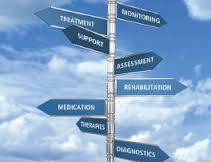
 Think of clinical pathways as maps: imagine a patient coming into the emergency room with abdominal pain. That’s a pretty non-specific complaint, and it could easily send an ER doc’s mind spinning with possibilities.
Think of clinical pathways as maps: imagine a patient coming into the emergency room with abdominal pain. That’s a pretty non-specific complaint, and it could easily send an ER doc’s mind spinning with possibilities. With this common complaint the patient’s condition could run the gamut from a mild case of indigestion to a potentially fatal acute abdomen: and it’s up to the doctor to suss out what’s causing the patient’s pain before their condition worsens.
Of course, along with that patient, a doctor in a bustling ER might also be tending to a child with a fractured arm, a teenager with a sore throat who needs a mononucleosis test and an elderly patient who’s had a fall. With so many stories to keep straight and problems to be fixed, it would be nice for physicians, nurses and allied health professionals to have a step-by-step approach, a clinical checklist, to make sure that nothing falls through the cracks, and that no patient is lost to follow-up.
That was sort of the impetus behind the development of clinical pathways. They follow an “if A then B” structure, helping to lead providers through triage, treatment and post-hospital care. Another common complaint, chest pain, can benefit greatly from clinical pathways to help providers assess the patient in a timely and effective manner. In the case of an acute condition or illness, the patient will receive intervention faster when clinical pathways are used.

Take a look at some of the clinical pathways developed by The Children’s Hospital of Philadelphia: in this care map, physicians have identified the most efficient method of triaging, assessing and treating a child that presents to the emergency room with asthma.
Each step of the care map expands to remind healthcare providers of not-to-miss steps along the way and alerts them to vulnerabilities, or signs, implying that the patient’s case may be headed toward something more acute. When reviewing protocols for triaging a child presenting with asthmatic complaints or respiratory distress, we see the following:
The care map continues throughout the assessment, treatment and follow-up plan for the child, and each step of the way the provider is lead to another step in the process. Each step moves them toward an establish goal, or measures, which hospitals use to help them either avoid penalties or earn financial incentives for meeting those metrics.
Metrics that hospitals measure, and that are supported through the use of clinical pathways, often include:
- Reducing ER wait times
- Reducing the the length of stay for patients
- Decrease rates of readmissions
- Decrease the rate of initial hospitalizations
- Increase follow-up
- Decrease rate of medication related mishaps.
By standardizing patient care, outcomes too become standardized and more predictable. The more predictable the patient outcomes, the more predictable (and controllable) the costs associated. Clinical pathways, or maps, are still evolving, but it appears that they will be great tools for hospitals that seek to wrangle costs and standardize patient care to improve their outcome measures in 2015.