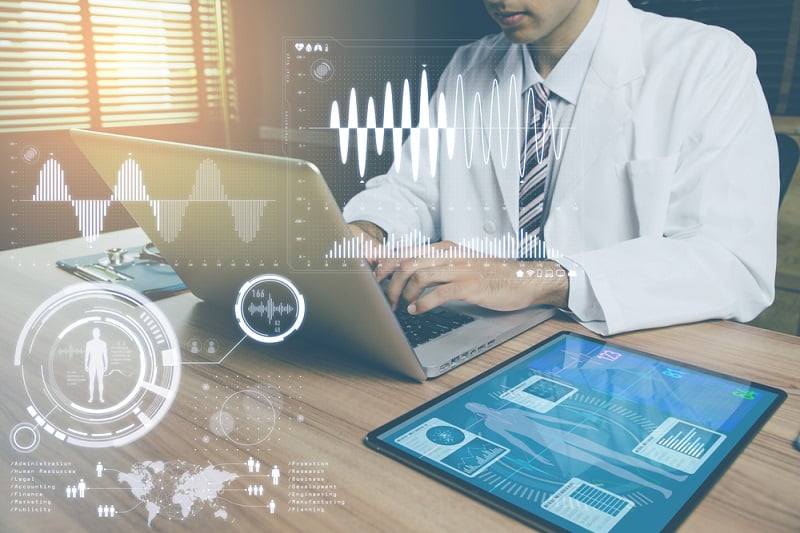
The IoT segment in the healthcare market is likely to hit the mark of 117 billion dollars by 2020 according to a report from market research. The role of IoT in healthcare industry is gaining more and more popularity due to its innovations. The development of technology is providing doctors and physicians with improved ways to treat their patients.
Statistics from Becker’s hospital review suggest that
- Nearly three-fifth of the healthcare providers use IoT devices in their institutions
- 73 % of facilities monitor their patients with IoT devices
- 89 % of the facilities have suffered from a security breach in their systems
- 87 % of organizations are planning on implementing IoT in their facilities by 2019
- Organizations feel that IoT has saved costs up to 57 % for their facilities.
As the above-provided data suggests, the implementation of IoT in healthcare is on a continuous rise. Organizations are looking for new ways to exercise the role of IoT in their facilities. There has been the development of many applications that can effectively help the treatment of patients. Some of these applications are listed below:
- Open-APS
Open artificial pancreas system is a free open source project that makes the APS (artificial pancreas system) technology easily accessible to all. This project was designed to make the availability of APS to masses quickly.
- Activity Trackers
Activity trackers developed by MSK and Medidata are used to gather information on day to day activities of patients who have cancer. The patients wear the activity tracker before their treatments. The trackers gather data on activities, fatigue, and appetite of the patient and store it on a platform. The data is useful when treatment is administered to the patient.
- Connected Inhalers
Novartis, a Swiss pharmaceutical company, is developing IoT connected inhalers for the chronic pulmonary disease. The device is connected to a platform which records and transmits the data to the cloud. Therefore, it is easily accessible. Devices connected to mobile apps help patients to receive constant reminders about their medication.
- Smart Contact Lenses
The smart lens technology which includes sensors enabled in the contact lenses is under development. The lenses will be able to measure diabetes of patients through their tears and store data on the device. Smart lenses are also being developed to help with presbyopia and various eye disorders.
- Coagulation Testers
Thrombin time (TT), Prothrombin time (PT), and partial thromboplastin time (aPTT) are some coagulation tests that are used to assess blood clots in patients. In 2016, a Bluetooth enabled system was launched by Roche that enables patients to check their blood clots. This device helps patients to stay in range of hospitals if there is a chance of stroke or bleeding. As it is connected to IoT, sending information to doctors online in case of emergency is easy.
As there are numerous applications of IoT in the healthcare industry so are the challenges that stand in its implementation. The most basic challenges are:
- Authentication
Hospitals should use a two-factor authentication system (2FA). It ensures patients’ security as a user has to provide biometric information (Phone Text Code, DNA sample and fingerprint) to access the records. 2FA applies restriction on accessing gadget and systems. It protects them from hackers.
- Data storage
There should be a centralized data dictionary to store health records of patients. Making separate inventories for each type of records makes retrieval and management difficult. A single location helps hospitals to access the critical information in the minimal time.
- Encryption
Hospitals must use encryption to avoid data breaches. They should insist their vendors for the use of hardware-level encryption. It does not affect CPU cycles and memory,unlike software-level encryption that deteriorates performance.
- Education and training
Hospitals need to train their employees about the functioning and usage of various IoT devices. They must also be aware of the risks and challenges in handling IoT devices. Lastly, patients should also understand the critical information about IoT devices as they are the regular users of them.
There are numerous applications of IoT in healthcare. It provides better analysis and monitoring of patients’ health. The healthcare industry must consider all the security issues and challenges that may help them in the growth of their business. Moreover, with the growth in competition, the enterprises will need to invest in IoT in the coming time.