(This post first appeared on Educate the Young)
(This post first appeared on Educate the Young)
 In a recent Baltimore Sun piece, healthcare writer Marie McCarren wrote an op-ed providing “A prescription for fewer medical errors” — reflections from an emergency room visit with her husband that later turned into a stay on the intensive care unit. McCarren emphasized the need for healthcare providers to work at clearly communicating the ways in which family members of patients can help make care safer. She advises healthcare executives create meaningful patient handbooks that provide clear ways for patients to keep track of the complicated care system at what is most often one of the most stressful times in their life. She reminds us:
…Hospital executives, please listen. We are untrained and underslept, scared and stupider than we are in regular life. And we’re passive, because we want very much to believe that the doctors and nurses have the situation under control. Exploit our weaknesses. Give us a framework that will help us come up with useful questions and essentially order us to use it. I believe it would result in fewer mistakes and shorter hospital stays…
Almost in tandem, the Association for Healthcare Research & Quality (AHRQ) released the Guide to Patient and Family Engagement in Hospital Quality & Safety, outlining the value of inviting patients and families to engage in their care, and providing a “how to” for those still unsure. The guide covers the following topics:

- Information to Help Hospitals Get Started, which addresses: a) How to select, implement, and evaluate the Guide’s strategies. b) How patient and family engagement can benefit your hospital. c) How senior hospital leadership can promote patient and family engagement.
- Strategy 1: Working With Patients and Families as Advisors shows how hospitals can work with patients and family members as advisors at the organizational level.
- Strategy 2: Communicating to Improve Quality helps improve communication among patients, family members, clinicians, and hospital staff from the point of admission.
- Strategy 3: Nurse Bedside Shift Report supports the safe handoff of care between nurses by involving the patient and family in the change of shift report for nurses.
- Strategy 4: IDEAL Discharge Planning helps reduce preventable readmissions by engaging patients and family members in the transition from hospital to home.
*For more information about the Guide to Patient and Family Engagement in Hospital Quality and Safety, contact Margie Shofer at (301) 427-1259 or Marjorie.shofer@ahrq.hhs.gov.
Many health systems have begun to create patient education and admission materials that do in fact take some of these factors into account. If you, or a loved one, are about to become a patient, be sure to ask how you can best partner with your care team. If possible, request patient education materials well before your stay and provide feedback!
We know that engaged patients have the potential to not only help make care safer, but also improve outcomes. There are many intelligent people, with a fresh outlook and vested interest in these outcomes waiting on the sidelines. If you are a care provider, find a way to invite them in. And please, share your results with us.
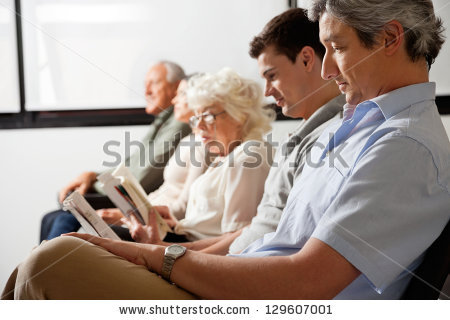
(Engaged patients / shutterstock)