We use cookies, including third-party cookies from Google to serve personalized ads through AdSense, to operate this site and understand how it is used. By continuing to browse, you accept this use. See our Privacy Policy and Terms of Use for details, including how to opt out of personalized advertising.
Accept
Health Works CollectiveHealth Works CollectiveHealth Works Collective
  • Health
    • Mental Health
  • Policy and Law
    • Global Healthcare
    • Medical Ethics
  • Medical Innovations
  • News
  • Wellness
  • Tech
Search
© 2023 HealthWorks Collective. All Rights Reserved.
Reading: Fighting Heart Disease Using the Web: 3 Tips for Success
Share
Notification Show More
Font ResizerAa
Health Works CollectiveHealth Works Collective
Font ResizerAa
Search
Follow US
  • About
  • Contact
  • Privacy
© 2023 HealthWorks Collective. All Rights Reserved.
Health Works Collective > Specialties > Cardiology > Fighting Heart Disease Using the Web: 3 Tips for Success
CardiologyeHealthPublic HealthSocial Media

Fighting Heart Disease Using the Web: 3 Tips for Success

Jayme Hummer
Jayme Hummer
Share
3 Min Read
Heart Disease Prevention
SHARE

In the U.S. one in every three deaths is related to heart disease or stroke, which, according to the CDC, equals 2,200 deaths per day or 800,000 deaths per year. Figures like this drove Enspektos to look at where people are searching for and encountering heart disease related information online. To take it one step further, we wanted to know if this online content was going to change their heart health behavior and lead to people taking preventative measures than can reduce the risk of heart disease and stroke.

In the U.S. one in every three deaths is related to heart disease or stroke, which, according to the CDC, equals 2,200 deaths per day or 800,000 deaths per year. Figures like this drove Enspektos to look at where people are searching for and encountering heart disease related information online. To take it one step further, we wanted to know if this online content was going to change their heart health behavior and lead to people taking preventative measures than can reduce the risk of heart disease and stroke.

An early analysis of data collected via digihealth pulse gave us specific insights into creating online content which is most successful at persuading people to take steps in preventing heart disease.

Tip 1: Know Where To Reach People Who Are Searching for Heart Disease Information

More Read

Rural Health White Paper Released by UnitedHealth Group Think Tank
Mobile Health Around the Globe: Smartphone Microscope for Nano Particle Detection
Just-in-Time Health Information Systems Are Coming: Are You Ready?
Everything We Know in Health is Wrong. Medicine is a Science, Not Dogma. #askforevidence
HIPAA & Health IT: $872 Million in Incentives

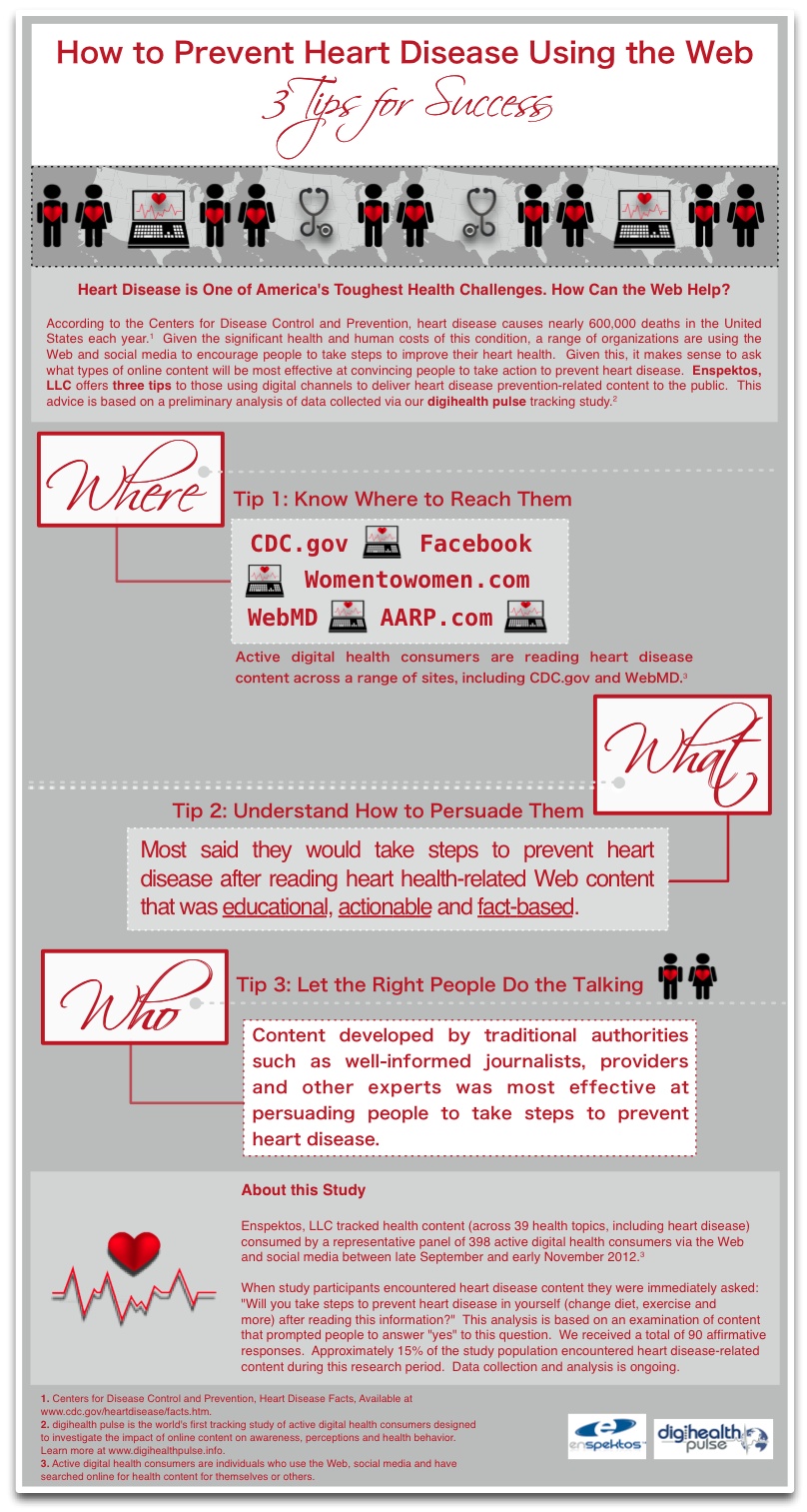
digihealth pulse data indicated people were relying on sites such as CDC.gov, WebMD, AARP.com and womentowomen.com for relevant, credible heart disease information.

Tip 2: Understand How to Persuade People to Take Action to Improve Their Heart’s Health

After carefully looking at the websites that persuading digital health consumers to take action around their health we found that content that is educational, actionable and fact-based is most effective. To read specific examples of this content click here.

Tip 3: Rely on Experts for Heart Disease Content Development

Heart-health content produced by medical professionals, government officials, and well-informed journalists was rated highly credible among our panel of digital health consumers and was most likely to influence behavior change and lead people to say they would engage in heart health improvement activities.
 Heart Disease Prevention


Check out more information on this study and these tips by clicking here.

TAGGED:heart disease
Share This Article
Facebook Copy Link Print
Share

Stay Connected

1.5KFollowersLike
4.5KFollowersFollow
2.8KFollowersPin
136KSubscribersSubscribe

Latest News

The Administrator's Guide to Auditing Regulated Waste Before an OSHA Inspection -- AI-generated illustration
The Administrator’s Guide to Auditing Regulated Waste Before an OSHA Inspection
Policy & Law
August 31, 2026
What Geographic and Specialty Variation Reveals About How Nursing Compensation Actually Works -- AI-generated illustration
What Geographic and Specialty Variation Reveals About How Nursing Compensation Actually Works
Career Nursing
August 27, 2026
Could Poor Ventilation Be Behind Your Afternoon Headaches?  -- AI-generated illustration
Could Poor Ventilation Be Behind Your Afternoon Headaches? 
Health
August 27, 2026
The Myth That Keeps People Stuck -- AI-generated illustration
The Myth That Keeps People Stuck
Addiction Recovery
August 25, 2026

You Might also Like

Doctors in Australia Will Please Maintain Silence on Social Media.

September 13, 2012
BusinessMedical RecordsNews

Stage 2 of Meaningful Use Delayed to 2014

December 2, 2011

Healthcare Data Breaches Up 32%

December 2, 2011

Dispelling the Myths of a Healthcare IT Investment ‘Bubble’

July 16, 2011
Subscribe
Subscribe to our newsletter to get our newest articles instantly!
Follow US
© 2008-2026 HealthWorks Collective. All Rights Reserved.
  • About
  • Contact
  • Privacy
Welcome Back!

Sign in to your account

Username or Email Address
Password

Lost your password?