Last week, we heard from Trish Broome at LifeBridge Health and the use of social media to engage and educate patients.
Last week, we heard from Trish Broome at LifeBridge Health and the use of social media to engage and educate patients.
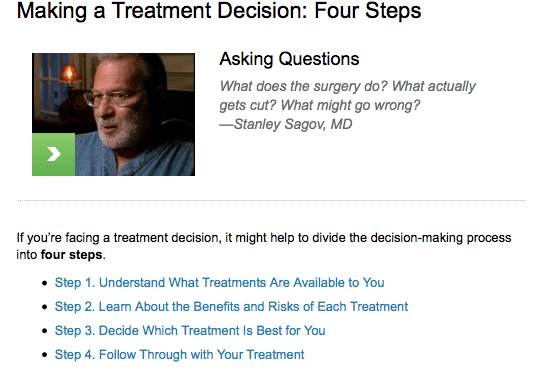
This week, I would like to bring your attention to the Decsion Aid, a wonderfully helpful educational tool for patients developed by Informed Medical Decisions Foundation and Health Dialog and developed by David Arterburn and the team at Group Health Research Institute. A decision aid is a collection of video and/or printed material that helps patients who are at a crossroads, trying to decide whether to have a procedure or not. Group Health has developed decision aids in 6 specialties: orthopedics, cardiology, urology, women’s health, breast cancer, and back care and distributed more than 25,000 of these aids so far.
Patients can read decision aids and watch the videos with their family at home. A DVD can be mailed to them or they can watch online at Group Health’s secure website for patients. They can discuss the situation with family members or their medical team and make an informed decision that suits them personally.

Decision aids do not try and influence patients one way or the other. They are configured to give the patient information needed to make a personal decision. Decision aids can cover medical information about anatomy, disease process, diagnosis, tests, and surgical and non-surgical treatment (physical therapy, medication, lifestyle changes, etc.).
The decision aids also cover topics such as:
- Using Medical Tests Wisely
- Getting the Most Out of Your Doctor Visits
- Asking for a Second Opinion
- Managing Your Medications
- Finding Reliable Medical Information
- Creating Your Own Health Record
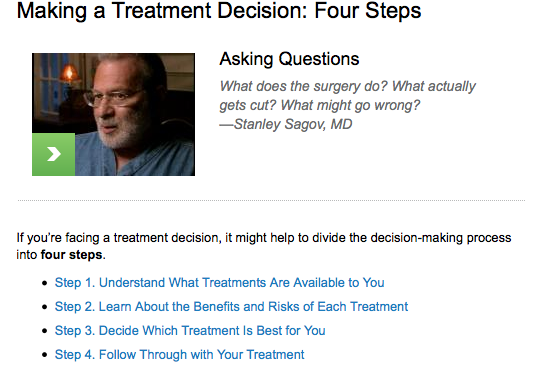
- Making a Treatment Decision (4 Steps)
and others.
To view a decision aid, please see here.
In Washington, in 2007, the state passed legislation recognizing decision-aid use and shared decision making as a higher standard of informed consent. In 2009, as part of a quality-improvement program, Group Health leaders, providers, and staff started to implement decision aids as part of their program.
A recent study done showed that costs for knee and hip surgery declined substantially after patients made decisions for surgery based on decision aids. Research has shown that patients tended to make more conservative decisions after viewing the decision aids and seemed to be more content with their choices.
To quote from an article by HealthGroup on the study:
“Joint replacement can reduce pain and improve function for many patients,” said co-author Charles F. Jung, MD, Group Health’s chief of orthopedics. “But so can many nonsurgical actions that people can take to help ease their knee and hip arthritis.” Dr. Jung said. Because excess weight strains joints (particularly knees), the main action is to lose any extra weight. Other examples are physical therapy, nonsteroidal anti-inflammatory drugs like ibuprofen, avoiding injury, and mixing up a variety of low-impact activities, like walking, swimming, and biking. “These are the same things that we suggest for patients who choose surgery, to lower the risk of their new joint failing and needing to be replaced again, which can be more complicated,” he added.
“People often have wishful thinking about what joint replacement can do for them,” Dr. Jung said, “like our patient who thought he’d be his club’s singles-tennis champ again.” Biased information sources, including direct-to-consumer ads for artificial joints, may fuel such expectations. By contrast, decision aids serve as a balanced reality check, describing factors including the three-month recovery time, the 10- to 20-year lifespan of artificial joints, and risks such as infection and possible reoperation. “After people see a decision aid, they tend to come into our office with more realistic expectations, and we can have a more focused discussion about what matters most to them as individuals,” he added.
Dr. Arterburn explains further, “After weighing the pros and cons in the context of their own values and preferences, patients can make the right choice, at the right time, for the right reasons for them.” Also, because patients take part in their decision-making, they are more apt to be satisfied with the result.
“This has helped to improve Group Health’s culture of care so it is centered even more on the individual patient,” says Dr. Arterburn.
View the excellent GroupHealth video below for more information:
If you like this post, please read other posts in the series on the Person-Centered HealthCare main page.
And if you have a story to tell that may be a fit with our series, please comment below or email me at joan@socialmediatoday.com