First published on Medical Daily
First published on Medical Daily
More Read

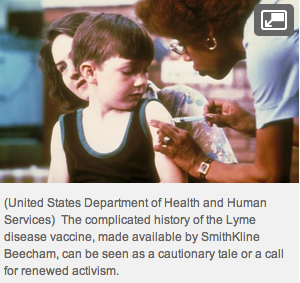
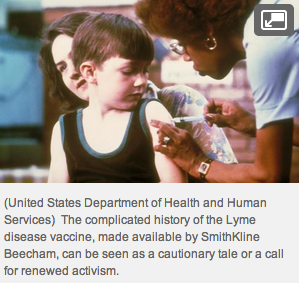
A recent New York Times opinion piece calls for a return of the vaccine for Lyme disease. “Return?” you ask. Most people never knew that a vaccine for Lyme disease ever existed. The fact is, LYMERix did exist, if only briefly, with a lifespan nearer that of a tick than of a human being: it was available from 1998 to 2002.
The history of this vaccine is somewhat complicated and, according to researchers from Children’s Hospital Boston and Harvard School of Public Health, offers us all a “cautionary tale.” In their words as published in Epidemiology and Infection, “The LYMErix case illustrates that media focus and swings of public opinion can pre-empt the scientific weighing of risks and benefits in determining success or failure.”
The Story of One Vaccine
A tick-borne illness in North America and Europe, Lyme disease is caused by a bacterium known as Borrelia burgdorferi, and it is passed by deer ticks, which feed on the blood of both animals and humans. Ticks carrying the disease thrive in grassy and heavily wooded areas, and the disease is named after the Connecticut town where a number of cases were identified during the 1970s. Early symptoms, as recorded by the Mayo Clinic, include a distinctive bulls’ eye rash and flu-like symptoms, such as chills and fever. Later symptoms include joint problems that resemble arthritis and neurological issues, including weakness and impaired movement. Typically, it is treated by a course of antibiotics, which is effective for most people, especially in the earliest stages. To prevent the disease, it is recommended that you inspect your skin for ticks and remove them promptly.
LYMERix was developed by SmithKline Beecham and approved by the U.S. Food and Drug Administration (FDA) in December 1998. The Phase III safety and efficacy trial enrolled 10,906 subjects between the ages of 15 and 70 years old, all living in endemic areas. Generally, the Northeast and Mid-Atlantic states, the Upper Midwest region, and the West Coast, specifically northern California, are the areas where the disease is considered endemic by public health officials. For SmithKline Beecham’s clinical trial, during which the vaccine was tested before being released to the general public, researchers ‘randomized’ the participants into two groups: those who received the three-dose Lyme vaccine regimen and those who received placebo injections.
“Vaccinated individuals showed a 76 percent reduction in Lyme disease in the year following vaccination, with no significant side-effects noted,” according to published research. Based on these very promising findings, the FDA approved the vaccine, though scientists noted its limitations — in particular, the fact that the safety tests did not include young children (a population at high risk for the disease). Another problem was that the FDA as well as the company producing it were uncertain as to the duration of immunity. For people who had received the vaccine, booster doses might be necessary as often as every year. Still, despite its imperfections, LYMERix was ‘suggested’ by the Advisory Committee on Immunization Practices for persons who live in an endemic area and who engage in activities that result in frequent or prolonged exposure to ticks.
All good so far, but dark clouds appeared almost immediately on the horizon.
Activists and Media
After receiving the vaccine, some people reported side effects, in particular arthritis-like complaints, previously unrecorded in the testing data. The Lyme Disease Network, a non-profit citizen action group, placed great emphasis on this, and a class action lawsuit against SmithKline Beecham was soon filed. Soon enough, the FDA reconvened its advisory panel in January 2001 to discuss the vaccine. After reviewing evidence, the FDA allowed the manufacturer to continue to sell the vaccine while requiring more data — accomplished by entering more participants in Phase IV trials of the vaccine — as to its safety and efficacy. Despite the FDA’s continued endorsement, sales dropped and in February of the following year, the company removed LYMERix from the market.
LYMERix died, then, “even though studies indicated the vaccine represented a cost-effective public health intervention for people at high risk of acquiring Lyme disease,” the researchers wrote. Clearly, Stanley A. Plotkin writing for the New York Timesagrees this amounts to a sad cautionary tale. His own son had become gravely ill due to Lyme disease but survived. Naturally, he hopes that no one else need undergo the same pain. “The experience of Glaxo has unfortunately frightened other companies away from pursuing this needed vaccine,” Plotkin stated in his published piece. “Physicians and patients should write to the C.D.C. to remind them of high public demand.” Clearly, Plotkin believes activism cuts both ways with participation entirely a matter of individual belief.
Source: Nigrovic LE, Thompson KM. The Lyme vaccine: a cautionary tale.Epidemiology and Infection. 2006.