(Editor’s Note: Dan Munro writes for Forbes.com under the heading “Healthcare Compass”)
(Dan will appear as a panelist in our upcoming webinar, How to Provide High Quality, Low Cost HealthCare, on Wed, July 24th at 12 noon EDT – Please join us!)
(Editor’s Note: Dan Munro writes for Forbes.com under the heading “Healthcare Compass”)
(Dan will appear as a panelist in our upcoming webinar, How to Provide High Quality, Low Cost HealthCare, on Wed, July 24th at 12 noon EDT – Please join us!)

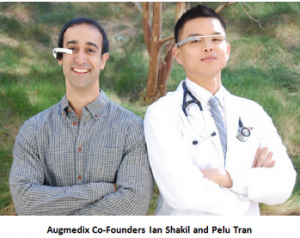
I can’t say for sure that the fictional Google GOOG -1.53%Glass instruction in the headline has happened – but given a quote on the Augmedix website – it’s a safe bet it either has – or will soon.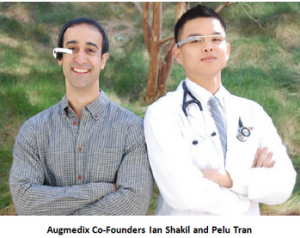
“I didn’t even notice it [Google Glass] until the doctor pointed them out.”Patient quote on Augmedix website
Several startups are actively working at the intersection of Glass and Healthcare, but perhaps none more directly than Augmedix – the startup that “… was founded with one core belief: technology can free physicians and allow them to focus on what they do best – taking care of patients.”
Earlier this year, the publication Medical Daily outlined 12 examples of how Glass could be used for personal wellness and 14 examples of how Glass could benefit providers clinically (here).
Forbes colleague John Nosta recently highlighted how Glass was used by a surgeon during a fairly routine surgical procedure (here) and just yesterday, Christian Assad-Kottner, MD (a Cardiology Fellow at UTMB and The Methodist DeBakey Heart Center) described a prototype application he’s working on called CPRGlass that could (in theory) provide potentially life-saving and interactive CPR instructions (here).
Life saving CPR aside, there are clearly dozens of immediate and practical applications for Glass in healthcare. In fact, we don’t even need the technical sophistication of Glass to accomplish many of the same objectives. Any smartphone can easily capture and record both audio and video of a patient encounter (either at the scene of an accident, at home, at work or in the exam room).
Cars have already begun using cameras for exterior video capture (with Google’s own self-driving cars being the highest technical achievement), but can video monitoring inside the cabin be far behind? Ford is working on embedding sensor technologies that will aid with driver safety, comfort and convenience.
A low cost (by healthcare standards) Microsoft MSFT -11.37% Xbox (with Kinect) could capture not only the audio and video portion of a patient encounter in an exam room – but also the heart rate (and potentially other vital signs).
The point is simply that the technology has definitely arrived. While I haven’t seen one yet, it’s easy to imagine a GoPro camera as a low-cost solution for high-definition video capture inside almost any exam room, urgent care, ambulance or emergency room setting. E-Visits (online consults with a webcam and HIPAA compliant software) are easily able to record the audio and video portion of patient encounters and there’s even a billing code for provider reimbursement.
In a similar vein, the VA is working with anonymous avatars to help vets with sensitive (and often personal) behavioral health issues online. For some Vets – it’s an easier way to talk with some anonymity about issues that can be awkward with a total stranger.
The question isn’t will this happen, but rather what are the new rules governing patient encounters and engagement? Are surgeons free to record surgical procedures for personal or professional use? Who is the rightful owner of the recorded data?
As Hugo Campos knows all too well (TEDx talk here), the issue of data ownership remains unresolved for his own implantable cardiac defibrillator (ICD). Turns out Medtronic MDT +0.59% (the ICD manufacturer) considers that data the legal property of the company – and patients have no legal rights to the data at all. Will the healthcare provider community see these new recording capabilities as yet another opportunity to leverage data and hold patients captive – or will they openly share the data as a logical extension to a patients own health record?
Dr. Bryan Vartabedian (“Dr. V” as he is known from his own blog – 33 Charts) recently commented on a patient visit where the exam was recorded – by the patient.
“During a clinical encounter recently the mother I was visiting with reached down to the phone sitting on her chair and discreetly hit a red record button.” Dr. V – 33 Charts – Doctors On The Record
One big question there – why the discretion? As patients, do we need provider consent to record our encounters or should this be an assumed right? Does that consent need to be in writing? Can providers refuse to be recorded for services paid by either patients directly – or insurance companies indirectly? Contrary to Dr. V’s open (and positive) acceptance of the recording, the statistics around provider comfort with electronic recordings is low (some I have talked with suggest it’s below 10%).
Of all the technologies that are being considered for healthcare use – perhaps none represents the digital divide more clearly than bringing recording technologies (all forms) into the patient-provider dialog. Those that envision the breathtaking attributes and applications of technology in healthcare and those who, as patients, are simply hoping to survive any major healthcare encounter intact – and hopefully without going bankrupt.
Healthcare needs a tech reality that brokers both constituents with equal aplomb. We should absolutely embrace and promote technologies that aid with patient safety, engagement, health and cost, but not at the sole discretion or exclusive benefit of the provider. In the same way that doctors are free to use Glass to record a patient encounter for their needs, patients should also be allowed the right to record the encounter for their needs – or at least receive a free copy of any recording made.
That instruction in the headline – “OK Glass, Start Patient Record” – may well be a command coming soon to a provider near you, but the final Glass instruction should also be: “OK Glass, Send Secure Copy to Patient.” The concern is that we’re quick to showcase the former – which is often easy and logical – at the expense of the latter – which is less intuitive, often cumbersome and where the real work around patient engagement begins.