If an apple a day keeps the doctor away, what can a knee bend do? The American Academy of Orthopedic Surgeons recently answered this question with the results of a new study of the impact of physical therapy on surgical outcomes for hip replacement. The answer: “Prehabilitation reduces the need for perioperative care by 30%.” Amazing results, especially considering that total joint replacements will increase by 400% by 2030 according to the academy.
If an apple a day keeps the doctor away, what can a knee bend do? The American Academy of Orthopedic Surgeons recently answered this question with the results of a new study of the impact of physical therapy on surgical outcomes for hip replacement. The answer: “Prehabilitation reduces the need for perioperative care by 30%.” Amazing results, especially considering that total joint replacements will increase by 400% by 2030 according to the academy. Considering that post-acute care costs are the fastest rising and most variable, an investment in pre-habilitation can pay off huge dividends. Based on data from the AMA and CDC we’ve estimated that a 10% decrease in post-acute care costs could help realize $4.3B in savings over this same period. The AAOS study showed that patients who received pre-habilitation saw a decline in up to $1,215 per patient in perioperative care, due to a decrease in costs for skilled nursing and home care. Given that total joint replacement costs vary from a low of $6000 to a high of $30,000, providing pre-habilitation and a means for patients to be adherent is a very easy way to get to this 10% decrease. If you’d like more information on how we calculated these costs contact us.
The theme of pre-habilitation was also prevalent at the recent ACRM annual congress in Toronto, consider it the preventative health of rehabilitation, which literally means the act of restoring something to it’s original state. If you can decrease the amount of damage done in the first place, restoring it to the original state becomes easier or at least if you don’t see complete recovery, you see better outcomes. Two sessions at the conference explored this concept where there was known risk of damage: one focused on pre-habilitation for cancer patients that would need to undergo surgery, and the other a focused study on adults with lower back pain who were at risk of declining.
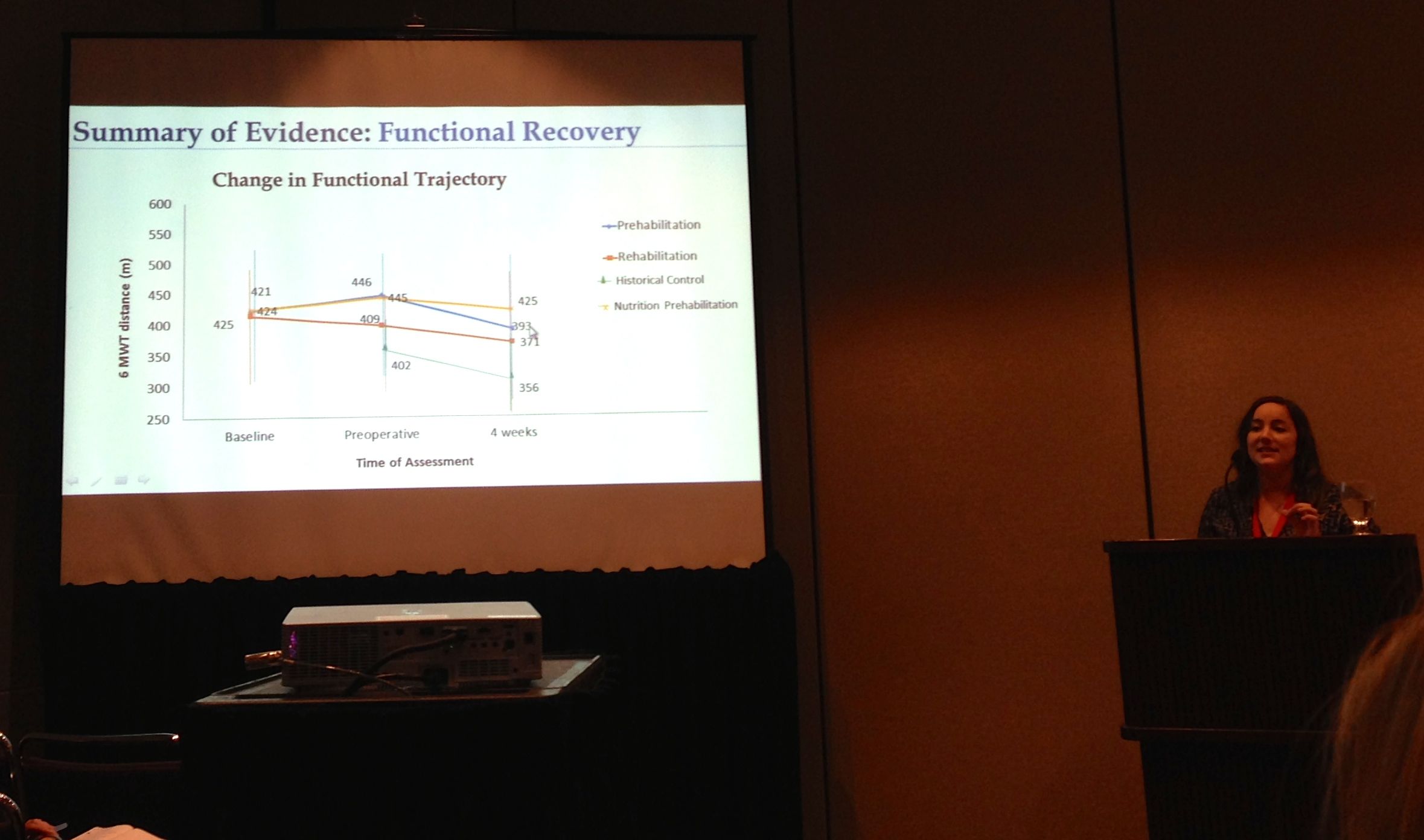 One session focused on pre-habilitation for patients undergoing cancer surgery, and was striking both for the outcomes and for the collaborative and interdisciplinary team. The session, “Improving Outcomes With Multimodal Prehabilitation in Surgical Cancer Patients” was notable both for the outcomes presented and for the strength of the collaborative and inter-disciplinary team that included led by Dr. Carli from McGill University that included physicians, dieticians, and physical therapists. The team presented the results of their randomized clinical study that showed that a prehab program including strength training, exercise, diet, and nutrition counseling could decrease hospital stays by ½ a day and that the strength training helped patients compensate for surgery-related weakness perioperatively.

Patients were given either just nutrition counseling or nutrition counseling plus a whey supplement or a placebo. Patients with nutrition counseling sustained their levels in the 6 minute walk test before and after surgery. Patients with both nutrition counseling and the whey supplement improved their distances in the 6-minute walk test after surgery.
Together the strength training, nutritional counseling, and protein supplements improved patient surgical outcomes. Ideally, nutrition counseling was recommended to begin at cancer diagnosis, but at the very least pre-surgery. This study proved that there are modifiable patient risk factors before surgery that can improve outcomes.
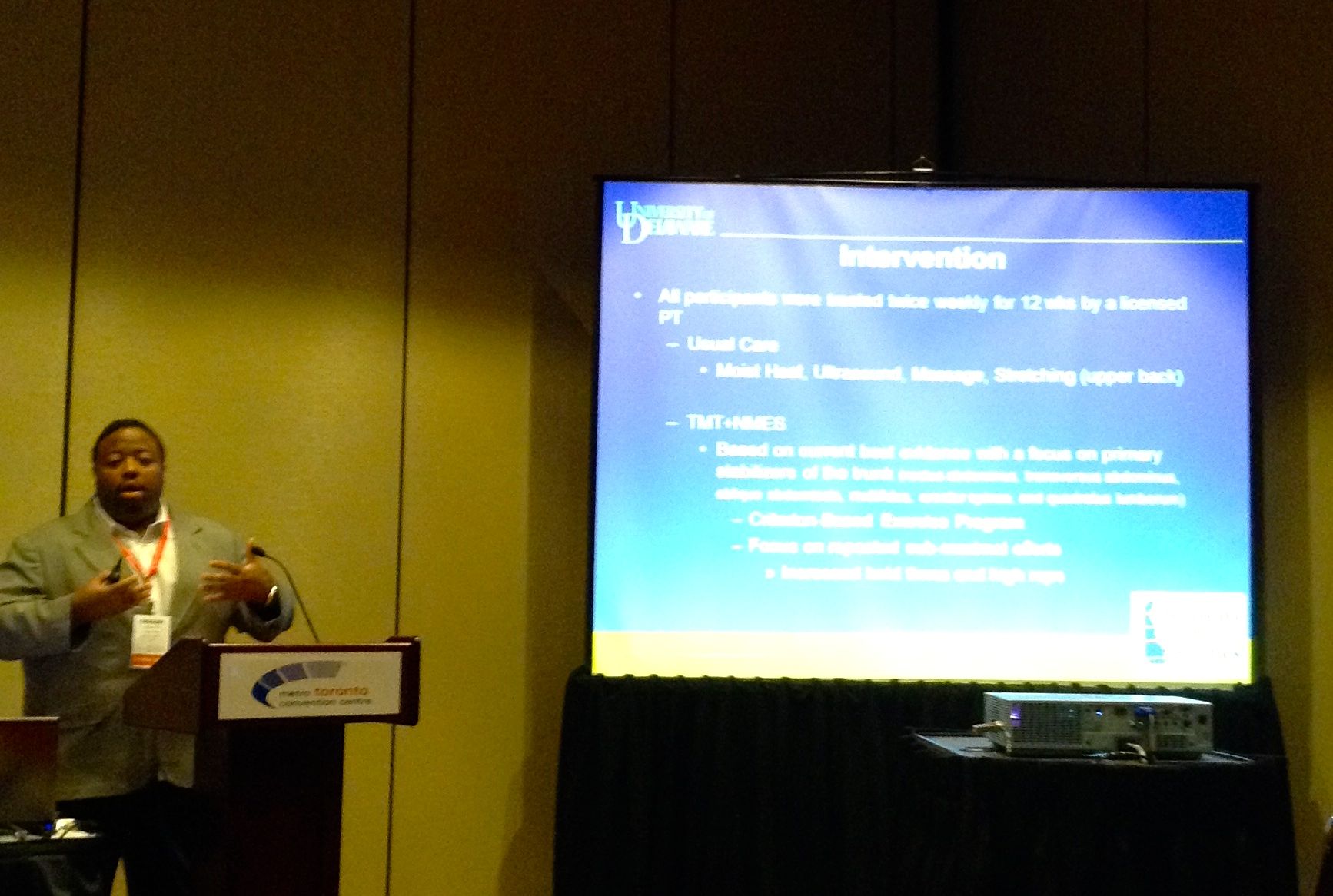 A second study outlined by Dr. Gregory Hicks from the University of Delaware in the session “Novel Ways to Improve Mobility and Physical Function in Older Adults: A Targeted Intervention Approach”, looked at whether stabilizing trunk exercises could prevent decline in high-risk seniors. Interestingly, the presenter X pointed out, any studies involving trunk muscle stabilization had purposely excluded adults over 65 so there was no evidence of the impact. In this study, the control group was given the usual care condition of heat, ultrasound, massage, and stretching. The second group was given trunk muscle training and Neuromuscular Electromagnetic Stimulation. Unfortunately, the second group had low adherence to their programs, and were not happy to miss out on heat and massage. This probably says more about the need for patient education and engagement than anything. In many studies strengthening exercises have proven helpful, but not if you can’t get patients to do them. Regardless, patients in the trunk muscle group had a 17% higher rating on the top 3 functional limitations that they had reported as being most important to them at the outset of the study and their exercise self-efficacy was expected to continue to improve over time.
While the results were positive, Hicks outlined some of the limitations of the study, including the exercise adherence but also pointed out that patients had different outcomes based on the physical therapist delivering the treatment and based on how closely they identified with the pre-defined outcome measures that were used in the standard tools (OSWESTRY). This brings up an interesting point about how to deliver care.
While research has proven that proactive activities, like improving diet or exercise, can improve outcomes, patients, and by that I mean humans, are subject to human nature, which is not always doing what’s in our own best interest.
There are ways to change this within the care delivery system to help patients adhere to their treatment plans:
- Making sure patients understand what they are being asked to do
- Making it easy to follow instructions
- Fostering a positive relationship between patient and healthcare provider
Adapted from http://www.ncbi.nlm.nih.gov/pmc/articles/PMC1661624/pdf/tcrm0103-189.pdf
These principles are fundamental to our Wellpepper patient engagement solutions and help us get over 70% patient engagement. We’re pretty excited to see the opportunities for these types of solutions to be used in pre-habilitation scenarios that are proven to improve outcomes.