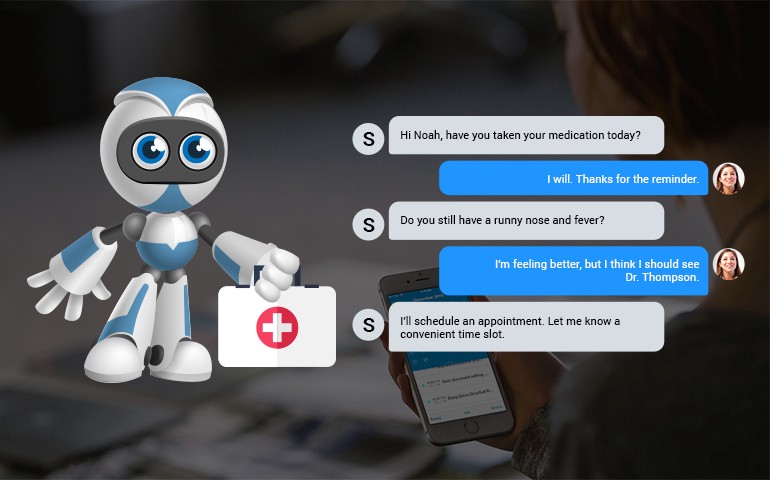
Whether you are an Android user or an iPhone user, AI is has been an integral part of our lives. From asking Siri about the weather or asking Google Assistant to make a call to someone, these AIs make lives easy. But are we equally comfortable to talk with medical chatbots?
Healthcare is a big concern for everybody and we always look forward to a doctor’s instructions regarding any health-related concern that we have. But will we be comfortable in taking the same kind of advice from a robot, even if it is approved by a professional medical practitioner?
The chatbot industry is growing at a rapid pace with a hope to cut costs. Though, Artificial Intelligence is in its early stage, many fears the risks involved, letting bots deal with only the non-vital tasks. However, this technology can help in improving the living standard of the patients in remote areas, who have limited access to healthcare facilities.
Artificially Intelligent Medical Assistants
ELIZA, the first ever bot that mimicked a Rogerian therapist, is considered as a milestone example for the modern day conversational interfaces. Let’s take a view of some of the modern chatbots which can perform tasks like booking appointments or even remind you to take your pills on time.
More Read
- Florence – the chatbot nurse who can tell you to take your medicine, remind you if you forgot to take a pill, monitors your daily health, monitors periods for women, and helps you find and book appointments with specialists in your area.
- MD – is like an assistant of a General Physician which ask you questions approved by healthcare professionals to identify a condition based on your symptoms before referring or setting up an appointment with an actual physician.
- Safedrugbot – is a messaging app dedicated to mothers. It helps the doctors to take notice of the possible side effects a drug can cause during breastfeeding.
- Babylon Health – is a conversational healthcare assistant which facilitates booking a doctor.
- SimSensei – is the newest technology which is still in experimental phase. This uses the voice, face, and gesture recognition to imitate a therapist, allowing the patients to deeply connect with the doctor similar to that of an in-person experience.
Uses of Chatbots in Healthcare
With the growing AI industry, there are endless possibilities as to how chatbots can be used. But with the current limitations, it is safe to use them for the actions which can be performed by an intern who is intelligent, good-natured but still learning.
At present, the safe uses of medical chatbots include:
- Booking doctor appointments based on the symptoms
- Monitoring health
- Notifying a human nurse if parameters go out of control
- Informing homecare assistant about improvements in patient
These intelligent bots can also take care of billing, inventory management, claims management, replacing the need for a customer service representative.
These bots are still in the evolution phase and must not be considered as a complete replacement of proper medical care. Yet, they can provide you a little comfort and reassurance until you see a doctor.
How Chatbots work in Healthcare
The medical chatbots functions on four basic structures:
- Natural language processing – to understand user’s demands
- Knowledge management – to provide relevant answers
- Deep learning – to improve responses to each interaction
- Sentiment analysis – to identify user’s frustration/disappointment in order to transfer them to a human channel
Depending upon its composure, a chatbot will try to forecast the interaction and be prepared to provide appropriate choices to the user.
Regulation of Chatbots
Chatbots must follow the same rules and regulations as any other software and must pass the privacy and security compliance if they are becoming the part of the medical system. They must ensure that the patient’s information remains secure and confidential and in any way, must not be directly exposed to the risk of hacking.
A chatbot is much more than static software. Hence, knowledge-based management rules must be implemented to ensure that any information derived during the interaction with the patient is compliant to ethical medical practices.
A bot should only be made available to the patient once the initial data has been completely verified by qualified medical personnel. Apart from the data fetched from existing drug prospects, FAQs, and medical manuals, the bot must remain up to date with the latest research in the medical field.
Relationship with Doctors
A chatbot can never replace the expertise of a professional doctor, as some have with engineers, manufacturers, and miners. However, a bot can be a trustworthy assistant to the doctor performing tasks like attending patients and handling registration.
Chatbots are not only for patients but provide benefits for doctors in the following ways:
- Providing 24×7 support to the existing patients
- Answering simple and repetitive questions from the patients
- Help to check any side effect of a medicine at any point of time
- Providing medicinal instructions and dosage calculators
Chatbots cannot offer diagnosis, but they can perform initial triage making it easier for the doctor to diagnose.
Conclusion
Chatbots are supposed to bring a revolution in different fields like insurance, banking, and retail. There is no doubt that medical sector can also benefit from the chatbots as they save costs for customer care.
However, extra attention must be the given to the automated functionalities of the chatbots as a simple mistake could be life-threatening.
Therefore, it is best to use chatbots for the simple and repetitive tasks which can save the doctor’s precious time while simultaneously focusing on providing the best experience to the patient before he is scheduled to meet the doctor.If you are sharing my views, don’t hesitate to reach out and partner up. We are always glad to make a significant contribution to the society.