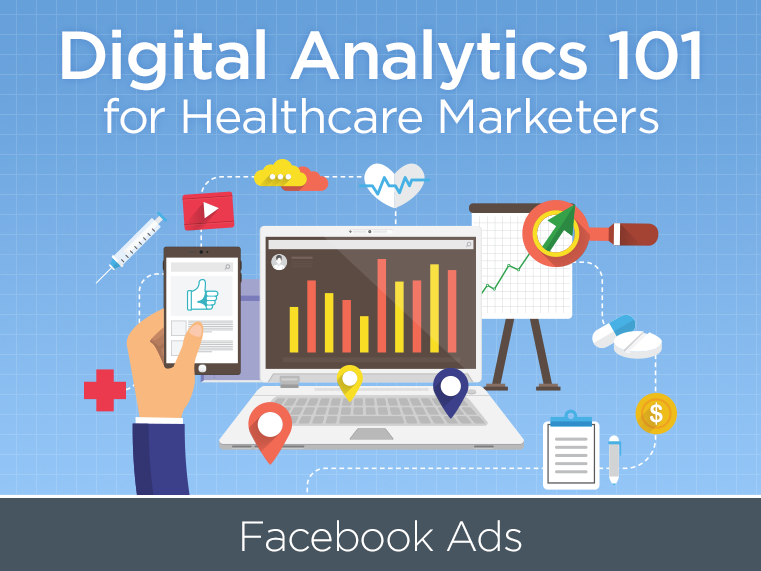
This post is part of our series, Digital Analytics 101 for Healthcare Marketers, where we provide short briefs on the What’s, Why’s, and How’s of digital strategy. In this article, we’ll discuss the unique advantages and targeting capabilities of paid Facebook ads.
More Read

This post is part of our series, Digital Analytics 101 for Healthcare Marketers, where we provide short briefs on the What’s, Why’s, and How’s of digital strategy. In this article, we’ll discuss the unique advantages and targeting capabilities of paid Facebook ads.
Facebook has become the online community of choice for about 75% of the American population, according to Pew Internet, with approximately 1.6 billion active monthly users worldwide, as Statista explains. No matter your opinion of social media, the reality is that for the medical industry, it’s arguably the best place to find and engage with prospective patients. As such, paid Facebook advertising has quickly earned itself a space in the healthcare marketer’s digital toolbelt.
And for good reason: 61% of all consumers (a full 90% of those 18-24) trust information that healthcare providers share on social media, according to PwC. And after health-specific websites like WebMD and medical magazines, Facebook is the most frequently-consulted website for healthcare information, as reported by Mashable.
But for medical marketers, Facebook provides another, more powerful asset that sets it far apart from other social media sites: its targeting capabilities.
Accurate, Timely, and Contextual
Facebook offers the most straightforward and effective ad targeting platform on the social web; recent research from eMarketer agrees with this statement, noting that it also drives higher ROI than any other other social channel. For these reasons, of the 1,500 hospitals nationwide that have a social media presence, Facebook is by far the most popular, according to WHPRMS.
The power of Facebook’s targeting capabilities lies in its accuracy and diversity of options. Its Detailed Targeting function, unveiled last October, enables healthcare marketers to reach prospective patients based on any combination of demographic, geographic, behavioral, or interest-based factors, as Adweek explains. If you have the need, it’s even possible to target for things like recent purchases, life events, or relationship status, according to Marketing Pilgrim.
If you’re not sure which patient segments to target, Facebook can automatically find Lookalike Audiences, which are matched contextually to your current customers of visitors to your Facebook page.
For healthcare marketers, it’s usually best to search general terms before honing in on specifics; there’s no sense in accidentally blocking potential patients from seeing your ads, especially in local markets. But because Facebook offers comprehensive ad tracking and analytics functions, it’s simple and cost-effective to test a variety of low spend campaigns side-by-side (on both desktop and mobile) before scaling the strategy that works best.
Some of the most popular Facebook ad types are simple page promotion (paid, but not ads in the true sense of the word), sponsored posts, pay-per-click (PPC) ads, or Call Now buttons, which enable click-to-call (CTC) functionality for a mobile audience. Generally, social reach is commensurate with spend, but certain ads tend to better with certain audiences. If you’re wondering, by the way, unpaid or “organic” content has very limited social reach, according to Social Media Week — much less than paid ads — and is almost never worth man-hours required to create it.
Always Be Wary of Regulation
Of course, when it comes to healthcare marketing, remaining aligned with FDA and HIPAA regulation should always be a top priority. Generally speaking, you’re not allowed to post any information that could potentially reveal a patient’s identity — it’s always a good idea to review protected health information (PHI) categories before posting. And as for medical device marketing, the FDA has issued strict guidelines for social media posting that must be adhered to. But unlike Twitter, Facebook posts thankfully have no practical character limit.
And while Facebook ads have proven themselves effective for healthcare marketers, the most successful digital campaigns typical incorporate several different channels to accomplish a variety of goals. As you might expect, diversity is a strength, and adopting a holistic approach will typically yield higher returns than any one channel on its own. That said, make sure you focus your efforts only on those platforms and techniques that are most impactful — then watch as costs go down while more and more patients start knocking on your door.

(Image credits: Hamazasp/Wikimedia; mkhmarketing/flickr)