
I’ve been MIA here, but I’ve been loud/proud pretty much everywhere else in the last few months. Including here and here. What follows is a rant based on what I’ve been seeing/doing since last seen on this page.
Elephants
There’s an old joke that goes like this: “What’s an elephant?” “It’s a mouse designed by a government committee.” There’s also the old “elephant in the room” bromide about topics that are not to be mentioned under any circumstances, despite their obvious impact on the issue under discussion. And the “How do you eat an elephant? One bite at a time.” motivational meme, along with the “blind guys describing an elephant” metaphor used to explain the impact of silo-ed thinking.
More Read

We’re up to our parietal bones in pachyderms in the healthcare transformation discussion. The biggest one – you can call him Jumbo, or you could call him Dumbo – is always in the room. What I call him is Huckster Nation.
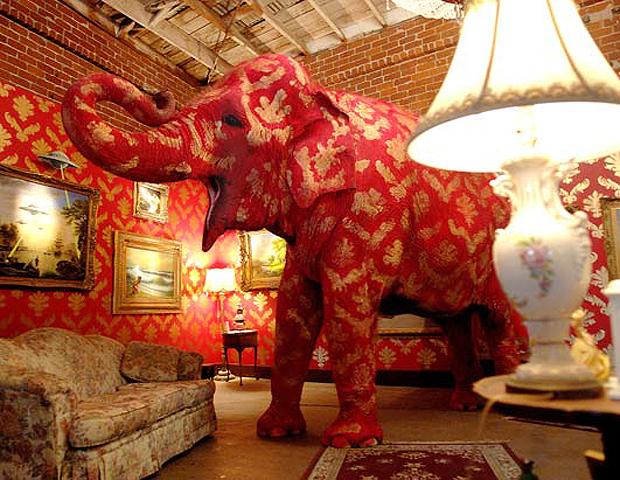
What do I mean? I mean the underpinning of pretty much all of American culture – the carnival barker sales guy (guy in this usage is gender neutral). We are a nation of flacks, flogging everything from Sham-Wow to space stations, and that includes our healthcare system. Hell, I’m selling myself, or at least I’m offering to rent out the contents of my cranium in exchange for coin of the realm, as are we all, in one way or another. Americans have taken this to the level of a cultural art form, in that we’ve built our national myth around economic freedom. That it works out to be a literal myth for too many of us – income divide, I’m talking to you – is part of what I’m calling out here, but for the moment let’s focus on the carnival barkers sales guys in US healthcare, shall we? I’m taking about the ….
Middlemen
Who are the middlemen in healthcare? Apart from the obvious ones – the health insurers, including Medicare, who administer the payment/money side of healthcare delivery – there are a metric ton of middlemen of all sorts threaded throughout the system. To use a biology metaphor, let’s call the ones that help Good Bacteria, and the ones that don’t help Ebola Outbreaks. By the way, I’m defining “help” here as improving something; making care more accessible, creating technology that improves care/care process, research that discovers new treatments. Here are some examples of Good Bacteria:
- Companies that build health literacy tools to improve people access and understand healthcare (click here and here for examples)
- Open-access scientific journals (click here and here for examples)
- Companies that build tech that helps patients, or clinical teams, or patient AND clinical teams (click here and here for examples)
Here are some Ebola Outbreaks:
- Any commercial enterprise operating the healthcare sector that puts ROI above human lives (click here for an example)
- Not-for-profit healthcare systems that treat humans solely as profit modules (click here for an example)
- Health insurance companies that allow games of “gotcha” where their covered lives are the game pieces (click here for a Modern Healthcare piece on the issue)
Systems
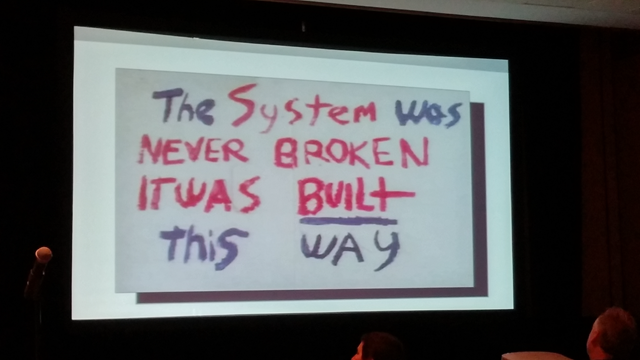
Which brings me to the whole US healthcare system conundrum, which was summed up pretty well by my friend Dan Munro:
I attended the Population Health Alliance Forum conference recently in D.C. I was surrounded by middlemen – some Good Bacteria, some Ebola outbreaks – as I sat and listened to clinicians, analytics geeks, policy wonks, and carnival barkers sales types talk about issues in population health. Population health is defined as “the health outcomes of a group of individuals, including the distribution of such outcomes within the group.” Meaning that in most conversations where the phrase appears, you’re talking about Employer Sponsored Insurance (ESI) or Medicare. So the attendees were heavy on the big insurer and big health provider side, with a strong showing in the “we want to sell our stuff to big insurers and big health providers” cohort. I was, as far as I could tell, the only person wearing the “I’m a patient here, myself” label. I guess I was the patient voice carnival barker sales guy. Hey, we’re all selling something, even if it’s only an idea.
Meanwhile, I’m surrounded by system players in a series of hotel ballrooms in D.C. I found myself getting a little shouty with frustration on Twitter:
“Hearing *part* of my song, but where are wellness or engagement programs co-designed by PATIENTS? #phaf15”
“US Preventive Med has powerful mission statement, but what about SOCIAL DETERMINANTS of health not visible in workplace? #phaf15“
Population health needs to invite people/patients to co-design programs. Otherwise, stuck in Einstein’s Theory of Insanity. #phaf15
OK, kidz, here’s a reality sandwich: without Natl Patient ID (NPI), we’re stuck on slow/stupid re pop-health. Srsly. #phaf15
Hellllloooo. Can we start a K-12 effort “How to go to the doctor” or “How to buy health insurance” a la LITERACY, please? #healthlit #phaf15
Only took 70+ minutes for someone to mention PATIENTS as contributors to healthcare transformation efforts. Jayzus. #s4pm #phaf15
“What’s the ROI?” question in pop-health analytics session. My answer, “Human life, dude.” Srsly. Too much $$-think in US system. #phaf15