We use cookies, including third-party cookies from Google to serve personalized ads through AdSense, to operate this site and understand how it is used. By continuing to browse, you accept this use. See our Privacy Policy and Terms of Use for details, including how to opt out of personalized advertising.
Accept
Health Works CollectiveHealth Works CollectiveHealth Works Collective
  • Health
    • Mental Health
  • Policy and Law
    • Global Healthcare
    • Medical Ethics
  • Medical Innovations
  • News
  • Wellness
  • Tech
Search
© 2023 HealthWorks Collective. All Rights Reserved.
Reading: Forecasts for neurointerventions in acute stroke
Share
Notification Show More
Font ResizerAa
Health Works CollectiveHealth Works Collective
Font ResizerAa
Search
Follow US
  • About
  • Contact
  • Privacy
© 2023 HealthWorks Collective. All Rights Reserved.
Health Works Collective > Diagnostics > Forecasts for neurointerventions in acute stroke
Diagnostics

Forecasts for neurointerventions in acute stroke

PatrickDriscoll
PatrickDriscoll
Share
3 Min Read
SHARE

Over the past two decades, one could witness the advent and significant expansion of the neurointerventional armamentarium targeting management of acute stroke. In mid-1990s, endovascular coiling embolization tools and techniques for treatment of cerebral aneurysms and AVMs (arterio-venous malformations) were introduced as a less invasive alternative to craniotomy-based surgery in primary prevention of hemorrhagic stroke. Several years later, these techniques were supplemented with coil-containing stents, which enabled treatment of large, giant, and wide-neck aneurysms.

Over the past two decades, one could witness the advent and significant expansion of the neurointerventional armamentarium targeting management of acute stroke. In mid-1990s, endovascular coiling embolization tools and techniques for treatment of cerebral aneurysms and AVMs (arterio-venous malformations) were introduced as a less invasive alternative to craniotomy-based surgery in primary prevention of hemorrhagic stroke. Several years later, these techniques were supplemented with coil-containing stents, which enabled treatment of large, giant, and wide-neck aneurysms. The latter was followed by the launch of stent-based flow diversion systems, which allowed clinicians to hemoisolate such aneurysms without tedious and risky coil packing of the rupture-prone aneurysmal sac.

In primary ischemic stroke prevention, development of embolically-protected carotid stenting and left atrial appendage closure techniques provided clinicians with an option of using non-inferior transcatheter tools instead of customary surgical interventions.

Finally, a recent launch of the novel stent-based cerebral thrombectomy systems manifested a qualitative breakthrough in emergent treatment of acute cerebral ischemia, where marginally effective and severely caseloads restrictive intravenous tPA therapy represented the only available therapeutic option.
More Read

Use of Light Technology Avoids Blood Clotting
An Indian Hospital on the Fast Track
8 Proven Tips on Finding Difficult Veins
Cause and Effect – What Leads to a Misdiagnosis?
SaaS Firm Crowdfunds “People-Focused” Image Sharing

Presently, endovascular techniques are increasingly seen and used by practicing clinicians as preferred therapeutic modalities in prophylaxis and treatment of acute stroke and are likely to expand their role in the years to come.

Based on the industry reporting and other estimates, in 2014, approximately 227.3 thousand cerebral endovascular therapeutic procedures were performed worldwide. Prophylaxis of ischemic stroke via carotid artery stenting and left atrial appendage (LAA) closure with contributed 91.2 thousand and 11.9 thousand interventions (or 40.1% and 5.2%, accordingly), followed by transcatheter embolization of intracranial aneurysm and AVM for hemorrhagic stroke prevention with 90.5 thousand interventions (or 39.8%), and cerebral thrombectomy-based emergent treatment of acute cerebral ischemia with 33.7 procedures (or 14.8% of the total).

Geographically, Western Europe and the U.S. accounted for the largest shares of corresponding cerebrovascular interventions in 2014, with 35.7% and 35.0%, accordingly, followed by major APAC states with 19% and rest-of-the-world with the remaining 10.3% of the total procedures performed.
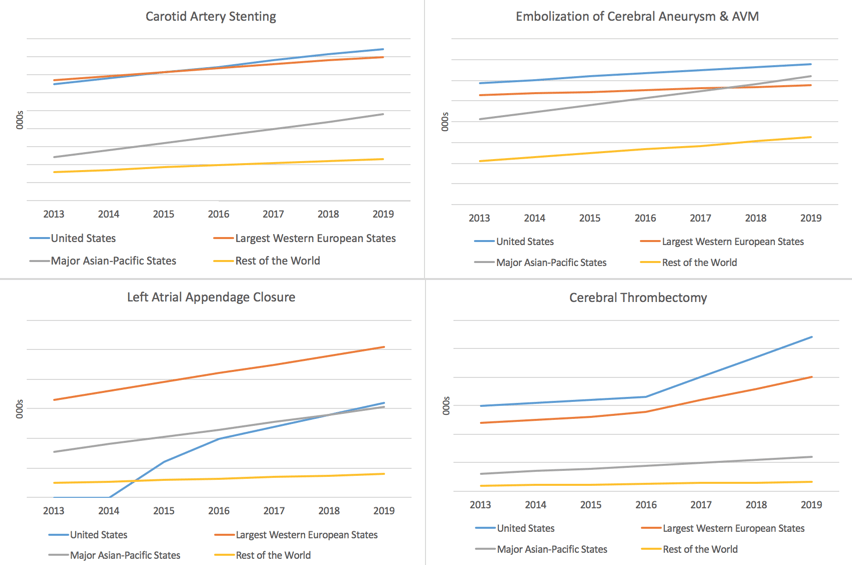
Source: MedMarket Diligence, LLC; Report #C310.


 

TAGGED:cardiologystroke
Share This Article
Facebook Copy Link Print
Share
By PatrickDriscoll
Follow:
I serve the interests of medical technology company decision-makers, venture-capitalists, and others with interests in medtech producing worldwide analyses of medical technology markets for my audience of mostly medical technology companies (but also rapidly growing audience of biotech, VC, and other healthcare decision-makers). I have a small staff and go to my industry insiders (or find new ones as needed) to produce detailed, reality-grounded analyses of current and potential markets and opportunities. I am principally interested in those core clinical applications served by medical devices, which are expanding to include biomaterials, drug-device hybrids and other non-device technologies either competing head-on with devices or being integrated with devices in product development. The effort and pain of making every analysis global in scope is rewarded by my audience's loyalty, since in the vast majority of cases they too have global scope in their businesses.Specialties: Business analysis through syndicated reports, and select custom engagements, on medical technology applications and markets in general/abdominal/thoracic surgery, interventional cardiology, cardiothoracic surgery, patient monitoring/management, wound management, cell therapy, tissue engineering, gene therapy, nanotechnology, and others.

Stay Connected

1.5KFollowersLike
4.5KFollowersFollow
2.8KFollowersPin
136KSubscribersSubscribe

Latest News

What Hospitals Need to Know About EU MDR -- AI-generated illustration
What Hospitals Need to Know About EU MDR
Business Hospital Administration
August 18, 2026
How to Choose an On-Demand Medical Interpreting Provider for Your Hospital -- AI-generated illustration
How to Choose an On-Demand Medical Interpreting Provider for Your Hospital
Health care
August 12, 2026
The Chemistry Of Drug Consistency -- AI-generated illustration
The Chemistry Of Drug Consistency
Policy & Law
August 12, 2026
Dental Materials Through The Decades -- AI-generated illustration
Dental Materials Through The Decades
Dental health Infographics Specialties
August 12, 2026

You Might also Like

Vital Connect HealthPatch MD
Diagnostics

Monitoring for Deteriorating Conditions

January 27, 2016
Clinical Collaboration
Diagnostics

The Value of Clinical Collaboration in a Patient-centered Healthcare Model

February 11, 2016

5 Numbers Essential to Your Kidney Health

August 13, 2013
DiagnosticseHealthMedical InnovationsTechnology

How Soon Will Healthcare Connect Machine Learning with Consumers?

December 11, 2017
Subscribe
Subscribe to our newsletter to get our newest articles instantly!
Follow US
© 2008-2026 HealthWorks Collective. All Rights Reserved.
  • About
  • Contact
  • Privacy
Welcome Back!

Sign in to your account

Username or Email Address
Password

Lost your password?