What a silly question. What doctor has time to follow patients on Twitter? Besides, healthcare is serious business and Twitter is mostly about frivolity, right? Not so fast, let’s think about it.
Do you think the content of your Tweets is a reflection of your general state of health?
What a silly question. What doctor has time to follow patients on Twitter? Besides, healthcare is serious business and Twitter is mostly about frivolity, right? Not so fast, let’s think about it.
Do you think the content of your Tweets is a reflection of your general state of health?
I was thinking the other day about when my son was away at college. He went to the Air Force Academy in Colorado Springs, so we only saw him a couple of times a year. We really looked forward to a weekly phone call and communicated frequently by email. He graduated in 2011. I now have two daughters in college, also far away, and though we chat frequently (by Skype or FaceTime, interestingly), I don’t feel the same pining that I felt when Derek was away because I follow both of my daughters on Twitter. Their Tweets (several daily) are mostly thoughts that pop into their heads, so it gives me a great window into what they’re thinking and what is going on in their lives, almost in the moment.
I recently became intrigued with free text analysis as a tool to learn more about an individual’s health. Tools like Wordle and Mirror.me are among the many that enable you to create interesting graphics of text. The words that are mentioned more frequently in any block of text are featured more prominently in the graphic. A glance at the graphic gives you a sense of what the writer feels is important, what is on her mind, or even a quirk in her writing style (if certain phrases are emphasized, for instance).
I’m intrigued because of my belief that analyses like this are probably a more accurate barometer of someone’s health than what we’d learn if we asked anyone of us a series of questions. We want to look good for others and we tend to report ourselves as being healthier than we are. This phenomenon is well studied and referred to as Social Desirability Bias. Interestingly, this also applies to religion, as I learned from this recent NPR story. I am guessing that what we write on Twitter can give some sense of what is going on beneath this veneer.
Am I onto something? Well, you tell me.
Here is one example, created on Mirror.me by entering @sixuntilme, the Twitter handle of a woman who blogs about her life with diabetes.
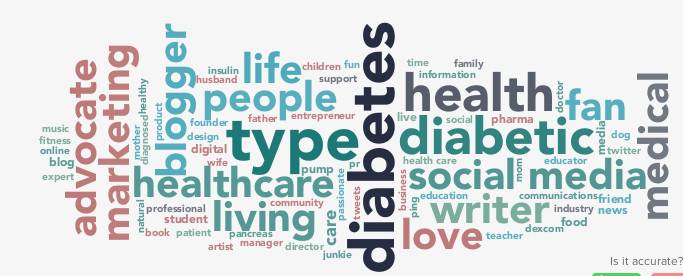
The prominent words reveal what this person focuses on and indeed diabetes and health are prominent.
So far, so good.
Here is one from my daughter Julie @julie_taboule.
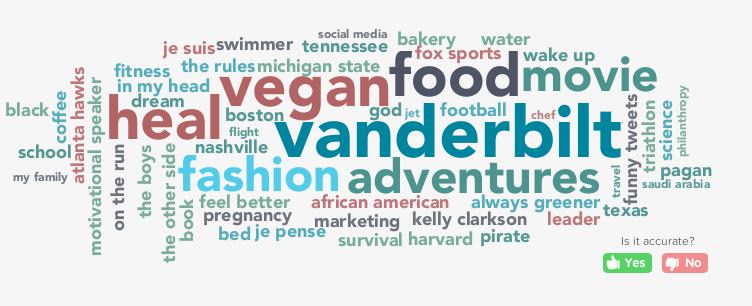
She mentions vegan a lot as that is a big part of her life. Likewise for Vanderbilt, her school. It is interesting that ‘heal’ is prominent – she is a healing person.
Contrast my other daughter Megan’s (@mkvedar) word cloud.
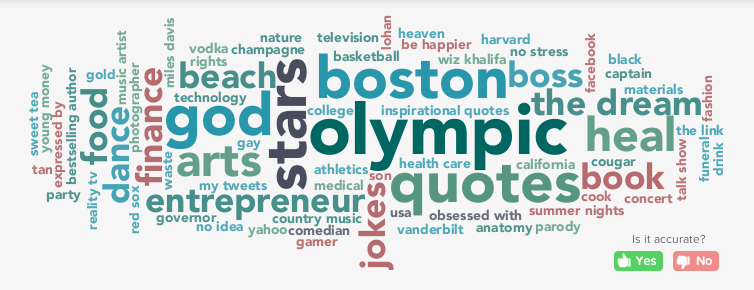
Words like finance and entrepreneur belie her interest in business. It is curious that Olympic is so prominent, but I’m guessing that is because she was Tweeting a lot during the Olympics.
I’m happy to say that neither of my daughters is unhealthy or unhappy so in this very early experiment, you could call them ‘positive controls.’
Just to be a fair dad, I’ll note that my son Derek Tweets too (@tribecallederek), but his Tweets are too infrequent for Mirror.me to build a word cloud on him.
Try it yourself and send me word clouds that illuminate real-life thoughts, patterns and behaviors.
I’m intrigued enough to continue to pursue it. When we’re going about our daily lives, messaging about what we’re thinking or doing in-the-moment, these Tweets can provide a more accurate picture and far more information of a person’s state than a series of routine questions. Hence, I believe Tweets and other social media postings can provide a window into an individual’s health and wellness.
Of course this could be applied to SMS text messages too. They are harder to get your hands on. I’m in contact with colleagues at AT&T to see if I can get access to mine. To get a sense of the power of analyzing text messages, see this short TED talk by Nancy Lublin.
So, based on this early analysis, I’m inclined to think that yes, your doctor should follow you. Not in the sense that she will be waiting for your Tweets to come up on her iPhone, but rather in this more analytic sense. My hypothesis is that Twitter feeds and text messages will enable us to get a window into your soul.
And what is more important when following your health than that?