By using this site, you agree to the Privacy Policy and Terms of Use.
Accept
Health Works CollectiveHealth Works CollectiveHealth Works Collective
  • Health
    • Mental Health
  • Policy and Law
    • Global Healthcare
    • Medical Ethics
  • Medical Innovations
  • News
  • Wellness
  • Tech
Search
© 2023 HealthWorks Collective. All Rights Reserved.
Reading: Three Key Forces Behind Startups and Investment in Medical Technology
Share
Notification Show More
Font ResizerAa
Health Works CollectiveHealth Works Collective
Font ResizerAa
Search
Follow US
  • About
  • Contact
  • Privacy
© 2023 HealthWorks Collective. All Rights Reserved.
Health Works Collective > Technology > Three Key Forces Behind Startups and Investment in Medical Technology
Technology

Three Key Forces Behind Startups and Investment in Medical Technology

PatrickDriscoll
PatrickDriscoll
Share
4 Min Read
SHARE

We see three key forces underlying investment trends in medical technology:

We see three key forces underlying investment trends in medical technology:

  • The spectrum of competition has been broadened and sometimes isn’t even obvious.

Widely different technologies (as in treatment of coronary artery disease, see white paper) can address a clinical condition, with the solution to the problem being the focus of new investment.

New materials for devices, drug-device hybrids, biotech-driven solutions, and other innovations can create competition between very different technologies. As a result, the paradigms and truths held true in the past, when devices only went head-to-head with devices, are no longer relevant, creating the need to better assess the competitive landscape.

More Read

InSite Vision Is Developing Treatment For Common Eye Disease Blepharitis, For Which There Is Currently No Approved Treatment
VESAG Mobile Diagnostics Watch
Healthcare Buzzwords: What Is Big Data?
The Future (Ours) is in China for Medtech
MS Cloud for Healthcare: Enabling Virtual Hospital

Manufacturers must there develop good market awareness, as in being cognizant of all the potential source of competition, such as from companies in adjacent markets who might pivot and seize market share.

  • Money flows to niches in medtech where the demand for clinical utility is high.

The biggest forces driving medtech are increasing patient populations or the cost of managing them. Niches that address the challenges of an older population with unsolved painful and or costly conditions (orthopedics, chronic wounds, diabetes, bariatrics) have prominent cost targets that stimulate investment.

Patient demographics, healthcare cost/utility demands and other forces make some medtech niches very attractive, even if only as a result of technology migration (e.g., to growth geo markets).

  • Underserved patient populations command almost as much attention as the untapped patient populations.

There is much potential return on investment to be made in blockbuster treatments, but these can be financial sinkholes compared to less grandiose technology solutions. A motive force exists in medtech, centered around healthcare costs, that is relentlessly forcing medical technology innovators to find opportunity within existing markets, by eliminating cost (e.g., shifting care to outpatient as via minimally invasive technologies). Significant medical technology investment has already recognized the value in targeting conditions for which new technology, new clinical practices and/or simply new ways of thinking can improve the quality of life, patient costs or both.

Medtech investment is most serious when it is (1) in high dollar value, or (2) tied to the formation of companies. It reflects confidence in that sector to the degree set by the investment.

In the past five years, MedMarket Diligence has tracked the identification of over 600 companies in medtech. Below is the distribution of their focus across a large number of clinical and technology areas (multiple possible, as in “minimally invasive” and “orthomusculoskeletal”).

These companies have also been tracked through their specific investments (detailed historically at link).
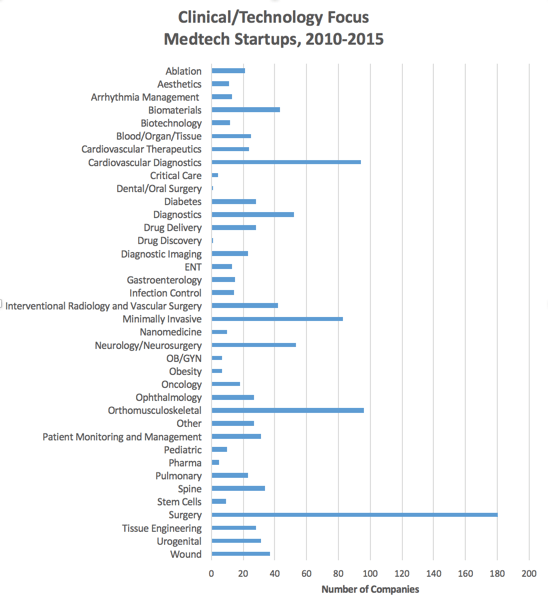
Source: MedMarket Diligence, LLC; Medtech Startups Database.

Cardiology, orthopedics, and surgery are mainstay drivers of new technology development in medtech, as has been the push for minimally invasive therapies, but nanotechnology, interventional (e.g., transcatheter) technologies, biomaterials, wound management and other niches have a steady stream of new company formations.


See recent reports from MedMarket Diligence in the following clinical areas.

  • Ablation (see Smithers Apex)
  • Coronary Artery Disease (See Smithers Apex)
  • Stroke
  • Wound Management
  • Surgical Sealants and Glues
  • Spine Surgery

TAGGED:health start-upmedtech startups
Share This Article
Facebook Copy Link Print
Share
By PatrickDriscoll
Follow:
I serve the interests of medical technology company decision-makers, venture-capitalists, and others with interests in medtech producing worldwide analyses of medical technology markets for my audience of mostly medical technology companies (but also rapidly growing audience of biotech, VC, and other healthcare decision-makers). I have a small staff and go to my industry insiders (or find new ones as needed) to produce detailed, reality-grounded analyses of current and potential markets and opportunities. I am principally interested in those core clinical applications served by medical devices, which are expanding to include biomaterials, drug-device hybrids and other non-device technologies either competing head-on with devices or being integrated with devices in product development. The effort and pain of making every analysis global in scope is rewarded by my audience's loyalty, since in the vast majority of cases they too have global scope in their businesses.Specialties: Business analysis through syndicated reports, and select custom engagements, on medical technology applications and markets in general/abdominal/thoracic surgery, interventional cardiology, cardiothoracic surgery, patient monitoring/management, wound management, cell therapy, tissue engineering, gene therapy, nanotechnology, and others.

Stay Connected

1.5KFollowersLike
4.5KFollowersFollow
2.8KFollowersPin
136KSubscribersSubscribe

Latest News

weight loss surgeon
How to Choose the Best Surgeon for Weight Loss Surgery
Weight Loss Wellness
February 11, 2026
aging care healthcare system
The Growing Role of Terminal Care Specialists in a Rapidly Aging Healthcare System
Global Healthcare Senior Care
February 11, 2026
Why Trauma and Addiction Are Linked and How Effective Programs Treat Both
Addiction Addiction Recovery
February 10, 2026
car accident injuries
The Hidden Healthcare Impact of Car Accident Injuries
News Policy & Law
February 8, 2026

You Might also Like

image_Touch_Prime_PIU_10_hires
Medical DevicesMedical InnovationsTechnology

A New Ultrasound System Design to Support HAI Reduction Programs and Infection Control

March 26, 2016
HIMSS 2014
Medical InnovationsTechnology

HIMSS14: Population Health Management and the CareXcell™ Solution

February 26, 2014
Health careMedical DevicesSpecialtiesTechnology

The Merger of Technology and Nutrition

May 26, 2017
Medical Devices

4 Common Medical Device Digital Marketing Mistakes

September 16, 2015
Subscribe
Subscribe to our newsletter to get our newest articles instantly!
Follow US
© 2008-2025 HealthWorks Collective. All Rights Reserved.
  • About
  • Contact
  • Privacy
Welcome Back!

Sign in to your account

Username or Email Address
Password

Lost your password?