Social networking allows doctors, nurses and other health professionals to deeply connect and engage with the community and their colleagues.

Social networking allows doctors, nurses and other health professionals to deeply connect and engage with the community and their colleagues.
“We are standing at the precipice of a new online revolution in health care. As more and more health experts embrace the Internet and increase their social media activity, health information seekers will undoubtedly benefit in profound ways.” [Source: Mashable]
Dynamic health and medical professionals engaged in social networking, using Twitter, Facebook, Blogs and YouTube are on the front-line of new modern medicine.
Today’s modern medicine is all about the patient. Participating, partnering and developing a professional relationship is paramount.
While many health consumers are searching the web for support, reassurance and specific health news and information; doctors and nurses continue to question the value of the internet for patients.
Social networking sites such as Twitter, Facebook, and Blogs are not a waste of time for health professionals because it offers value.
Social networking sites and blogs are a powerful and phenomenal platform to educate patients, raise awareness of health issues and it offers a forum to collaborate and connect. It gives a voice to patients and it allows for the conversation to get started with their doctors and other health care professionals.
Doctors, nurses and other health professionals can help validate what is important for patients.
3 reasons why social networking is not a waste of time
1. Offers Valuable and Real-Time Health Information to Help Guide Patients and Consumers
“The internet has changed people’s relationships with information. Our data consistently show that doctors, nurses, and other health professionals continue to be the first choice for most people with health concerns, but online resources, including advice from peers, are a significant source of health information in the U.S.” [Pew Internet Study]
According to the Pew Internet & American Life Project and the California HealthCare Foundation, the survey finds that, of the 74% of adults who use the internet:
- 80% of internet users have looked online for information about any of 15 health topics such as a specific disease or treatment. This translates to 59% of all adults.
- 34% of internet users, or 25% of adults, have read someone else’s commentary or experience about health or medical issues on an online news group, website, or blog.
- 25% of internet users, or 19% of adults, have watched an online video about health or medical issues.
These findings came from a national telephone survey conducted in August and September 2010 among 3,001 adults in the U.S.T
People are online searching for health information and as health professionals engaged in social networking, we can help guide them and share valuable, accurate and real-time health information.
Health care consumers can tap into health experts that they can trust.
Internet users can tap into some of the brilliant blogs that have been created by phenomenal health experts; they can join the community on Twitter and Facebook and share information.
Accurate Blogs and Resources:
A few trusted sites:
- Better Health
- Cleveland Clinic
- CDC
- Dr. Greene
- Health Commentary
- Health Tech Today
- HealthNewsReview.org
- International Medical News Group-Elsevier
- Inspire
- Kevin MD
- Kinetics
- Mayo Clinic
- MedlinePlus
- Miriam E. Tucker
- Sharecare
- The Health Care Blog
- The Lancet
2. Establishes a relationship with the Community
Health care is a partnership between doctors, nurses and other health care professionals and patients.
Today’s modern patients are savvy health care consumers.
The e-patient community means business and they are a group of patients who are advocating for better, closer patient care. They want a partnership with their doctors and nurses, they want their medical records at their fingertips and they want telehealth to be implemented for better health.
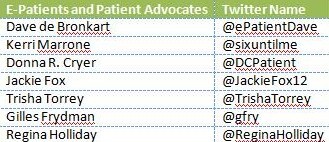
List of Valuable Patients and Advocates on Twitter
3. The use of social networking is the real game-changer. Did Twitter save a life?
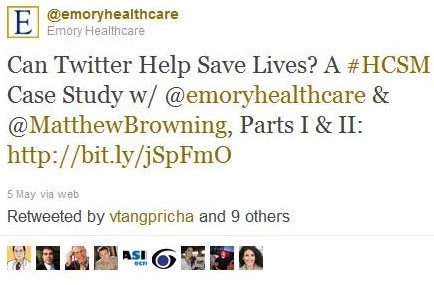
Here’s a real-time example how one health care organization embraced Twitter and listened to a patient’s family member cry for help and took real-time action.
“The dialogue that took place on Twitter between Emory Healthcare and Matthew Browning on April 25, 2011 was a powerful one. Without time to spare, Matthew turned to Twitter in a time of crisis to help get his wife Phoebe’s grandmother transported to a hospital with capacity and capabilities to help treat her ruptured aorta. We were able to assist Matthew and his family in an emergency situation, leading to Phoebe’s grandmother being airlifted within 16 minutes of receiving contact information, a truly amazing feat. Despite this, there are countless lessons learned from the experience. While Part I of this case study explored the story and events of April 25, 2011, this portion focuses on the meaning behind and implications of that story. The whole goal here is to help people; and if that’s truly your goal with social media crisis resolution, there are steps you can take to make that a reality, knowing that there will always be scenarios and circumstances that can’t be resolved with a cookie cutter process.”
Valuable Resources – Helpful Sites for Medical Professionals and Hospitals
Mayo Clinic Center for Social Media
AMA Policy: Professionalism in the Use of Social Media
New AMA Policy Helps Guide Physicians’ Use of Social Media
Lee Aase – Social Media University
Takeaway
Social networking is not going to go away; it is only going to become fiercer, faster and more fabulous.
Social networking has not spread like wildfire. More health professionals need to embrace this fascinating tool for educating the public.
What you can do
Dive into this phenomenal and powerful tool, you can truly help improve the lives of people.
Your turn
We would love to hear from you. Health professionals, what suggestions do you have for your colleagues? Patients, how do you engage in social networking?
As always, thank you for your valuable time.